Week 2 : Basic Calibration of Single cylinder SI-Engine
Aim:
To perform 1D CFD simulations for basic calibration of 1 cylinder SI Engine using GT-Suite
Objectives:
- Provide brief introduction to SI Engine
- Carry out simulation and report performance metrics for 1800 RPM
- Improve the power output at 3600 rpm by 10% by changing several geometrical features and initial conditions of the engine.
Introduction:
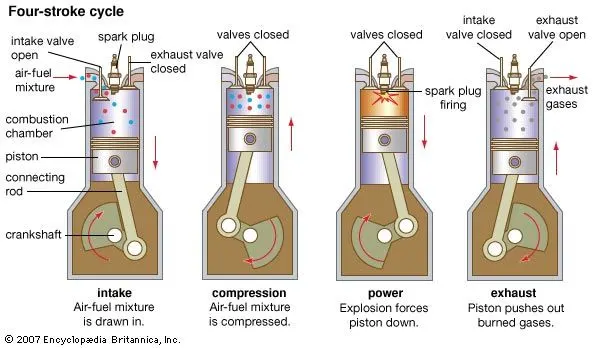
The Spark-Ignition engine is an internal combustion engine, where the air-fuel mixture is ignited by a spark from the spark-plug. The four stroke SI engine pressure-volume diagram variation is modelled usind the Otto cycle. The four strokes are summarized as follows:
- Intake Stroke: The first stroke which is characterized by the opening of the intake valve and the fuel-air mixture entering into the engine cyclinder at constant pressure.
- Compression Stroke: The air intake valve is closed and the fuel-air mixture inside the cylinder is compressed due to the motion of the piston from the bottom dead center to the top dead center.
- Power Stroke: After the heat is added into the compressed mixture from the spark, the high pressure fluid pushes the piston from the top dead center to the bottom dead center. This stroke generates the mechanical work from the heat release from the controlled explosion of the fuel-air mixture.
- Exhaust Stroke: The last stroke in the otto cycle in which the exhaust valve is opened and the burned residue is pushed out of the cylinder as the piston again moves from bottom dead center to the top dead center.
The above statements are visualized in the following figure for properly explaining the concept.
To quantify the performance of the SI engine, few of the imporant perfomance metrics have been briefly discussed as follows:
- Air-flow rate: It is the amount of the air that is entering in the engine and it is important because it decides how the fuel combustion takes place. A low air flow produces incomplete combustion leading to CO emissions whereas a higher air flow leads to NOx emissions. Therefore, an air close to stochiometry is desired.
- Break Mean Effective Pressure: It is ratio of gross work-done per cycle. It is provided a valuable measure of the engine performance which is independent of the engine displacement.
- Brake Specific Fuel Consumption: It is the amount of fuel consumed per unit power produced in a cycle. Low values of BSFC are desirable.
- In-cylinder pressure: It is the maximum pressure that is developed inside the engine during a single cycle. It provides a measure of the work that can be extracted from the engine.
Problem Setup:
As the current model in consideration is conceptually easy to grasp, we use the inn-built tutorial of the 1 cylinder SI Engine. The figure of the model is shown as follows:
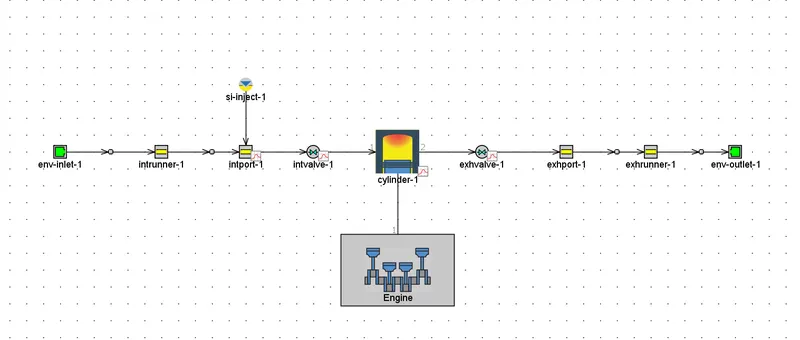
To summarise the details, the following information of the model is provided:
- The inlet and outlet pressure and temperature are set to 1 bar and 300 K respectively.
- The heat transfer model used is the WoschinGT model.
- The Weibe function is used here to impose the combustion burn rate.
- Fuel is injected in the inlet port and the amount of the air-fuel mixture depends on the injection rate and the air fuel ratio.
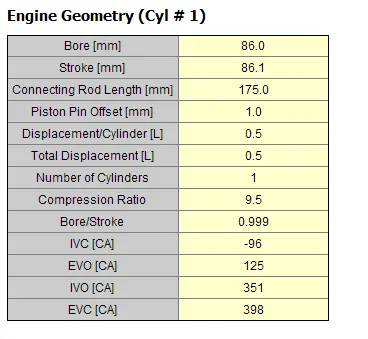
The geometric parameters of the engine for the current model are as follows:
Results for the 1800 rpm case:
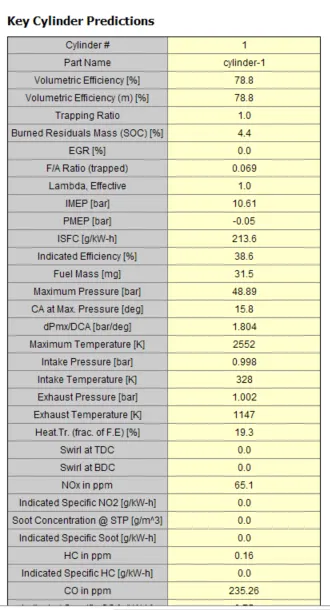
The simulation of the SI Engine model ran for 10 cycles and the performance parametrics are noted as follows:
The air flow rate is measured as 24.6 kg/h and the BSFC is measured as 239.2 g/kW-h.
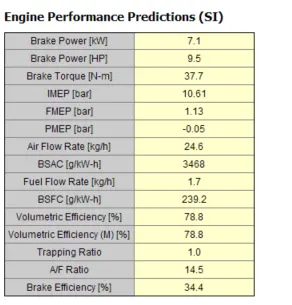
The maximum pressure in the cylinder is measured to be 48.89 bar
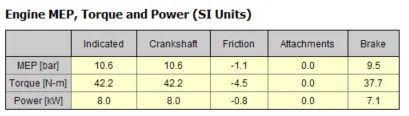
The BMEP takes the value of 9.5 bar
Results for 3600 rpm and variants:
From theory, the relationship between power and other operating parameters is given by the following equation
`P = {eta_f . eta_v . N. V_d . Q_{HV} . rho_a . (F/A)}/2`
Where,
`P` = engine power
`eta_f` = fuel conservation efficiency
`eta_v` = volumetric efficiency
`N` = rotation speed of the crankshaft
`V_d` = displacement volume
`Q_{HV}` = heating value of the fuel
`rho_a` = density of incoming air
`F/A` = Fuel air ratio
From the above formula we can conclude that to increase the power output of the engine, following modifications are favorable:
- Increasing the volumetric efficiency
- Increasing the fuel conservation efficiency
- Increasing the rpm
- Increasing the displacement volume
- Using fuel with higher heating value
- Increasing the density of the incoming air
- Increasing the fuel-air ratio
In the current study, we will report the change in the output power with the variation of the displacement volume, density of incoming air and air-fuel ratio on the engine brake power.
Effects of displacement volume:
The displacement volume can be increased by either increasing the bore length or the stroke length. We will first understand the effects of the increasing the bore length.
Effects of bore length:
The bore length is made to vary from 86 mm to 92 mm for four cases and all the other parameters are kept the same.
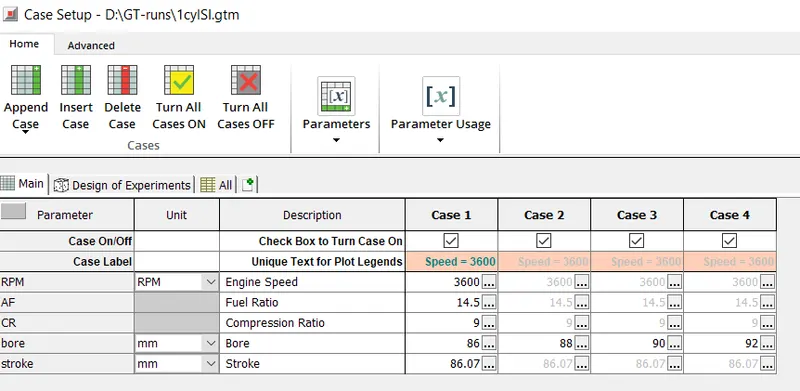
The results of this optimization study is as follows:

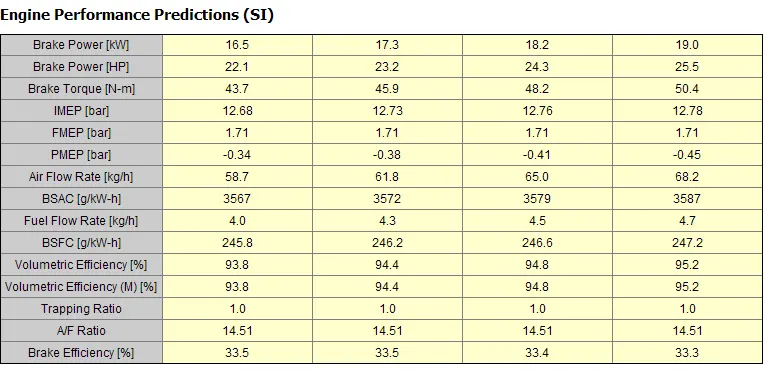
From the above analysis, we conclude that increasing the bore length increases the output power and bore length of 90 mm provides 10% increment in the power output.
Effects of stroke length:
The bore length is made to vary from 86 mm to 92 mm for four cases and all the other parameters are kept the same.
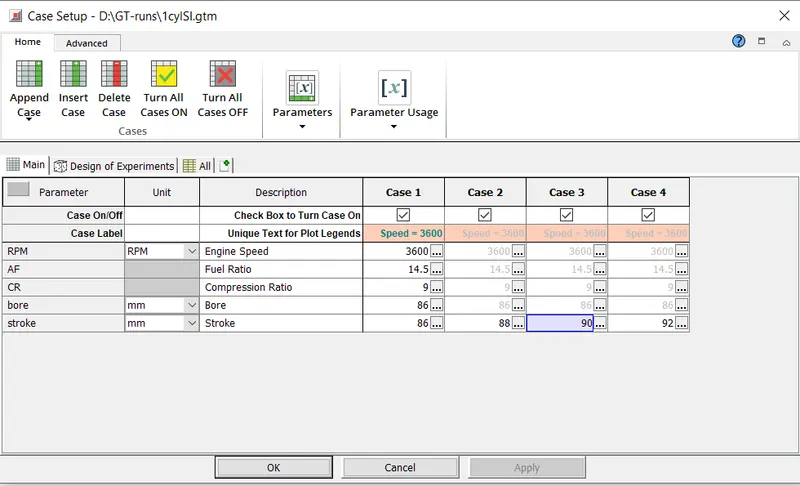
The results from this optimization studies are as follows

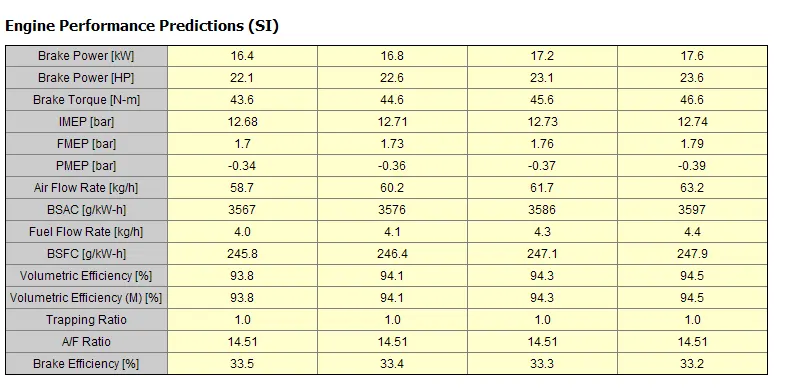
From the above study, we observe that we have to further increase the stroke length is required for an increament of 10% in the output power.
Effects of air density:
The air density is varied by changing the atmospheric temperature from 300 to 290 K in 3 cases. This effect can be simulated by using a turbocharger or supercharger.
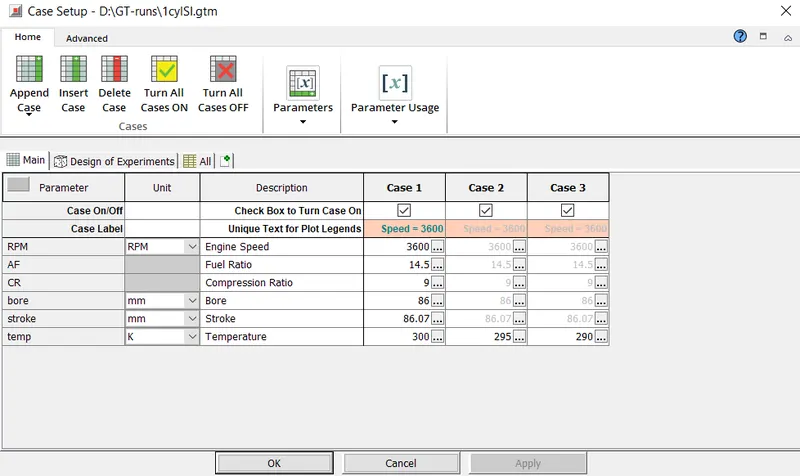
The results from this optimization studies are as follows
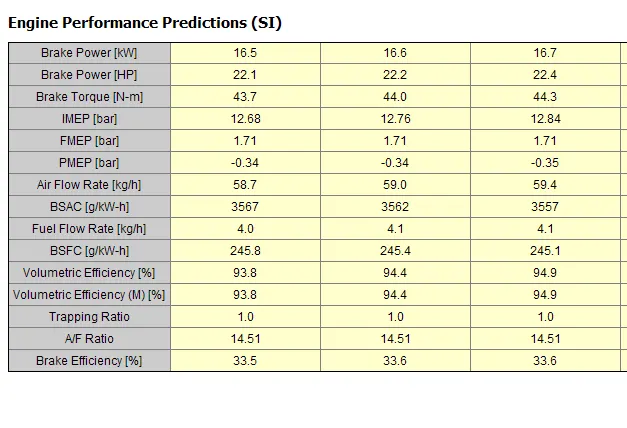
From this study, we observe that there is a positive correlation between increase in the density of the gas and the engine performance but the current range of density changes are not sufficient to increase the power output to 10%
Effects of air-fuel-ratio:
The ai-fuel is is varied from 8-14.5 for four cases as the formula suggests that increasing the fuel richness leads to higher power output.
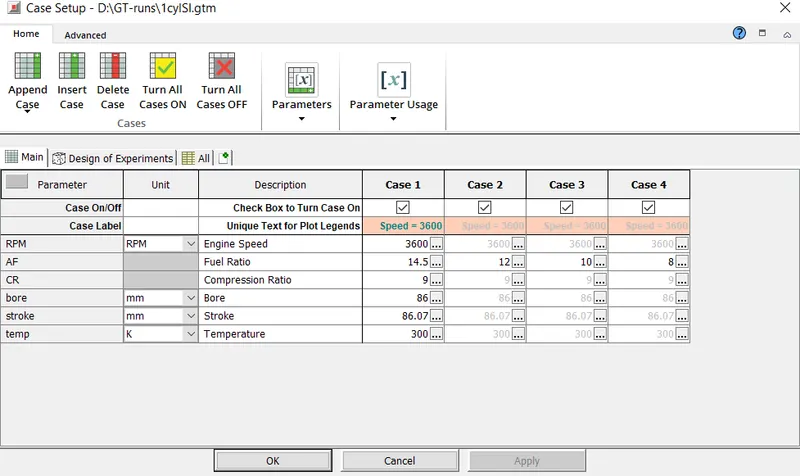
The results of this optimization study is as follows:
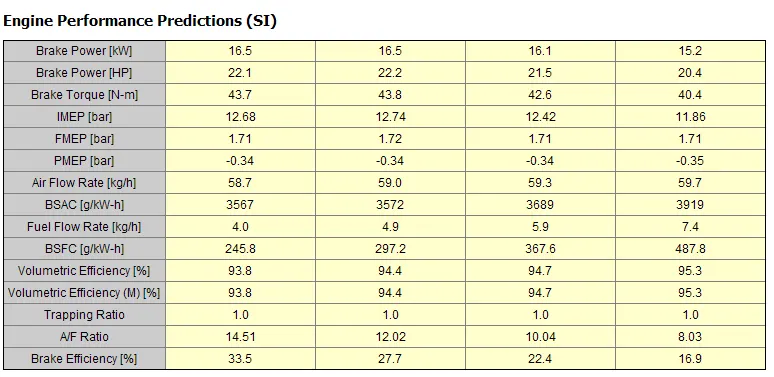
On the contrast, we observe that the increasing the fuel richness leads to a reduction in the power output. This pheonmenon is observed as the fuel remains unburnt and the CO residue increases as shown in the following figure

Conclusions:
We have sucessfully ran a simualtion of 1 cylinder SI engine at 1800 rpm and carried out a small scale optimization study to improve the performance by 10%. We observe that the simpliest way to do this is to increase the bore of the cylinder.