Basic Calibration of Single cylinder SI-Engine in GT-SUITE
PART I: Running the case file at 1800 RPM
The case in the tutorial file in path GTIv2019tutorialsModeling_ApplicationsEngine_Performance1-1cylDIorSI was run with 1800 RPM engine speed and the quantities of interest are shown below.
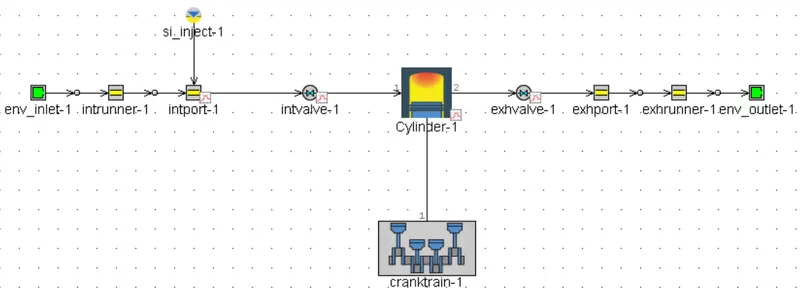
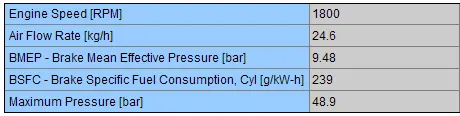
Some important engine performance parameters are:
Power
Power is the time rate at which work is generated by the engine. In context to location, the power generated by the engine is classified as,
- Indicated power: It is the power generated by the expansion of gases inside the engine cylinder during the combustion stroke. It is calculated using an indicator diagram.
- Brake power: It is the power available at the engine crankshaft. It is measured using a dynamometer attached to the crankshaft.
Brake Torque
The torque available at the engine crankshaft for a given throttle opening is called brake torque.
Engine Speed
It is the rotational speed of the crankshaft. It is usually measured in RPM(rotation per minute) or RPS (Rotation per second). Engine speed & torque are needed for each throttle position for designing a reduction gear train in the transmission system.
Specific fuel consumption
It is the mass flow rate of fuel needed for generating a unit power output. It measures how efficiently fuel is used by the engine to produce work. Since power output is defined in two ways so is specific fuel consumption,
- `"BSFC (Brake Specific Fuel Consumption)"= dotm_f//BP`
- `"ISFC (Indicated Specific Fuel Consumption)"= dotm_f//IP`
Mean effective pressure
Comparing engines based on power, torque or SFC provides valuable info but it doesn’t give us the means to account for the engine size. So, the quantity, power divided by volume displaced per cycle is used and this quantity has units of pressure hence is called mean effective pressure.
- `"BMEP (Brake mean effective pressure)" = BP//V_d`
- `"IMEP (Indicated mean effective pressure)" = IP//V_d`
Volumetric efficiency
Air filter, throttle plate, intake port, intake manifold & intake valve restricts the amount of airflow that an engine of given displacement can induct. The parameter used to measure the effectiveness of an engine's induction process is called volumetric efficiency. For a 4 stroke engine,
`eta_v = (2dotm_a)/(rho_(a,i) V_dN)`
where, `rho_(a,i) = "inlet air density" (kg//m^3)`
`N="Rev. per second"`
`dotm_a ="Air mass flowrate"(kg//s)`
Fuel efficiency
It is the engine’s efficiency with which it converts the fuel’s energy into piston work.
`eta=P/(dotm_f Q_("HV"))` where, `Q_(HV) = "Lower heating value of fuel"(kJ//kg)`
Mechanical efficiency
The work produced inside the engine cylinder is used to overcome friction & inertia of mechanical components and to drive engine accessories in addition to providing power output at the crankshaft (brake power). Thus the efficiency with which indicated power is converted into brake power is mechanical efficiency.
`eta_m = P_b//P_i `
PART II: Increase power output at 3600 RPM by 10%
The power output (brake power) of an SI engine is given by,
`P = (eta_meta_feta_vNV_dQ_(HV)rho_(a,i)(F//A))/2`
The power output can be increased in the following ways,
- Increasing the compression ratio (CR): CR increases thermal efficiency & increases power however, higher CR induces higher pressures & temperatures which can increase susceptibility to knocking & higher NOx emissions
- Boosting (supercharging or turbocharging): Boosting increases air mass flow & pressure during intake stroke which allows more fuel injection and thus increases power. However, the increased pressure differential between intake & exhaust ports during valve overlap leads to fuel loss into the exhaust.
- Changing cylinder displacement volume: Increase in cylinder displacement increases mass flow of working mixture and increases power output. The problem with increasing cylinder volume is increased weight & volume of the engine. However, it is better judged by specific weight & specific volume parameters.
`"Specific weight" = "engine weight"/"rated power"` & `"Specific volume" = "engine volume"/"rated power"`
Changing cylinder displacement increases power output for which only the cooling & lubrication system needs to be adjusted. However other two methods introduce additional problems of knocking, NOx emissions & fuel loss which need to be addressed separately. Hence the third method is used to increase power output.
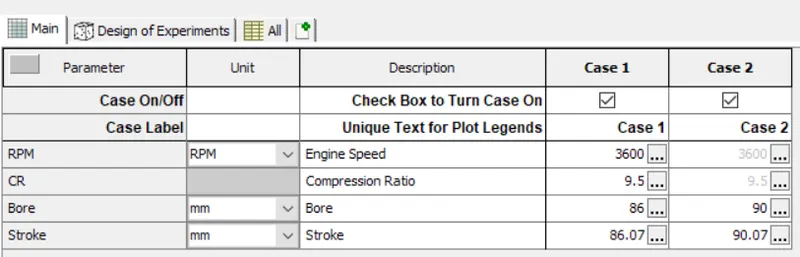
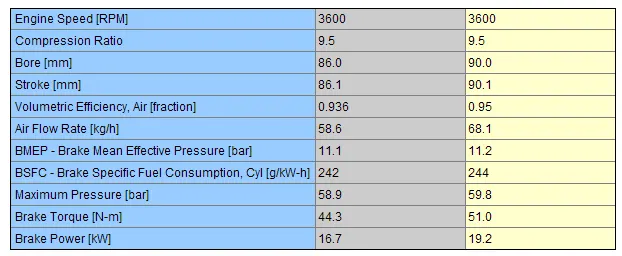
In order to keep the engine cylinder square, both bore & stroke were increased by 4mm. The case setup & simulation results are shown below,
Clearly,
`"Increase in (brake) power" = ((19.2-16.7)/16.7)"x"100 = 14.97%`