Week 12 - Validation studies of Symmetry BC vs Wedge BC in OpenFOAM vs Analytical H.P equation
Aim=Validation study between symmetric boundary condition, wedge boundary condition vs analytic H.P equation for the flow along the pipe using OPENFOAM.
OBJECTIVES
- To simulate the flow with symmetry and wedge boundary condition for following angles
10,25,45 degrees.
- To validate hydrodynamic legth with the numerical results.
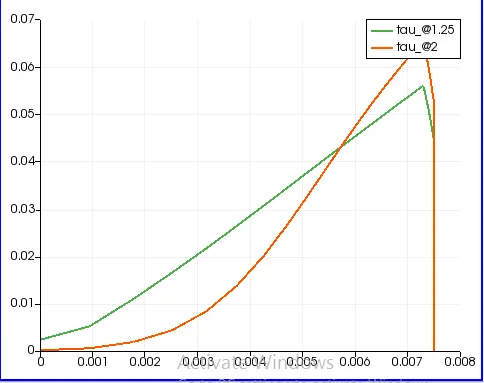
- To validate the shear stress results for fully developed flow.
- To validate maximum velocity and pressure drop for the fully developed flow.
This project is the continuation of the week 11 challenge.
What is symmetric boundary condition?
The symmetry boundary condition defines a mirror face/surface. It should only be used if the physical object or geometry and the expected flow field pattern of the developed solution are mirrored along that surface. By using this boundary condition, the domain can essentially be halved, reducing the time to achieve a solution.
In detail, the symmetry condition applies the following constraints on the flow variables:
- The fluxes across the symmetry are zero.
- The normal components of all variables are set to zero.
It can be applied to both planar or non-planar faces/surfaces on the domain boundaries.
What is the wedge boundary condition ?
The wedge boundary condition (BC) is used in computational fluid dynamics to define an axisymmetric situation, for eg. cylinder. The model and flow must be axisymmetric along a central line such that all physical variables of the flow have the same value and distribution at a given radius for all angles.
This boundary condition is specified by two planes that must be selected on separate sides of the domain (referred to as front and back) on surfaces running along the axis. It works for 2D simulations only.
Wedge is different from the symmetry boundary condition in the sense that the wedge BC applies the Navier-Stokes equations in cylindrical coordinates whereas the latter applies in cartesian coordinates. One big advantage of wedge is that it allows for the rotational flow around the axis and this is possible only because the fluxes and normal components are not assumed as zero.
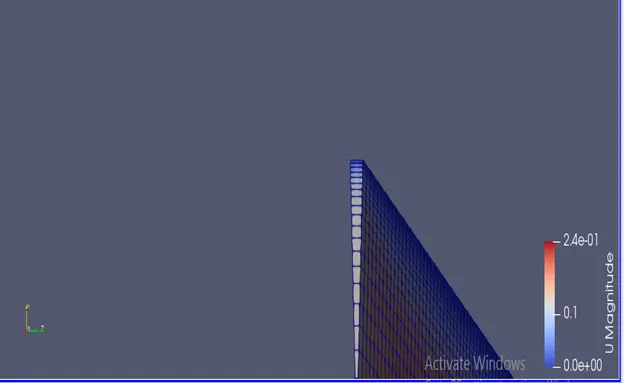
Simulation using the wedge angle of 10,25,45 degrees.
The boundary condition selected for the simulation is wedge boundary condition.
For the 10 degree using the wedge boundary condition.
Velocity plot at different location.
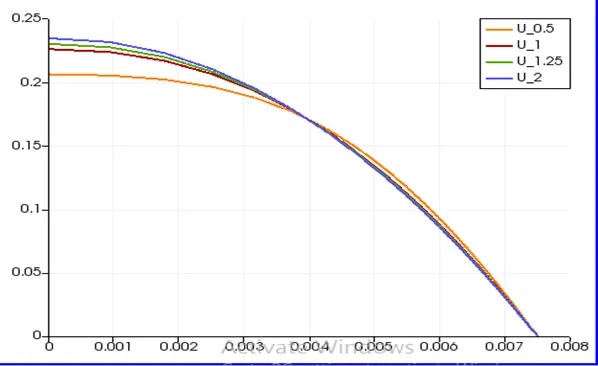
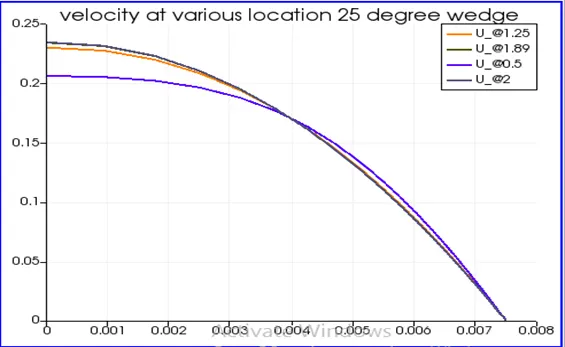
For 25 degree
Velocity plot
shear stress plot
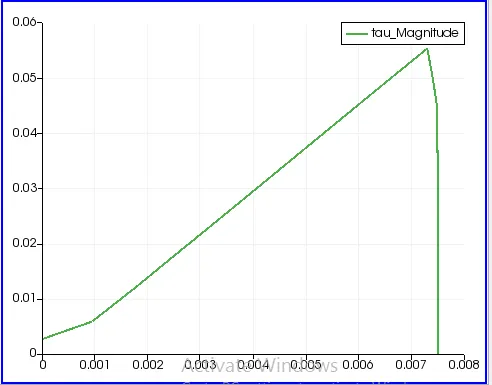
for 45 degree wedge condition
velocity plot
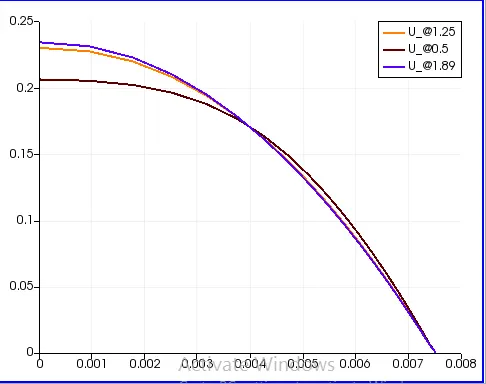
shear stress plot
the maximum velocity from the numerical data 0.2498.
The maximum value for velocity for symmetry boundary condition is 0.235744 m/s and for the wedge boundary condition its value is 0.234863 m/s.
blockMeshdict file for 45 degree symmetry condition
/*--------------------------------*- C++ -*----------------------------------*\
  =========                 |
  \\      /  F ield         | OpenFOAM: The Open Source CFD Toolbox
   \\    /   O peration     | Website:  https://openfoam.org
    \\  /    A nd           | Version:  8
     \\/     M anipulation  |
\*---------------------------------------------------------------------------*/
FoamFile
{
    version     2.0;
    format      ascii;
    class       dictionary;
    object      blockMeshDict;
}
// * * * * * * * * * * * * * * * * * * * * * * * * * * * * * * * * * * * * * //

convertToMeters 1;
vertices

(
	(0.000000 0 0)
	(0.000000 0.002870 0.006929)
	(0.000000 0.002870 -0.006929)
	(2.500000 0.000000 0.000000)
	(2.500000 0.002870 0.006929)
	(2.500000 0.002870 -0.006929)

);

blocks
(
 	hex (0 3 5 2 0 3 4 1)(200 20 1) SimpleGrading (1 0.1 1)
);

edges
(
	arc 1 2 (0 7.5e-3 0)
	arc 5 4 (2.5 7.5e-3 0)
);

boundary
(
	axis
	{
		 type empty ;
		 faces
		 (
			 (0 3 3 0)
		 );
	}

	inlet
	{
		 type patch ;
		 faces
		 (
			 (0 1 2 0)
		 );
	}

	pipe
	{
		 type wall ;
		 faces
		 (
			 (2 1 4 5)
		 );
	}

	outlet
	{
		 type patch ;
		 faces
		 (
			 (3 5 4 3)
		 );
	}

	front
	{
		 type wedge;
		 faces
		 (
			 (0 3 4 1)
		 );
	}

	back
	{
		 type wedge;
		 faces
		 (
			 (0 2 5 3)
		 );
	}

);

mergePatchPairsn(n);

(
);
initial condition for pressure and velocity
pressure file
/*--------------------------------*- C++ -*----------------------------------*\
  =========                 |
  \\      /  F ield         | OpenFOAM: The Open Source CFD Toolbox
   \\    /   O peration     | Website:  https://openfoam.org
    \\  /    A nd           | Version:  8
     \\/     M anipulation  |
\*---------------------------------------------------------------------------*/
FoamFile
{
    version     2.0;
    format      ascii;
    class       volScalarField;
    object      p;
}
// * * * * * * * * * * * * * * * * * * * * * * * * * * * * * * * * * * * * * //

dimensions      [0 2 -2 0 0 0 0];

internalField   uniform 0;

boundaryField
{
    inlet
    {
        type            zeroGradient;
    }

    outlet
    {
        type            fixedValue;
        value           uniform 0;
    }

    axis
    {
        type            empty;
    }

    front
    {
        type  		wedge;

    }

    back
    {
        type  		wedge;

    }

    pipe
    {
        type  		zeroGradient;

    }
}

// ************************************************************************* //
velocity file
/*--------------------------------*- C++ -*----------------------------------*\
  =========                 |
  \\      /  F ield         | OpenFOAM: The Open Source CFD Toolbox
   \\    /   O peration     | Website:  https://openfoam.org
    \\  /    A nd           | Version:  8
     \\/     M anipulation  |
\*---------------------------------------------------------------------------*/
FoamFile
{
    version     2.0;
    format      ascii;
    class       volVectorField;
    object      U;
}
// * * * * * * * * * * * * * * * * * * * * * * * * * * * * * * * * * * * * * //

dimensions      [0 1 -1 0 0 0 0];

internalField   uniform (0 0 0);

boundaryField
{
    inlet
    {
        type            fixedValue;
        value           uniform (0.119 0 0);
    }

    outlet
    {
        type            zeroGradient;

    }

    axis
    {
        type            empty;
    }

    front
    {
        type  		wedge;

    }

    back
    {
        type  		wedge;

    }

    pipe
    {
        type            fixedValue;
        value           uniform (0 0 0);

    }
}

// ************************************************************************* //
now for simulating for the symetry conditions
Front and back are changed into symmetry in file blockmesh and pressure,velocity
    front
    {
        type  		symmetry;

    }

    back
    {
        type  		symmetry;

    }