Week-11 Challenge: Braking
1) For a defined driving cycle, calculate the energy required for braking.
Need for Driving Cycle
- A driving cycle is a series of data points representing the speed of a vehicle versus time.
- Driving cycles are produced by different countries and organizations to assess the performance of vehicles in various ways, for instance, fuel consumption, electric vehicle autonomy, and polluting emissions.
Calculate the energy required for braking
- Normally brakes have to absorb three times the amount of engine horsepower energy in its equivalent form.
- Thus, the kinetic energy doubles as the weight doubles, but it increases four times as the speed doubles.
Braking Energy =
Where,
m = Mass of vehicle (kg)
v = Velocity of vehicle (m/s)
MATLAB program for the calculation of braking energy:
clc
clear all
close all
Data = xlsread('Drive cycle.xlsx'); % Loading the drive cycle data
mass = 1000; % mass of the vehicle in kg
time = Data(:,1); % time period
speed = Data(:,2); % velocity data in m/s
vf = []; % Final speed array
vi = []; % Initial speed array
for i = 1:(length(speed)-1)
if speed(i)>speed(i+1)&&speed(i+2)<speed(i+1)&&speed(i-1)<speed(i)
Vi = [vi,speed(i)];
elseif speed(i)<speed(i+1)&&speed(i+2)>speed(i+1)&&speed(i-1)>speed(i)
Vf = [vf,speed(i)];
end
end
vf = [vf,0];
B = (0.5.*mass.*(vi-vf).^2)/1000;
x = sprintf('Total Braking Energy = %0.2fkWh',sum(B));
disp(x)
% Plotting the drive cycle
plot(time,speed,'linewidth',2)
title('Drive Cycle')
xlabel('Time')
ylabel('Speed')
grid on
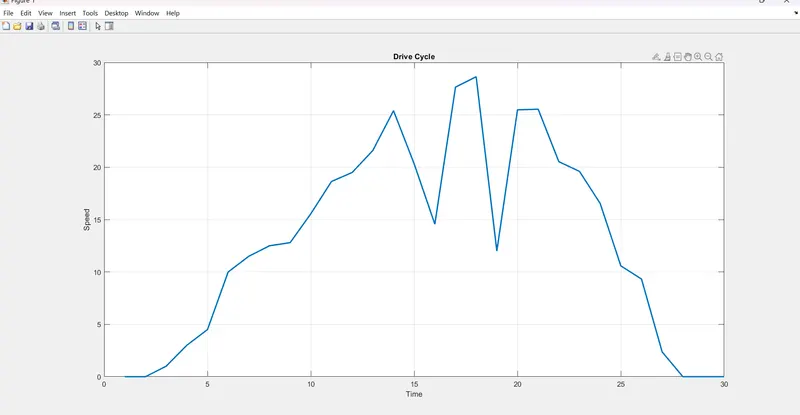
Result For Drive Cycle
2) Why electric motors can’t develop braking torque at a high speed similar to starting
- Electric motor brakes are used in applications where moving parts need to stop instantly. This is the main difference compared to mechanical brakes, which stop gradually.
- The braking system plays an important role in electric vehicles.
- In order to achieve high energy regeneration efficiency and also ensure driving safety at the same time, the regenerative braking system should be well coordinated with the mechanical braking system.
Speed torque characteristics of the Motor
- The motor reaches the critical speed it has constant torque and once it reaches the critical speed, the curve is having a down slope which is a constant power region.
- At High speeds, the torque will be less and operates at a constant power region hence it is difficult to bring the vehicle to rest or decelerate immediately.
- The peak acceleration torque is greater than the peak deceleration torque. So Electric motor can't develop braking torque at a high speed similar to starting, because the Braking torque of an EV Motor is not as high as the acceleration torque.
- Therefore Regenerative braking is cannot happen so effectively that we can get all the power back to the battery.
Electric and mechanical brakes are coordinated
First of all, we can classify the term braking into two parts
- Mechanical Braking
- Electrical Braking
Mechanical Braking
- Mechanical brakes are applied by brake shoes which are pressed with force against the wheel of the train.
- In mechanical braking, the braking force is generally produced by means of a piston-cylinder arrangement.
- The movement of the piston is transmitted to the brake shoes through a system of levers.
- In mechanical braking, regenerative braking is not possible.
Electric Braking
- In electric braking, the kinetic energy of the moving parts of the motor is converted into electrical energy which is either dissipated in a resistor or returned to the supply source.
- Thus, electric braking is a system of braking in which a braking action is applied to an electric motor by causing it to act as a generator.
- In electrical braking, 60% to 80% of the kinetic energy of moving parts can be fed back to the supply line in regenerative braking.
Types of Braking
Brakes are used to reduce or cease the speed of motors. which are applicable to almost every type of motor.
- Regenerative Braking.
- Plugging type braking.
- Dynamic braking.
3) Make a MATLAB program that plots the contour of given motor speed, torque, and efficiency values.
clear all
close all
clc
x = linspace(0,500,200); % Speed in rad/sec
y = linspace(1,1000,300); % Torque in Nm
Ku = 0.5; % Copper loss constant
ki = 0.006; % Iron loss constant
kw = 0.00018; % Windage loss constant
[X,Y] = meshgrid(x,y); % Converting to 2D
Output_power = (X.*Y); % Power = Torque x Speed
c_loss = (Y.^2)*Ku; % Copper loss
I_loss = X.*ki; % Iron loss
W_loss = (X.^3)*kw; % Windage loss
Const_loss = 21; % Constant motor loss
Input_power = Output_power + c_loss + I_loss + W_loss + Const_loss;
Efficiency = Output_power./Input_power; % Efficiency of the motor
c = [0.60,0.75,0.50,0.10]; % Efficiency values for contour
contour(X,Y,Efficiency,c);
title('Speed, Torque, and Efficiency characteristics of Motor');
xlabel('Speed (rad/sec)');
ylabel('Torque (Nm)');
Result
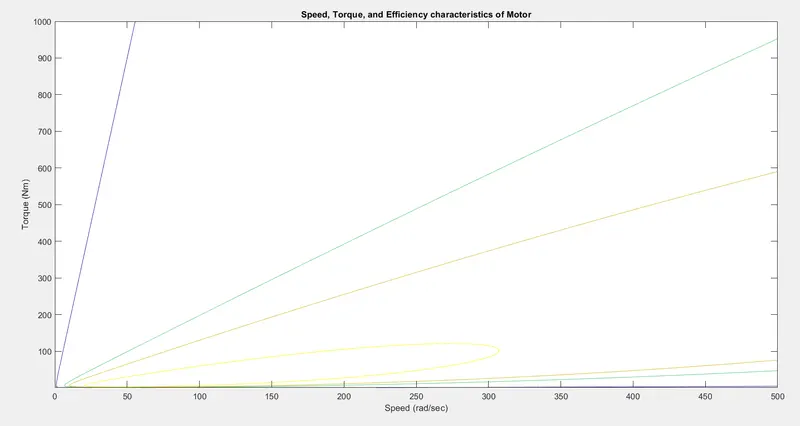
The above Plot shows the Motor speed, torque, and efficiency Contour Plot.