Project-1: Powertrain for aircraft in runways
Part A
1) list of the total weight of various types of aircraft.
Typical Airplane Weights
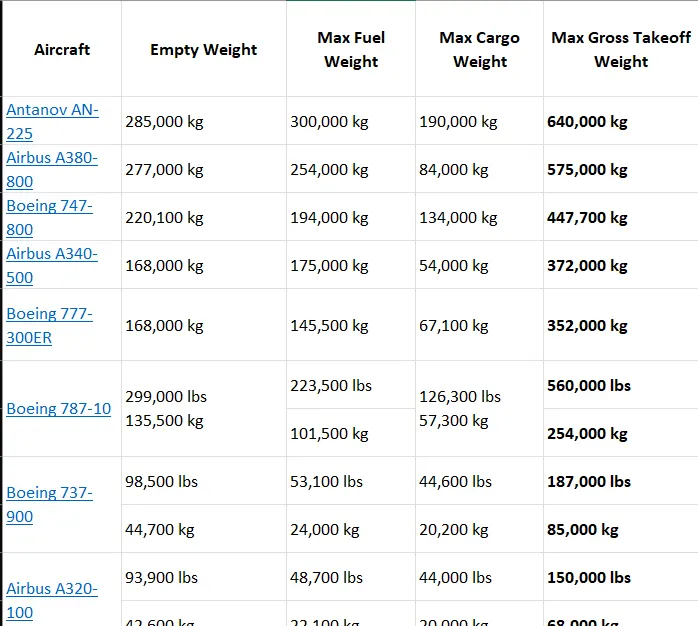
What do Aircraft Weight Names mean
if we took the Aircraft's Empty Weight and added the Maximum Fuel Weight and Maximum Cargo it could carry, it could be well over the aircraft’s Maximum Gross Weight.
Aircraft Empty Weight (AEW)
This is sometimes referred to as OEW – Operating Empty Weight and it is the weight of the aircraft with all its equipment on board but no fuel, no passengers, or no cargo.
Aircraft Maximum Gross Takeoff Weight (MGTW)
This is the maximum permissible weight the aircraft can weigh as it lifts off the ground at takeoff. This includes the aircraft’s empty weight, the fuel, the crew, the passengers, and all the cargo. Many aircraft accidents have been caused by an aircraft being overweight and the pilot/s have not had enough power or maneuverability to prevent the accident.
Aircraft Useful Load
This is the weight that a pilot can place in the aircraft. Take the MGTW figure and subtract the AEW and this is the total useful load that can be placed into the aircraft. This is the fuel, crew, passengers, and cargo.
2) Is there any difference between ground speed and airspeed
Airspeed is the vector difference between the ground speed and the wind speed. On a perfectly still day, the airspeed is equal to the ground speed. But if the wind is blowing in the same direction that the aircraft is moving, the airspeed will be less than the ground speed.
Airspeed vs. Ground Speed
- True airspeed is simply the speed at which an aircraft is moving relative to the air it is flying in. As such, it’s also the speed at which the air is flowing around the aircraft’s wings.
- Ground speed, on the other hand, is the aircraft’s speed relative to the ground. One thing that should be noted here is that it’s horizontal rather than vertical speed – an aircraft climbing completely vertically would have a ground speed of zero.
- In other words, while airspeed is what determines whether there is enough airflow around an aircraft to make it fly, ground speed is what determines how fast an aircraft will get to its destination.
- Airspeed = Groundspeed - Wind Speed
Wind’s Effect on Ground Speed
- The relationship between airspeed and ground speed is fairly simple. Ground speed is simply the sum of airspeed and wind speed.
- If the aircraft is flying in the same direction as the wind is blowing, the aircraft experiences a tailwind, and its ground speed is higher than its airspeed.
- On the other hand, if the wind is blowing against the direction the aircraft is traveling in, the aircraft experiences a headwind, and its ground speed is lower than its airspeed.
- If there was a 100 miles per hour headwind – wind blowing against the aircraft’s direction of travel – the aircraft would still be traveling at an airspeed of 500 miles per hour.
- However, its ground speed would be just 400 miles per hour (100 miles per hour slower than its airspeed). And as such, it would take the aircraft five hours to reach its destinations.
3) Why is it not recommended to use aircraft engine power to move it on the ground at Airport
First of all, planes have brakes on the wheels. But secondly, they almost never put full power on the engines while standing still, which could actually damage the brakes and wheels. So while it may feel like full power for a passenger it's almost guaranteed not. It might be 50%, and then the second they release the brakes they put full power on at the same time.
Aircraft towing equipment is typically used for the towing and pushback process to avoid some of the significant hazards posed by aircraft engines. When an aircraft's engine is activated, the thrust can create a high-speed wind that can easily cause damage to the airport terminal, surrounding ground vehicles, jetway, baggage, and most importantly, ground personnel.
Additionally, aircraft engines consume a great deal of fuel and generate extreme noise that can be harmful to ground personnel. Using a pushback tug for aircraft is simply a more economical and safer option than running the engines.
4) How an aircraft is pushed to the runway when it's ready to take off
- Pushback is when an aircraft is pushed backward away from the airport gate by vehicles called tugs or tractors.
- Closer to departure, an aircraft tug will park right in front of the nose wheel.
- The tug might be directly attached to the plane's nose gear with a tow bar, or could be a "wheel-lift" tug.
- When aircraft tugs are used to tow planes, an airline can maximize safety and optimize efficiency with on-ground operations.
- These tugs cradle the nose gear, then lift it up before moving the plane.
- That gives the tug driver control over the plane's direction during pushback.
- New taxi technologies are appearing, like pilot-controlled tugs, and electric motors mounted to the plane's landing gear.
5) Learn about take-off power, tire design, rolling resistance, tire pressure, and brake forces when landing.
The four forces acting on an aircraft in straight-and-level, unaccelerated flight are thrust, drag, lift, and weight. They are defined as follows:
- Thrust—the forward force produced by the powerplant/propeller or rotor. It opposes or overcomes the force of drag. As a general rule, it acts parallel to the longitudinal axis. However, this is not always the case, as explained later.
- Drag—a rearward, retarding force caused by disruption of airflow by the wing, rotor, fuselage, and other protruding objects. As a general rule, drag opposes thrust and acts rearward parallel to the relative wind.
- Lift—is a force that is produced by the dynamic effect of the air acting on the airfoil, and acts perpendicular to the flight path through the center of lift (CL) and perpendicular to the lateral axis. In level flight, lift opposes the downward force of weight.
- Weight—the combined load of the aircraft itself, the crew, the fuel, and the cargo or baggage. Weight is a force that pulls the aircraft downward because of the force of gravity. It opposes lift and acts vertically downward through the aircraft’s center of gravity (CG).
Take Off Power:
On take-off, in order to position the aircraft to a safe height away from terrain and obstacles the engine thrust is set to a high ‘take-off power’ setting, and the aircraft attitude is pitched up to maintain a specific speed (usually in the region of V2 + 15kts). Once the ‘safe height’ is reached the engine thrust can therefore be reduced to a more appropriate (i.e. efficient) setting and the aircraft flight path can be changed to a more appropriate (i.e. efficient) flight path.
- At 1,500ft aal reduce thrust to climb power and accelerate the aircraft towards 250 knots, retracting flaps and slats.
- At 1,500ft aal reduce thrust to climb power maintaining V2 + 15kts. At 3,000ft accelerate the aircraft.
Tire design
An aircraft tire is designed to withstand extremely heavy loads while landing, taking off, taxing, and parking. The number of wheels required for aircraft increases with the weight of the aircraft, as the weight of the airplane needs to be distributed more evenly.
A Boeing 737NG & 737MAX uses 6 wheels, Boeing 787 uses 10 wheels, Boeing 777 uses 14 wheels and Airbus A380 uses 22 wheels. Aircraft tires work under extreme conditions, carrying up to 340 tons and accelerating at over 250 km/hour at takeoff, in addition to enduring varied environmental stress when in flight and taxiing.
Carcass plies are used to form the tire. They are sometimes called casing plies. An aircraft tire is constructed for the purpose it serves.
- They support the weight of an aircraft while it is on the ground.
- It also provides the necessary traction for the braking and stopping of an airplane.
- Tyre also helps to absorb the shock of landing and provides cushioning for the roughness of takeoff, roll-out, and taxi operations.
Rolling resistance
Therefore, the trailing tires will have a lower rolling resistance than the leading tires. Experimental data presented in Ref. 10 for tires with an inflation pressure of 179 kPa show that the resistance of the trailing tire can be around 20% of the resistance of the leading tire. However, as shown in Ref. 6, aircraft tires that have an inflation pressure in the range of 560-1400 kPa, compact the snow such that further compaction of a significant level is only possible if the pressure of the trailing tire is at least more than 2100 kPa. The compaction of the snow in the rut by the trailing tires, which have an inflation pressure of 560-1400 kPa, will be minimal. Therefore the rolling resistance of the trailing tires can be neglected when compared to the rolling resistance of the leading tires. Hence, the resistance on a bogie landing gear is equal to that of a dual-tire configuration.
Rolling resistance force Frr = urr * m * g
Where m = total mass of the aircraft(Actual mass+Pay load) in kg and g = gravitational constant, that is 9.8 m/s^2.
Airplane wheel/tire assemblies are inflated to high pressures (many in excess of 200 psi). In addition, the pressure in the bottle or tire-servicing cart can be as high as 3,000 psi. As a result, when the high-pressure bottle is connected directly to the wheel without a regulator, the wheel is suddenly subjected to high pressure, which can exceed the design limits for the wheel and the wheel tie bolts. Consequently, the wheel, the wheel tie bolts, or both experience an explosive fracture and become projectiles.
In most of the reported cases of related injuries, the wheel/tire assembly that exploded was a nose wheel on a smaller-configuration airplane such as the 737 or DC-9. Reportedly, the wheels were being inflated from a high-pressure bottle or cart without a regulator when the explosion occurred.
Disc brakes are designed to remain static at all times. In other words, they don’t rotate with the wheels of an airplane’s landing gear. As the wheels turn, the disc brakes will remain static and stationary. They are a vital component of an airplane’s braking system because they are designed to apply pressure to the airplane’s wheels. Disc brakes will squeeze the wheels, thereby slowing down the speed at which they spin. In turn, this reduces the speed of the airplane so that it can come to a complete stop on the runway.
6) A) With the necessary assumptions, calculate the force and power required to push/pull an aircraft by a towing vehicle.
Rolling resistance force is
Frr = c*mr*g
where
Frr = rolling resistance (N)
c = rolling resistance coefficient
mr = rolling mass (kg)
If the mass of a plane is 50000 kg and the rolling resistance co-efficient between the aircraft wheel and the runway is 0.02
The force required to overcome the rolling resistance can be calculated as
Frr = (0.02) * (50000 kg) *(9.81 m/s^2) = 9810 N
Mass of the pushback = 1000kg (assumed)
For the Towing Vehicle Frrt
Frrt = 0.02*1000*9.81
= 196.2 N
As the towing vehicle resistance is so less compared to the Aircraft because this is a heavy aircraft these can be neglected.
Aerodynamic resistance (Far)
Drag coefficient(Cd) = 0.025
Air Density (ρ) = 1.125 kg/m^3
Frontal Area (A) = 150 m^2.
Velocity (v) = 6 m/s
Far = (1/2)*Cd*ρ*A*v^2
Far = (1/2)*0.025*1.125*150*6^2 = 75.93N
As the vehicle and Plane are moving at very low-speed Aerodynamic resistance can be neglected
Total Resistance:
Ft = 9810 N
The power for pulling/pushing the aircraft can be calculated as
Calculating the power (p) =Force*Velocity
Power = Ft*v
v = 6
P = 9810*6
= 58860 w
Power = 58.86kw
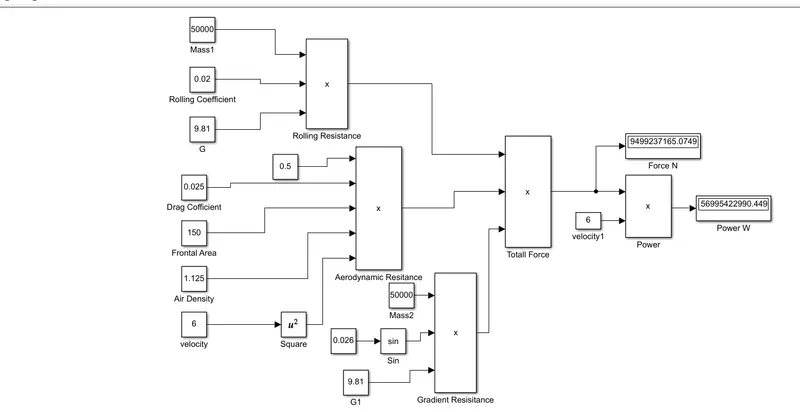
Power required = 261.6 kw
Let us assume,
The Radius of the Tyre for the Tug = is 25 inches = 0.635m
Gear ratio = 8
Transmission Efficiency (ηt) = 80%
Motor Efficiency (ηm) = 96%
then,
The torque required for the wheels (Tw) = Total Force * Radius in meters
= 43.6 * 0.635
Tw = 27.686 KNm
Motor Torque = Wheel torque/(Gear ratio*ηt)
= 27.686 / (8*0.80)
Tm = 4.325 KNm
For ηm =95%, The required motor Torque (Tm)= 4.325/0.96 = 4.505 kNm
Similarly, The total power required by the motor considering all the efficiencies(Pt) = 261.6 /(0.80*0.96)
Pt = 340.62 Kw
Let us assume the towing operation was done for a 15 minutes (0.25 hrs) duration.
Then, Total Energy consumed = 340.62*0.25
= 85.16 KWh
If we consider the battery capacity =220 kw is used by the towing vehicle then, The duty cycle range to control the speed from 0 to max speed (3m/s) is given as
Duty Cycle (d) = (Required Power)/ (Rated power)= 340.62/220 = 1.54