Week-11 Challenge: Braking
EV BATCH17
Aim:
To calculate ,describe and make a codes of motor by using the matlab.
objective:1 For a defined driving cycle, calculate the energy required for braking.
codes:
- The below codes is used to calculate the energy required for braking torque.
- The kinetic energy formula is used for calculating the energy.
- BE=1/2*m*v^2,m=mass of vehicle,v=velocity of vehicle.
clear all
close all
clc

m=1000;
drivecycle=xlsread('udds.xlsx');
t=drivecycle(:,1);
v=drivecycle(:,2);
for i=1:(length (drivecycle)-1);
    if v(i)>v(i+1)
        BE(i)=0.5*m*(v(i)-v(i+1))^2;
    end
end
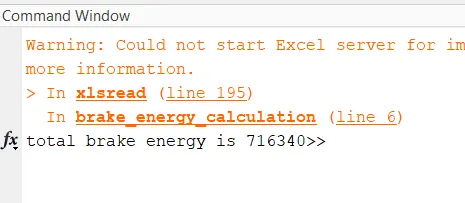
fprintf('total brake energy is %d',sum(BE))
figure(1)

plot(BE,'color','r');
xlabel('Time(s)')
ylabel('Energy(J)')
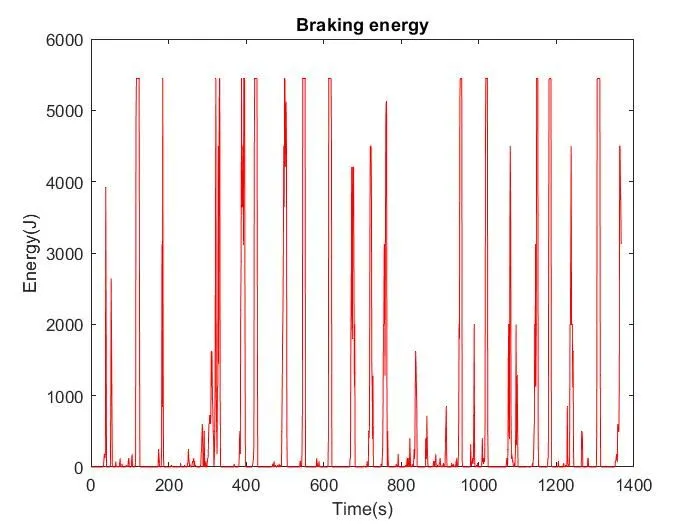
title ('Braking energy')PLOTS:The below plots represents the braking energy of the udds cycle.
output:
objective:2Why electric motor can’t develop braking torque at high speed similar to starting?
- If the load is removed from an electric motor and supply to it be disconnected, it will continue to run for some time due to inertia.
- The time elapsing before it stops will be especially long if the motor is massive and has run at high speed.
- It is essential, however, in many cases that the motor and its driven machine be stopped quickly.
- In fact, quick stopping of a motor is more essential than quick starting.
- Delay in starting up a motor only causes the machinery to stand idle; a delay in stopping a motor may result in heavy damage to equipment or to the manufactured products and even the loss of human life.
- Based on the purpose for which braking is employed, it is of the two types, viz, braking while bringing the drive to rest and braking while lowering loads.
- In the first type, the device employed for braking absorbs the kinetic energy of the moving parts while in the second one, it absorbs, in addition to the kinetic energy, potential energy, usually gravitational which can drive the system at an excessively high speed.
- Braking torque can be applied either by mechanical (or friction) brakes or electrodynamically.
- In mechanical braking, the stored energy of rotating parts is dissipated in the form of heat by a brake shoe or band rubbing on a wheel or a brake drum.
- In electrical (or electrodynamic) braking the stored energy of rotating parts is converted into electrical energy and dissipated in the resistance in the form of heat or returned to the supply. Here we will deal with electric (or electrodynamic) braking only.
How electric and mechanical brakes are coordinated?
- Electrical braking systems are used for functional braking (controlling the speed; bringing the load to standstill).
- Mechanical braking systems are used for emergency stopping or for parking.
- Electrical braking is usually very smooth and comfortable. Mechanical braking is usually rough and uncomfortable.
- No wear results from electrical braking. Mechanical braking on the other hand causes wear in the braking components and requires regular maintenance.
- It is possible (but not always feasible) in electrical braking systems to returnthe regenerated energy back to main supply.
- This is not possible in mechanical braking systems and the energy is always lost as heat, noise and wear.
- The electrical braking system cannot be used as a safety device. Most systems will require a mechanical braking system as a backup safety device.
-
There are three types of electric braking, all of which are applicable to the usual types of electric motors, viz.
- plugging (or counter-current braking),
- dynamic (or rheostatic) braking and
- regenerative braking.
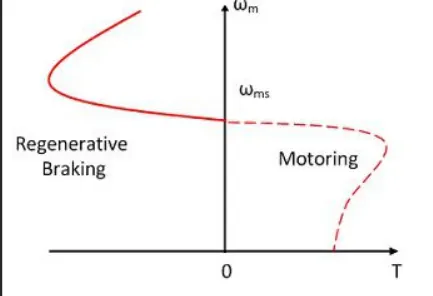
For regenerative braking it is necessary for:
(i) Supply voltage to drop,
(ii) The motor to be overexcited or
(iii) The motor to be running at a speed higher than no-load speed.
- In all of these cases the armature current is reversed and a retarding torque is produced, slowing down the motor until the back emf of the armature becomes equal to the supply voltage.
- Regenerative braking will not stop the motor. It is effective only for braking hauling loads.
- They may occur in a crane motor due to action of the lowering load or in the motor of an electric locomotive moving down grade.
-
Mechanical Braking SystemsThere are four types of mechanical brakes used in drive systems:1. Drum brakes.2. Disk brakes.3. Band brakes.4. Pawl and Ratchet brakes: The ratchet is linked to a spring loaded frictionplate. The ratchet is lifted using a solenoid.
-
The drum and disk brakes are either electromagnetically lifted or hydraulically lifted,but always spring applied.
-
They must be spring applied for safety reasons, so that when the power supply is lost, the brake will apply and safely bring the load to a standstill.
objective:3 Make a MATLAB program which plots contour of given motor speed, torque and efficiency values. Attach the code as a .m file attach a screenshot of all the plots.
codes:
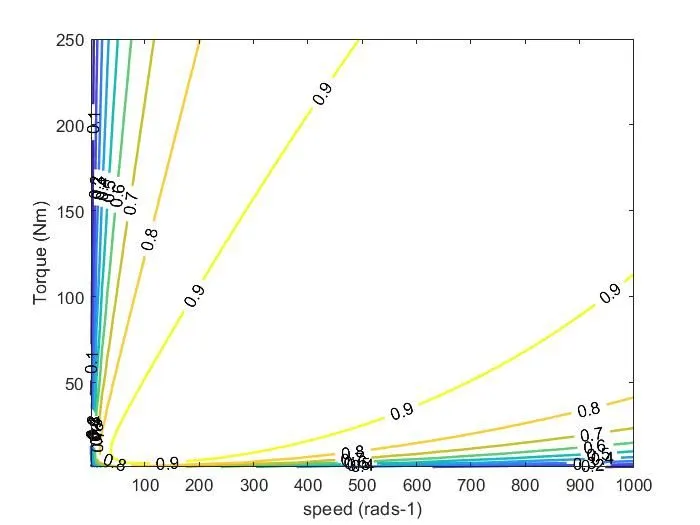
The below codes is used for plot the speed,torque and efficiency values by using the contour plots.
if plot the contour the 1D array is convert into 2D array.
clear all
close all
clc

%parameters of a motor
kc=0.2; %copper loss
ki=0.008;%iron loss
kw=0.00001;%windage loss constant
cons=20; %constant loss

%creation of torque and speed array
t=linspace (1,250); %1D torque array
w=linspace(1,1000); %1D speed array

%converting into 2D array
[T,W]=meshgrid(t,w);

%power calculations
P_out=W.*T; %power=speed*torque

%losses
L_c=(T.^2)*kc ;%cooper ;loss
L_i=W.*ki;%iron loss
L_w=(W.^3)*kw;%windage loss

p_in=P_out+L_i+L_c+L_w+cons; %input power


eff=P_out./p_in; %efficiency

contour(W,T,eff,'showtext','on','linewidt',1.5)
xlabel('speed (rads-1)')
ylabel('Torque (Nm)')plots:the below plots is the contour of the given motor speed,torque and efficiency.
conclusion:
The above objectives are calculated,plotted and described successfully by using the matlab.