Week-11 Challenge: Braking
1. For a defined driving cycle, calculate the energy required for braking.
Solutiom:
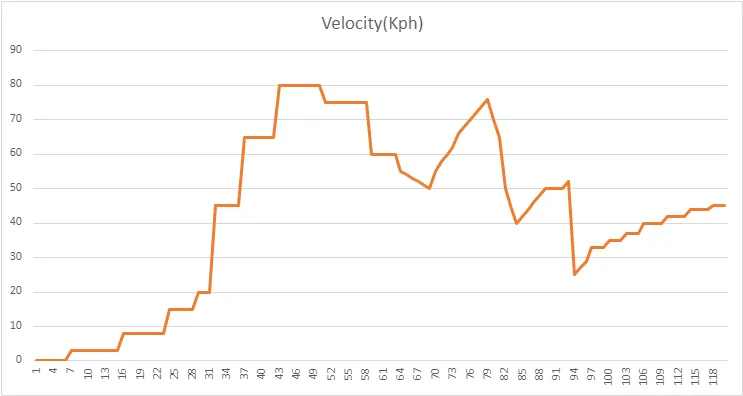
For any random drive cycle calculating the amount of energy required for braking at a particular instant.
Work done = Kinetic energy(E) = (1/2*m*v^2)
From work done Power is calculated as P = E/t
- m = mass of vehicle = 1000Kg
- v= relative velocity of vehicle (vf-vi)
- vf = final velocity and vi = inital velocity
- Considering vf = 48Kmph & vi = 76Kmph ( Vehicle is deccelerating ) vf-vi= 28Kmph = 7.778m/s
- t = time of required of braking = 10sec
- E = (1/2*1000*(5/18*28)^2) // Converting Kmph into m/s //
- = 30246.9145 J
- P = E/t
- = 3.024Kw
- Energy required for braking of vehicle from 76 to 48 Kmph speed in 10 sec = 0.8401 Whr
2. Why electric motor can’t develop braking torque at high speed similar to starting? How electric and mechanical brakes are coordinated?
Solution:
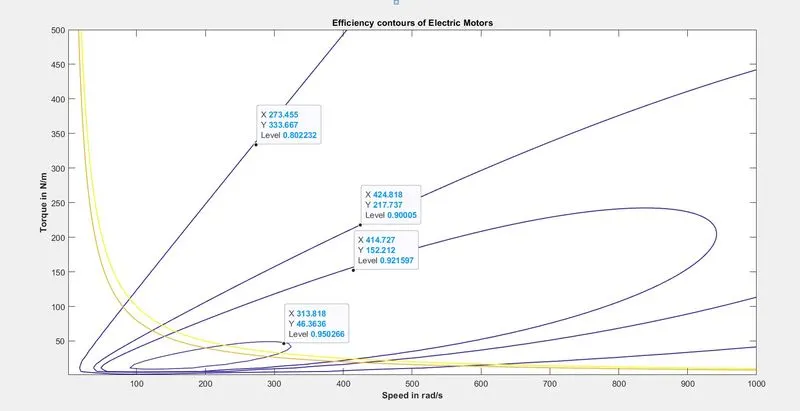
- From above figure we can see the characteristics of IM, the curve is divided into two region constant torque and constant power region.
- The reason why electric motor can't develop same braking torque at high speed similar to starting because of these characteristics.
- Motor has to develop starting torque at low speed this falls under constant torque region, and this is the operation of first quadrant where torque and speed both are positive.
- In deccelaration of vehicle torque is negative and speed is positive which results in negative power falling under operation of second quadrant.
- Here motor is operating in constant power region where torque is low so to develop exact amount of starting torque is not possible in deccelaration case.
- From the above conclusion we can say, the cause of ineffective regenerative braking is because of the compromised torque while braking, this do no allows all the power back into the battery.
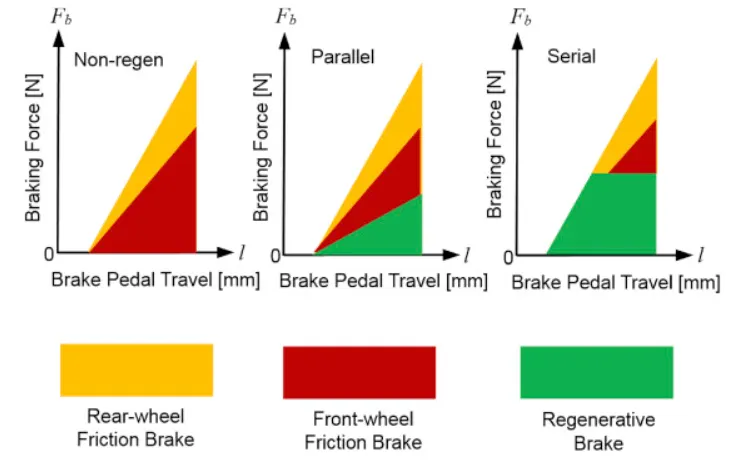
- Coordination of Electrical and mechanical braking is possible with the idea of which control strategy to be implemented.
- Two types of strategies are there: Series and Parallel
- In series, electrical and mechanical braking is done one after another with respect to speed of vehicle.
- At low speed only electric brakes are used, and at high speed both brakes contributes to stop the vehicle as that time only electric brakes are not capable to stop the vehicle in short time.
- In Parallel, both braking is done simultaneously.
3. Make a MATLAB program which plots contour of given motor speed, torque and efficiency values. Attach the code as a .m file attach a screenshot of all the plots.
Solution:
CODE:
%Plotting Efficiency contours for Electric motors%
%X axis corresponds to motor speed (w)%
%Y axis corresponds to Torque T%
clc;
clear all;
close all;
x = linspace (1,1000); %Setting up arrays for range%
y = linspace (1,500);
kc = 0.2; %For Copper losses%
ki = 0.008; %For Iron losses%
kw = 0.00001; %For Windage losses%
ConsL = 20; %For constant motor losses%
[X,Y] = meshgrid(x,y); %Now make mesh
OutputPower = (X.*Y); % Torque x speed = Power
B = (Y.^2)*kc; % Copper losses
C = X*ki; % Iron losses
D = (X.^3)*kw; % Windage losses
InputPower = B+C+D+ConsL+OutputPower;
Z = OutputPower./InputPower;
% Setting the efficinecies for which contours are plotted
V = [0.8,0.9,0.91,0.92,0.925,0.93];
contour(X,Y,Z,V);
xlabel('Speed in rad/s');
ylabel('Torque in N/m');
hold on
%Plot a contour of the power output at 3 and 5KW
V = [8000,10000];
contour(X,Y,OutputPower,V);
RESULT: