Week-11 Challenge: Braking
ANS 1
We require some amount of power which is used for accelerating the vehicle and also for the braking of vehicle. Here we consider the drive cycle which is predefined .
Workdone = kinetic energy = 0.5 * m *v^2
For calculating the energy-
E =0.5*m*v^2
m = mass of the vehicle = 1000 kg
v = velocity of the vehicle = Vf - Vi (here the vehicle is decelerating from 100 to 0 sec)
so, Vf = final velocity =100 kmph, Vi = 0 kmph
t = time required from 100 to 0 speed is = 10 sec,
Power required is P = Energy / time
p = (0.5*1000*(27.7)^2 / 10
p = 38364 w
p = 38.364 kw
Energy required for braking of vehicle from 100 to 0 speed in 10 sec is
E = 0.0106 kwhr
Energy required for braking of vehicle from 100 to 0 speed in 1 sec is
E = 0.106 kwhr
ANS 2
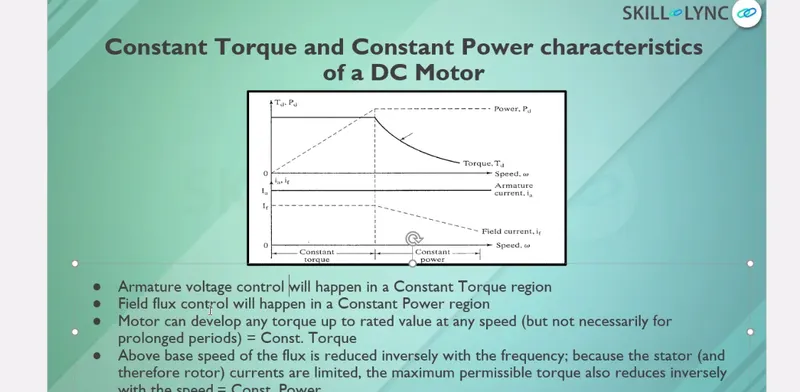
From this curve we have two region, constant torque and constant power region.At the start the motor achieves peak torque till it reaches a certain motor speed range from where it will rapidly drop. In constant torque region torque goes on increasing with speed of vehicle also increasing upto rated torque. Above rated torque, speed increases but torque goes on decreasing. The reason due to the drop in torque is due to the shaft reaching critical speed and the area where the peak torque is constant known as the constant torque region of the motor. The region where the torque decreases is known as the constant power region as the power generated by the motor will be at its peak.
since the torque produced at the constant power region is very low it is not possible to develop enough braking torque in this region.The braking torque produced increases as the speed decreases.
*In electric vehicles two types of braking systems are used electric brake system and mechanical brake system.
The electric braking system used in EVs and HEVs is regerative braking. This method uses the motor as a generator during braking, developing a retarding torque , which acts on the running motor and halts it. The kinetic energy and potential energy, minus the losses of the motor are returned to the mains and the motor runs at a constant speed. Thus regenerative braking eliminates the tendency of the load to accelerate the motor.
Mechanical brake system used can be either disc or drum brake system.Where in case of a disc brake system friction pads rub against a disc when the brake pedal is applied kinetic energy is converted to heat and slows the vehicle. Since the braking torque is very less at high speeds, mechanical brakes are applied to slow down the vehicle.As the motor reaches the constant torque region the regenerative braking system takes effect where the motor acts as a generator and the negative torque produced charges the battery pack.
Brake force distribution-
1)series braking
2)parallel braking.
ans 3
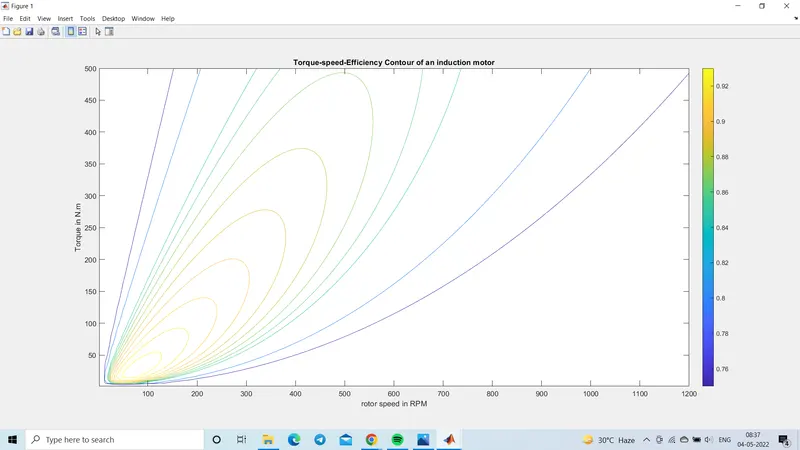
% Motar Speed, Torque, and efficiency plot
clear all
close all
clc

% Input quantities
V = linspace(1,1200);  % velocity array
T = linspace(1,500);   % Torque array
Kc = 0.1 ;             % copper loss constant
Ki = 0.006;            % Iron loss constant
Kw = 0.0001;           % Windage loss constant
Cl = 20;               % Motor loss constant

% calculations
[A,B] = meshgrid(V,T); % Array to matrics

% power calculations
P_out = (A.*B);        % Motor output power
P_c = (B.^2)*Kc;       % Copper loss power
P_i = A.*Ki;           % iron loss power
P_w = (A.^3)*Kw        % windage loss constant
P_in = P_out + P_c + P_i + P_w + Cl ; % Motor input power

% efficiency calculations
Efficiency = P_out./P_in;

% Contour plotting
N = [0.75,0.8,0.85,0.86,0.87,0.88,0.89,0.9,0.91,0.92,0.93,0.94,0.95]; % contour mapping

% plotting
box off
grid off
contour(A,B,Efficiency,N);
colorbar
title('Torque-speed-Efficiency Contour of an induction motor');
xlabel('rotor speed in RPM');
ylabel('Torque in N.m');
plot: