Week-4 Challenge WOT Condition Part-2
ANS 1
Difference between mapped and dynamic model of engine:
Powertrain Blockset provides two types of Engine models: mapped and dynamic. Mapped engines represent macro engine behavior as a set of lookup tables (brake torque, fuel flow, air mass flow, exhaust temperature, efficiency and emissions) as a function of commanded load and measured engine speed. Dynamic engines decompose engine behavior into individual components models that account for engine dynamics mostly for intake airflow and turbocharger dynamics.
You can switch between engine model types based on your application. Dynamic engine models are suitable for designing control, estimator, and diagnostic algorithm that depend on dynamic subsystem states,for example in closed loop AFR control algorithm development. Mapped engine models are suitable for analysis and design activities that do not require engine subsystem dynamic characteristics. for example, in engine and transmission powertrain matching analysis for fuel economy, emissions and performance.
Mapped Model- * it uses a prebuild data in lookup table for the simulation of powertrain blockset.
* In mapped model the calculations are very fast.
Dynamic Model-* it uses real time data for calculating every behaviour of vehicle characteristic like speed, velocity, drag, wheel braking etc.
* in dynamic model the calculations are time consuming.
ANS 2
Miles per galon:(MPG) is a fuel economy rating determined by how far a car can travel on a gallon of gasoline or diesel. Although the metric version would be kilometres per litre, MPG is adopted in many metric systems like canada.
While it is both cheaper and better for the environment to achieve a higher MPG rating, there is a curve, that the EPA calls the 'MPG ILLUSION' that shows the cost-benefits of increasing MPG decrease with higher rating. for example to travel a car of 1000 miles, a car that gets 10MPG will require 100 gallons of fuel. Conversely, a car that gets 15 MPG will require 67 gallons fo fuel. In this case, an increse of just 5 MPG cuts fuel consumption by 33%. When a car gets 30 MPG, however, increasing its mileage to 35 MPG will only save 5 gallons of fuel over 1000 miles.
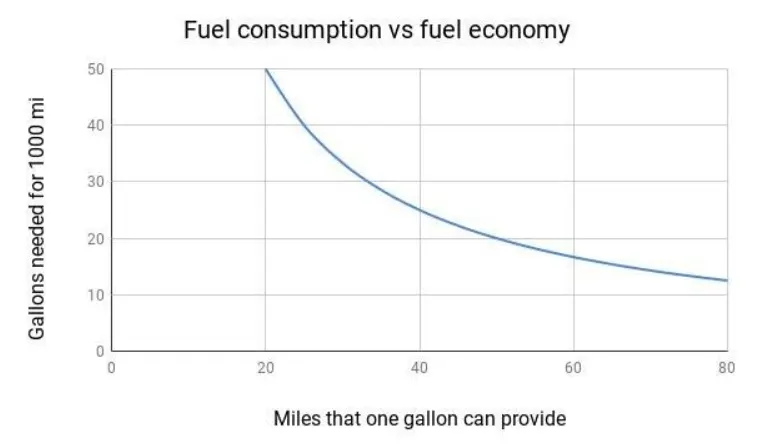
Note : MPGe - Miles per gallon equivalent for electric vehicle
264.172 US gallons = 1000 L
1 Gallon = 33.7 kilowatt hours of energy in electric vehicles .
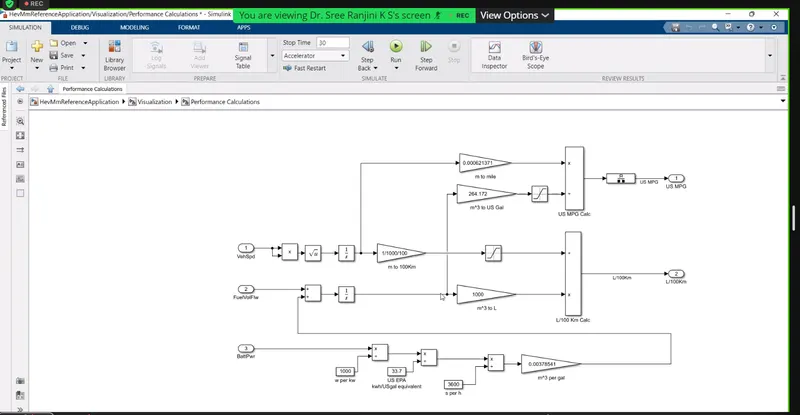
From above simulation blocks-
here vehicle speed (x) is multiplied itself and then square rooted. The value is then integrated (1/s) and converted into meters(m). Then the meters (m) is converted into miles in the block (m to mile ) then it is divided by US gallon to get US MPG.
For US Gallon we need to divide battery power divided by 1000 and then divide by 33.7. Now it is converted from sec to hours by dividing with 3600 then it is converted to m^3 per gal.
The value is finally converted into gallon and used as MPG after dividing miles with gallon.
Factors considered to model fuel flow:
1. Vehicle speed
2. Battery power
3. fuel flow.