Week-6 Challenge: EV Drivetrain
ANS 1
*Types of power converter circuits employed in an electric and HEVs-
Power electronics is the application to control and conversion of electric power. A power converter is a process of converting electric energy from one form to another. A power converter is an electromechanical device for converting electrical energy. A power converter can convert alternating current(AC) into DC current and viseversa,change the voltage or frequency of the current or do some combination of these.
There are three types of power converter circuits employed in an electric and HEVs-
1. AC to DC (Rectifier)
2. DC to AC (inverter)
3.DC to DC
1. AC to DC (Rectifier): A rectifier is an electrical device that converts alternating current (AC), which periodically reverses direction to direct current (DC), Which flows in only one direction,this prosess is known as rectification.
2. DC to AC .
An inverter is a devise that converts DC power to AC power used in an electric vehicle motor. The inverter can change the speed at which the motor rotates by adjusting the frequency of the AC Current, it also increase or decrease the power or torque of the motor by adjusting the amplitude of the signal.
3. DC to DC- A DC to DC to converter is an electronic device or electromechanical device that converts a source of direct current from one voltage level to another. It is a type of electric power conversion.Power levels range from very low to very high.
DC to DC converters change dc power from an onboard 200-800V HIGH Voltage battery into lower dc voltages(48v or 12v) to power headlights, interior lights, wiper and window motors, fans, pumps and many other systems within electric vehicles and hybrid electric vehicles.
DC converters are used in portable electronic devices such as cellular phones and laptop computers. also used in photovoltaic systems and wind turbines.
ANS 2
given- Rated armature voltage (v) = 72v
rated armuture current(Ia) = 400A
Ra = 0.5
k = 0.7 Volt second
chopper switching frequency = 400 hz
duty cycle = 70% =0.7
the average voltage is given by the product of the battery voltage and the duty cycle
Vs = V * Duty cycle
= 72* 0.7
= 50.4
Average voltage is 50.4 V
The vehicle characteristics are given in the form of equation..
Tv = 24.7+(0.0051)*w^2 ...........1
The formula for the motor speed characteristics.
T = (vs*k/Ra)-(k^2 * w/Ra)
By substituting the values
(50.4*0.7/0.5)-(0.7^2 *w/0.5)
we get
T = 70.56 - 0.98*w ............2
compare equ. 1 and 2 ,we get
70.56 -0.98*w =24.7 + (0.0051)*w^2
0.0051*w^2 + 0.98*w - 45 .86 = 0
by using the quadratic equ. formula we get
w = [-b ± √(b² - 4ac)]/2a
w = -0.98+1.377/0.0102 w = -0.98-1.377/0.0102
w = 38.92 rad/sec w = -231.07 rad/sec
Angular speed = 38.92 rad /sec.
ANS 3
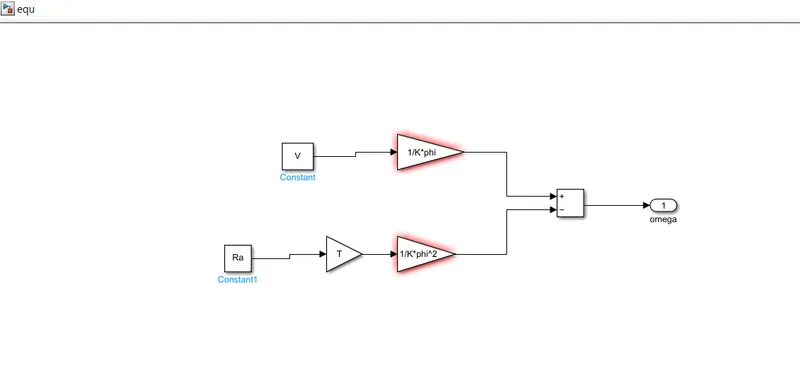
ω= V/Kϕ -Ra/Kϕ^2 .T
ANS 4
First auther explained, how BLDC And Induction motors works then explained that there were only a few brushless drives in the past but now most of the hybrid EVs use it. There is difference between brushless and inverter controls is the control.The DC Brushless requires a position sensor but an induction motor requires only a speed sensor.
less rotor heat is generated in DC brushless drives and rotor cooling is easier and peak point efficiency is generally higher.
DC brushless drives operate at apower factor of one, whereas the induction drives power factor is 85%.
With the increase in the size of the DC Brushless machines, magnetic losses incease and the part load efficiency decreases, whereas the induction drives, as the machine size increases, losses dont grow. During high performance task, induction drives are suitable.
finally we know that the writer says that the DC brushless will dominate the hybrid EVs markets but the induction drives will maintain dominance in the high performance in the pure electric vehicles. As of now, there is no winner out of the two as each has its own pros and cons and excels at its own.