Week-7 Challenge: DC Motor Control
ANS 1
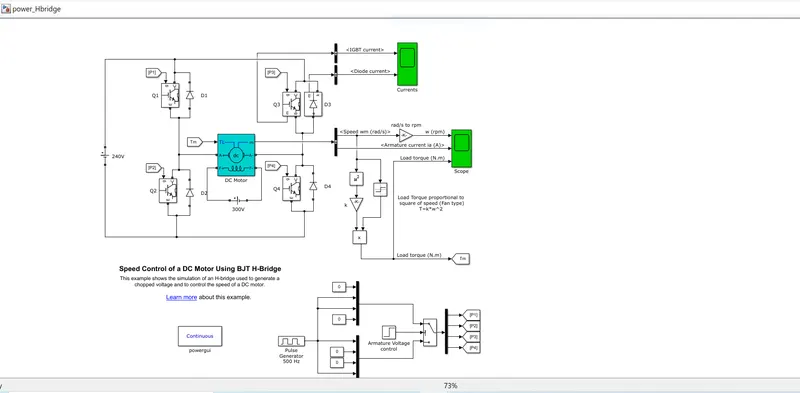
The bipolar junction transmitor(BJT) when used for power switching applications, operates as an IGBT.Where it is conducting(BJT operating in the saturated region), a forward voltage vf is developed between collector and emitter. Therefore the IGBT block can be used to model the BJT device.
The IGBT block doen not simulate the gate current controlling BJT. The switch is controlled by a simulink signal(1/0).the dc motor uses the preset model (5 HP 24V 1750RPM).It simulates the fan load ( where load torque is proportional to the square of speed) the armature mean voltage can be varied from 0 to 240v when the duty cycle (specified in the pulse generator) is varied from 0 to 100%.
The H-Bridge consists of four BJT/Diode pairs(BJT is simulated by IGBT models). Two transistors are switched simultaneously: Q1 and Q4 or Q2 and Q3.When Q1 and Q4 are fired, a positive voltage is applied to the motor and diodes D2 and D3 operates as free wheeling diodes when Q1 and Q4 are switched off. When Q2 and Q3 are fired a negative voltage is applied to the motor.
After running the results are:
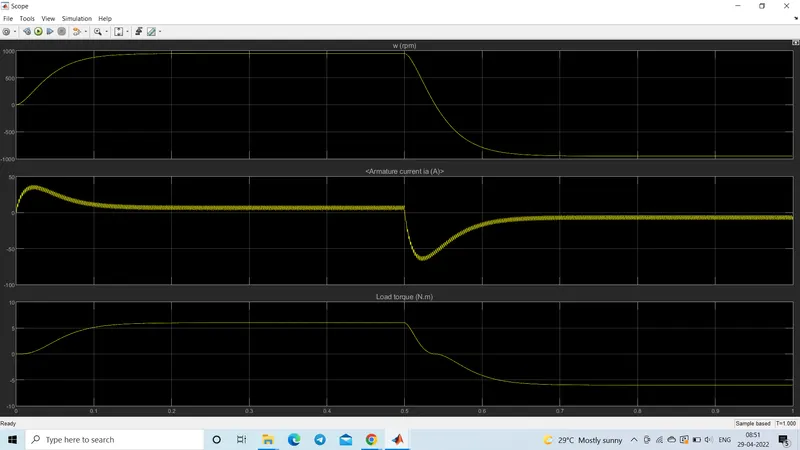
We can see the armature current changes its direction suddenly, when the speed of the motor reverses
ANS B
Duty cycle = 50%
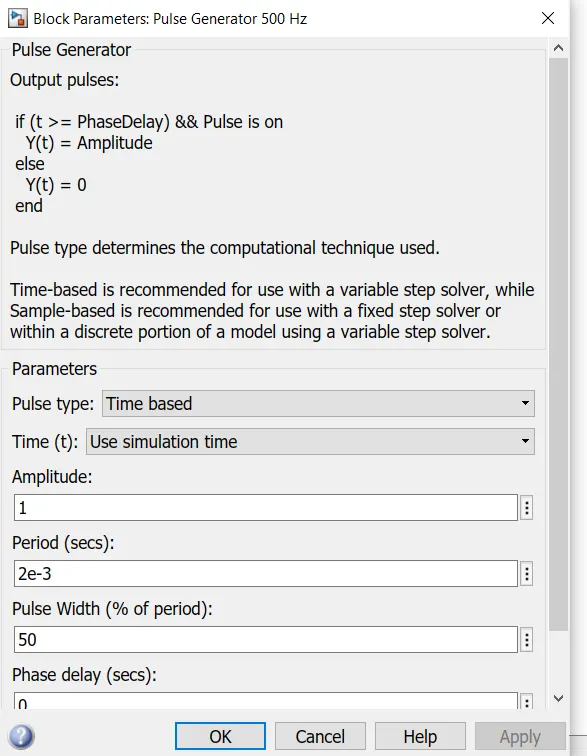
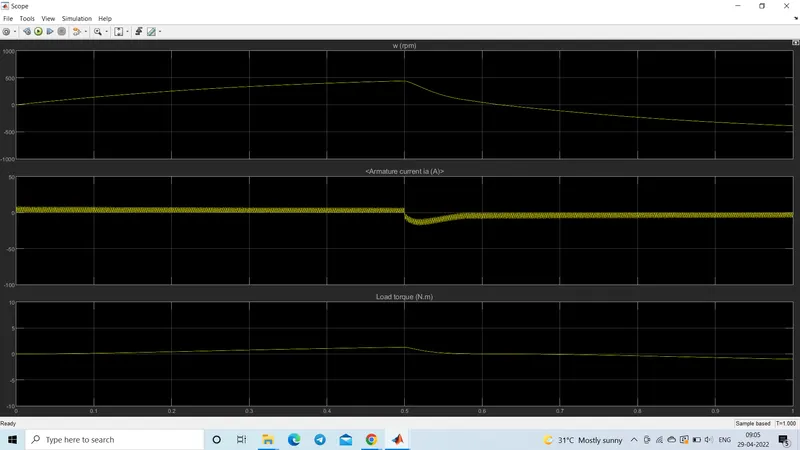
Duty cycle = 25
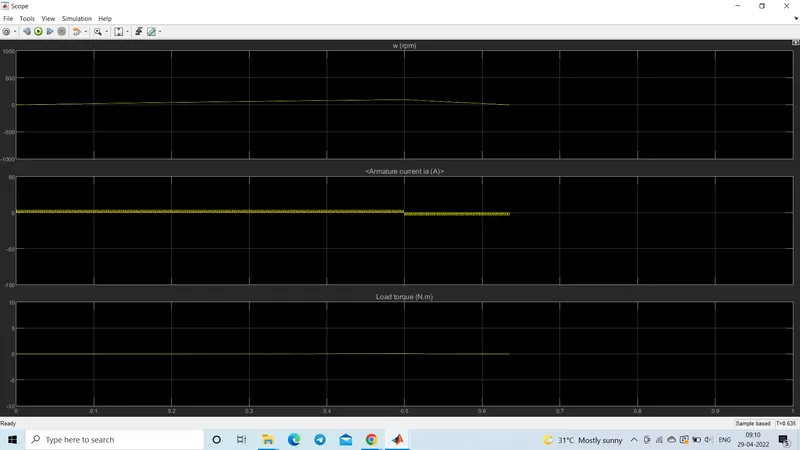
We can see the sudden shoot of armature current is reduced by changing the duty cycle i.e, the pulse modulation method.
ANS c
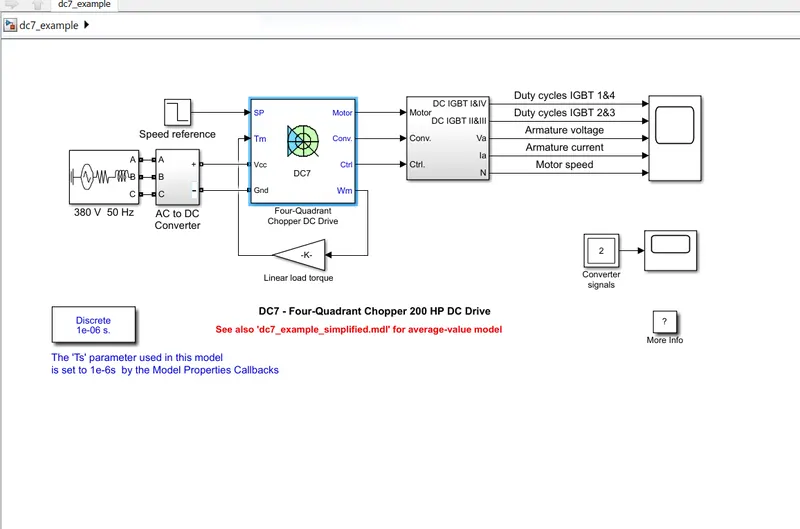
results from scope:
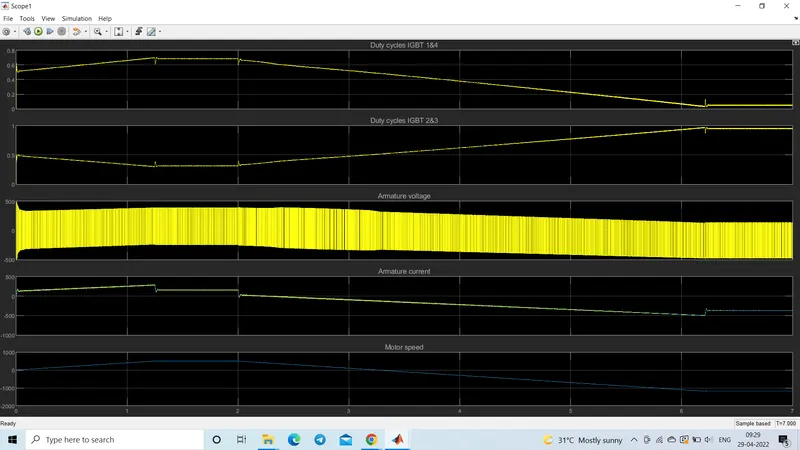
Comparison of four quadrant chopper dc drive with H-Bridge-
In four quadrant chopper DC drive distributes required current supply for each sector and it consist of four quadrants like forward Motoring, forward regenerative braking, Reverse braking, Reverse motoring and reverse regenerative braking.whereas H-bridge supplies irregular current for each sector that causes voltage fluctuation in armature current, it consists of two operations they are forward motoring, reverse motoring.
In modern battery charger for electrical vehicles,Hbridge circuits are used A four-quadrant is required in industrial as well as commercial applications.
The efficiency is high in chopper compare with H-bridge, and mainantenance is less than H-bridge.
In robotic technology H bridge circuits are used. The regenerative braking is not possible in H-bridge while in chopper it is possible.
In H bridge we need to change the polarity which turns into opposite direction to control the motor whereas in chopper model we need to interupt one signal under control of another.
ANS 3
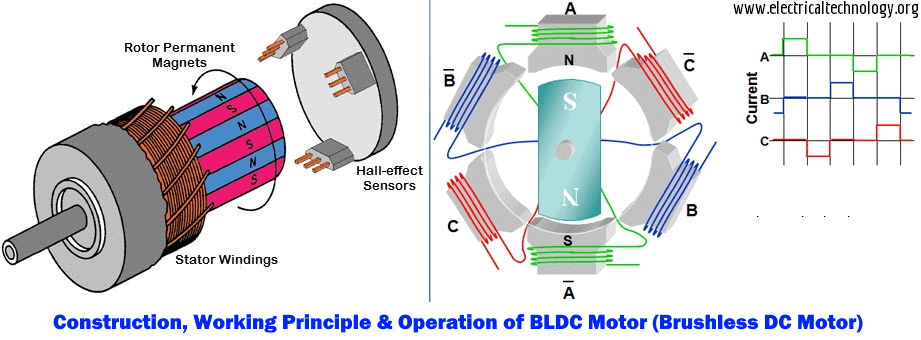
A brushless DC motor (known as BLDC) is a permanent magnet synchronous electric motor which is driven by direct current (DC) electricity and it accomplishes electronically controlled commutation system (commutation is the process of producing rotational torque in the motor by changing phase currents through it at appropriate times) instead of a mechanically commutation system. BLDC motors are also referred as trapezoidal permanent magnet motors.
Unlike conventional brushed type DC motor, wherein the brushes make the mechanical contact with commutator on the rotor so as to form an electric path between a DC electric source and rotor armature windings, BLDC motor employs electrical commutation with permanent magnet rotor and a stator with a sequence of coils. In this motor, permanent magnet (or field poles) rotates and current carrying conductors are fixed.
BLDC motor works on the principle similar to that of a conventional DC motor, i.e., the Lorentz force law which states that whenever a current carrying conductor placed in a magnetic field it experiences a force. As a consequence of reaction force, the magnet will experience an equal and opposite force. In case BLDC motor, the current carrying conductor is stationary while the permanent magnet moves.
Advantages of BLDC Motor
BLDC motor has several advantages over conventional DC motors and some of these are:
- It has no mechanical commutator and associated problems
- High efficiency due to the use of permanent magnet rotor
- High speed of operation even in loaded and unloaded conditions due to the absence of brushes that limits the speed
- Smaller motor geometry and lighter in weight than both brushed type DC and induction AC motors
- Long life as no inspection and maintenance is required for commutator system
- Higher dynamic response due to low inertia and carrying windings in the stator
- Less electromagnetic interference
- Quite operation (or low noise) due to absence of brushes
Disadvantages of Brushless Motor
- These motors are costly
- Electronic controller required control this motor is expensive
- Not much availability of many integrated electronic control solutions, especially for tiny BLDC motors
- Requires complex drive circuitry
- Need of additional sensors
Applications of Brushless DC Motors (BLDC)
Brushless DC Motors (BLDC) are used for a wide variety of application requirements such as varying loads, constant loads and positioning applications in the fields of industrial control, automotive, aviation, automation systems, health care equipments, etc. Some specific applications of BLDC motors are
- Computer hard drives and DVD/CD players
- Electric vehicles, hybrid vehicles, and electric bicycles
- Industrial robots, CNC machine tools, and simple belt driven systems
- Washing machines, compressors and dryers
- Fans, pumps and blowers