Week-11 Challenge: Braking
EV Live Batch 13
#1. For a defined driving cycle, calculate the energy required for braking.
A vehicle requires acceleration as well as deceleration. To stop the vehicle in a stipulated time we need to provide a force or enegy to oppose the motion of vehicle.
- Time and velocity of the vehicle has been initialised to Drive Cycle.
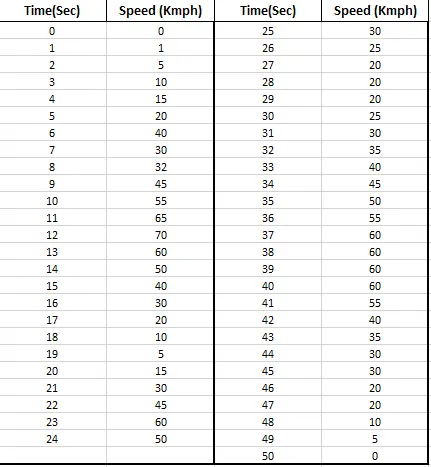
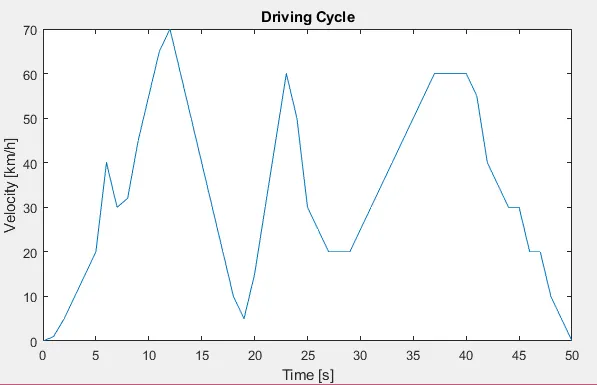
Plot of Driving cycle as per initialised values
There are two kinetic types of energy that are involved in a moving car:
Linear and rotational kinetic energy,
Linear Kinetic Energy, 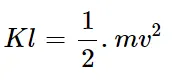 Where m - Total Mass of Vehicle, v - (Initial Velocity - Final Velocity)
Rorartional Kinetic Energy, 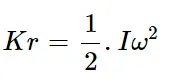
The deceleration will reduce the energy. This energy is being saved in hybrid and electrical cars as regenerative energy.
However, because of small "I" of the wheels compared to the mass of the car, the contribution of the wheel's change of energy is not significant.
Example:
To calculate the energy required for braking,
Assume the total mass of the vehicle is 500kg
Initial Velocity - 50 kmph in 14 sec
Final Velocity - 10 kmph in 18 sec
Energy require to reduce speed from 50 kmph - 10kmph in 4 second is,
Kl = 1/2 x 500 x ((50^2)-(10^2))
= 600000J
Kl = 600KJ
#2. Why electric motor can’t develop braking torque at high speed similar to starting? How electric and mechanical brakes are coordinated?
Torque - Speed Characterics of an Electric Motor
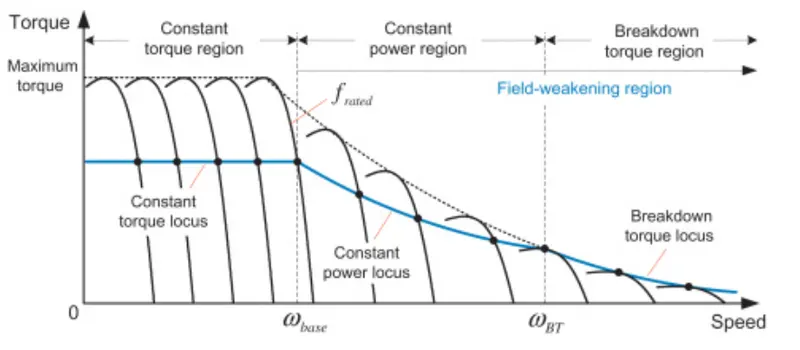
As we can see the motor is started at maximum torque for period of time, for this perios of time the motor runs at a constant torque region. After the specified period, at constatnt power region the torque of the motor reduces as speed increses. Since the electric motor cannot develop braking torque at high speed.
Electrical Braking
Electrical braking can be done in different ways such as:
- Regenerative Braking
- Plugging type braking
- Dynamic braking
Mechanical Braking
Mechanical brakes works on generating frictional forces. Frictional force is applied to shaft in eqipment drives. There are different types of mechanical rakes according to model of friction generating surfaces.
- Drum brakes
- Disc brakes
- Band Brakes
Electric and Mechanical brakes coordination
There are two types of control statergies for braking in electric vehicles.
- Series
In this model the brakes are applied one after other so that they are connected in series. Either regenerative braking or machanical braking is taken place at a time.
- Parallel
Bothe the Electric and Mechanical brakes are applied simultaniously at the same time. When the brakes are applied the front wheel friction brake and rear wheel friction brake and regenerative brakes are employed.
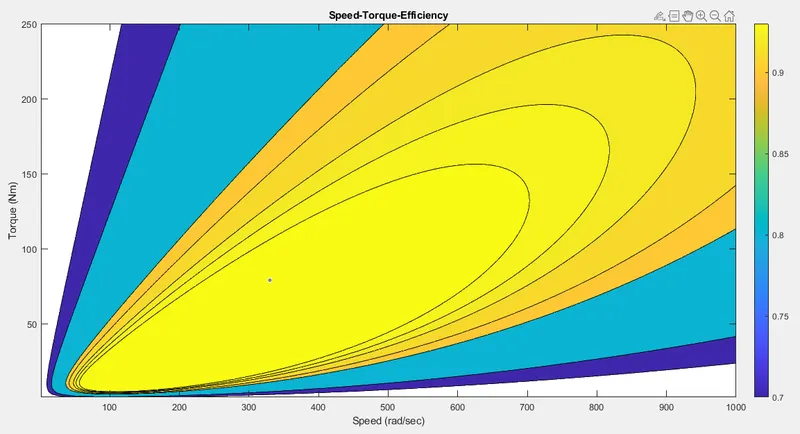
#3. Make a MATLAB program which plots contour of given motor speed, torque and efficiency values. Attach the code as a .m file attach a screenshot of all the plots.
MATLAB Program to plots contour of motor speed
clear all
close all
clc
%%
x=linspace(1,1000,250);                     %Speed in rad/sec
y=linspace(1,250,250);                      %Torque in Nm
%%
%Motor loss constants
kc=0.2;                                     %Copper loss constant
ki=0.008;                                   %Iron loss constant
kw=0.00001;                                 %Windage loss constant
Const_Loss=20;                              %Constant motor loss
%%
[X,Y]=meshgrid(x,y);                        %Converting to 2D
Output_power=(X.*Y);                        %Power = Torque x Speed
%%
B= (Y.^2)*kc;                               %Copper loss
C= X.*ki;                                   %Iron loss
D= (X.^3)*kw;                               %Windage loss
Input_power = Output_power + B + C + D + Const_Loss;
Efficiency= Output_power./Input_power;      %Eff of the motor
V = [0.70,0.80,0.90,0.91,0.92,0.925,0.93];  %Efficiencies to be plotted
%%
box off
grid off
contourf(X,Y,Efficiency,V);
contourcbar
title('Speed-Torque-Efficiency');
xlabel('Speed (rad/sec)');
ylabel('Torque (Nm)');
Plot