Week-11 Challenge: Braking
Challenge 1-
Braking Energy is somewhat equivalent for Accelerating energy. The power required for braking is basically negative acceleration power and it can be calculated just like accelerating power calculations.
deacceleration energy of the vehicle will be
power= work/time
work=`1/2*m*(underset(i)(V)^2-underset(f)(V)^2)`
This work is done by vehicle to change the velocity of vehicle from Vi to Vf.
consider a driving cycle......
The following drive cycle is followed by a vehicle, having following constraints,
curb weight= 500kg
payload = 100kg
angular acceleration effect = 5%
effective weight = (500+100)*1.05 = 630 kg
Now there is three cases where deacceleration occurs
1. from 6-7 sec.....
W1 = `1/2*630*(25^2-15^2)`
W1 = 126 kJoules
2. from 9-10 sec......
W2 = `1/2*630*(30^2-0^2)`
W2 = 283.5 kJoules
3. from 20-21 sec.......
W3 = `1/2*630*(50^2-0^2)`
W3 = 787.5 kJoules
Total deacceleration energy = W1+W2+W3 = 126+283.5+787.5 = 1197 kJoules
Challenge 2-
To understand the working of Electric drive in vehicle we consider a torque speed characterstics of a Typical DC motor(BLDC and induction motor also shows almost same behaviour) which has following characterstics
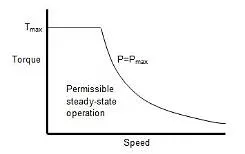
Here we can see in starting or low speed, the develop torque is maximum and constant over certain period and after that Torque will decrease as speed increases (constant power region). and this characterstics reflects in the negative torque region
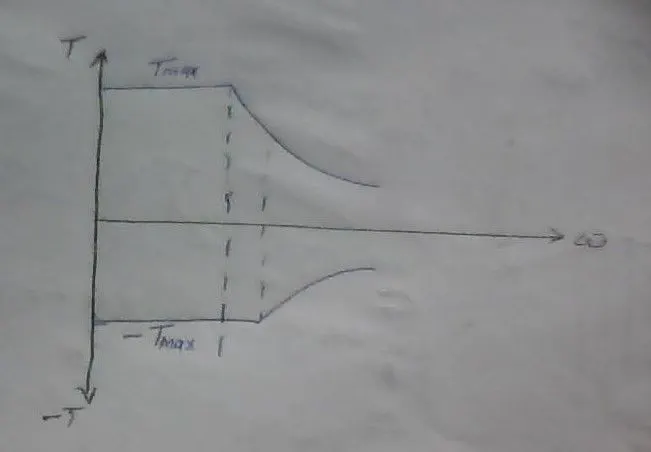
here we can see the Torque-speed charactersitcs are refelected on the negative side but Maximum torque is compermised due to battery charging current capacity(identical and opposite in case of battery charging current capacity is higher than rated current of motor).
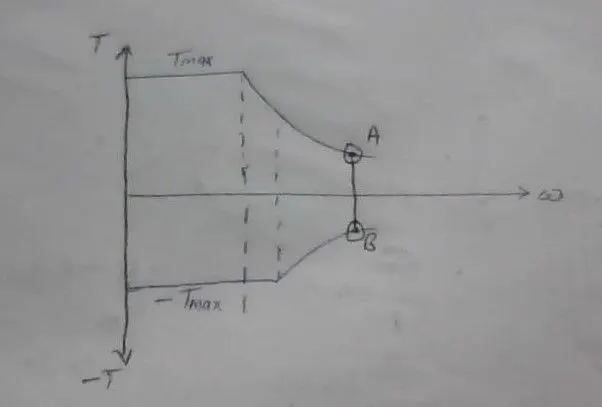
Here we can see in High speed if Braking required the operating point of motor shift from A to B in negative torque region and that is definetly less than the starting torque of the motor and after that torque increases as speed decreases and become maximum and it constant around low speed.
part- B
In order to achieve effective braking of the vehicle we have to combine Regenerative braking with mechanical brakes and have better safety and power efficiency of the vehicle. there are control stretagy for effective braking that is given below in the diagram...
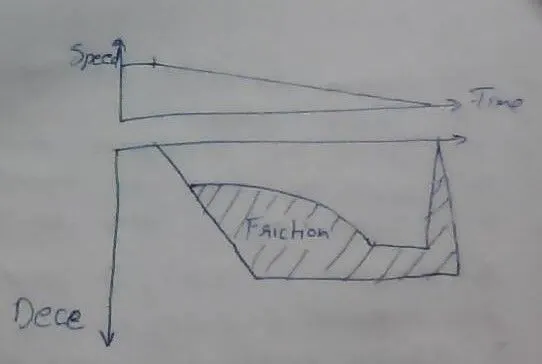
Here we can see braking period starts at high speed The unshaded area is correspond to motor regenerative braking and shaded area is correspond to mechanical or friction braking. At High speed the motor braking torque is low and increases as speed decreases but the applied braking torque(reference) is higher than the motor braking torque so the mechanical brakes are applied such that it will fullfill the required braking along with electrical braking. The priority is electrical braking as it reverse power to the battery.
Challenge 3-
The efficiency contour plots are the 2D plots that can represent the three dimentional data that is Torque, Speed and efficiency of the motor and we can easily understand the efficiency of motor for various operating conditions. The contour lines represent same efficiency depths on the 2D plot. Now we try to write a matlab code to plot Torque,Speed,efficiency contour plots.
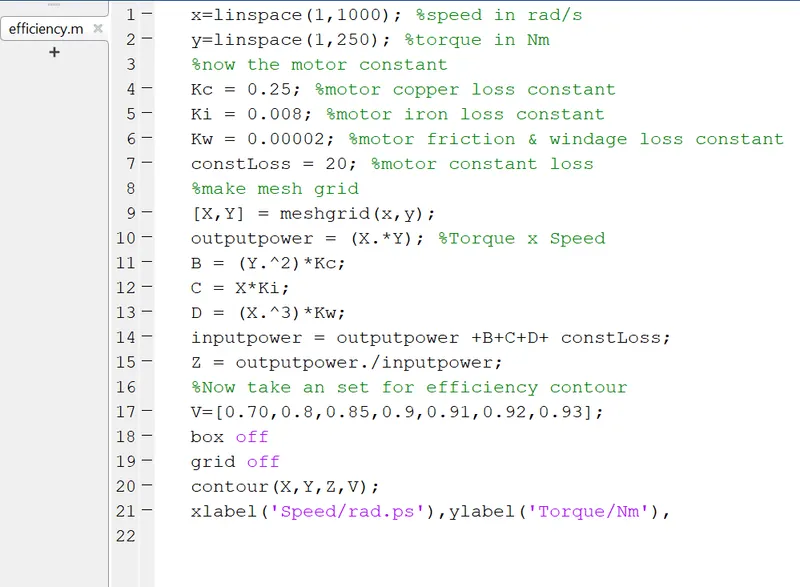
here we take 0-1000 rad/s speed and 0-250Nm of Torque as a variable and assign various motor constants for losses. here the total losses can be said as...
Total losses`=Kc*T^2+Ki*omega+Kw*omega^3+` constant losses
and the efficiency is
z = outputpower/inputpower
Now checkout the output plot of the matlab script file.
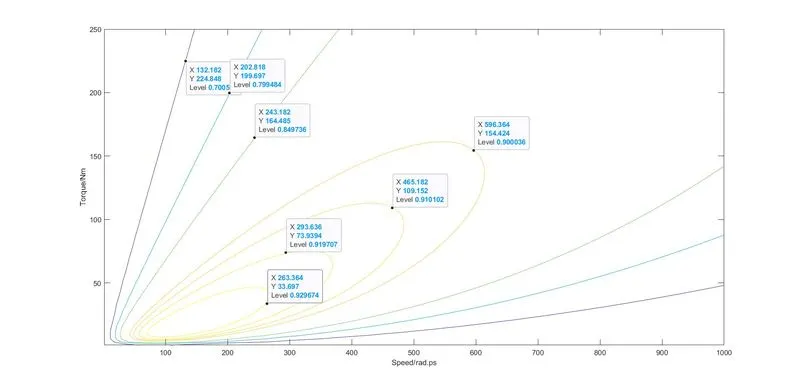
here we can see that the maximum efficiency of the motor occurs around 200 rad/s and 25 Nm Torque.