Week-11 Challenge: Braking
1. To calculate the energy required for braking for a defined driving cycle.
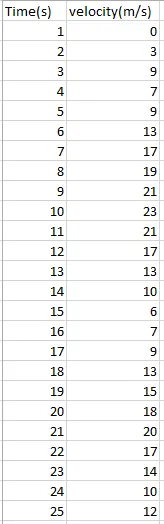

From the values in the sheet, a Drive cycle is simulated
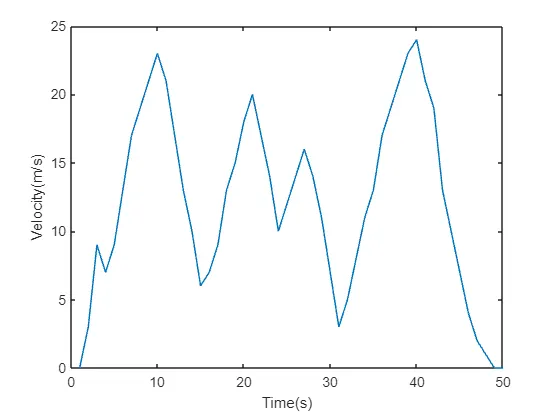
The kinetic energy used for braking is
K.E = (1/2) * M * (Vi - Vf)²
K.E - Kinetic energy (Joule)
M - Mass (Kg)
Vi - Initial velocity (m/s)
Vf - Final velocity (m/s)
To calculate the Braking energy for the above drive cycle
| Initial velocity(m/s) | Final velocity(m/s) | Braking Energy(J) |
| 9 | 7 | 500 |
| 23 | 6 | 4250 |
| 20 | 10 | 2500 |
| 16 | 3 | 3250 |
| 24 | 0 | 6000 |
Total braking energy for the implemented drive cycle = 500+4250+2500+3250+6000
= 16500 J or 16.5 kJ
2. To explain the reason for electric motor cannot develop braking torque at high speed similar to starting and to explain how electric and mechanical brakes are coordinated
Electric Motor cannot develope braking torque at high speed:
Regenerative braking allows electric vehicles to use the motor as a generator when the brakes are applied. To convert vehicle energy into electrical engergy, that will be be stored in an energy storage device. Regenerative braking is an effective approach to extend the driving range of an EV. The regenerative braking torque cannot be made large enough to provide all the required braking torque of the vehicle as it might lead to the deterioration in stability of the vehicle. When compared to the torque values, acceleration torque of motor is much higher than decceleration torque. At high speed, the motor will be in its constant power region which causes less values of torques produced and this limits the amount of braking torque that is used for regeneration. Hence the peak value of accleration torque and braking torque are not equal.
Electric and Mechanical brakes Co-ordination:
The regenerative braking system cannot be when the State of Charge (SOC) is high, temperature of the battery is high. In these cases, the mechanical braking system works to cover the required total braking torque.
Thus, cooperation between the mechanical braking system and the regenerative braking system is the main part of the design of the EV braking control strategy and is known as torque blending.
There are 2 different control strategies for Braking Combinations.
1. Series Control Strategy
2. Parallel Control Strategy
Series Control Strategy:
It is a combination of friction-based mechanical braking system with a regenerative braking system that transfers energy to the battery with an integrated control, which distributes the required braking force between the regenerative braking system and the mechanical braking system. Series control strategy can increase the fuel efficiency upto 30% and has more consistent braking due to good torque blending capability.
Parallel Control Strategy:
It is a combination of mechanical and the regenerative braking system, operated simultaneously without an integrated control. The regenerative braking force is added to the mechanical braking force which cannot be controlled. The regenerative torque is determined by considering the motor capacity, battery SOC, and vehicle velocity. The regenerative braking force is calculated from the brake control unit by comparing the required brake torque and the motor torque available.
3. To create a MATLAB program to plot contour of given motor speed, torque and efficiency values.
Formula used:
w - Angular speed
T - Torque
Copper loss Pc = kc *(T^2)
Kc - Copper loss constant
Iron loss Pi = ki * w
ki - Iron loss constant
Windage loss Pw = kw * (w^3)
kw - windage loss constant
Input power Pin = Pc + Pi + Pw + C
C - Constant loss
Output power Pout = T * w
Efficiency n = Pout / Pin
MATLAB script:
Output:
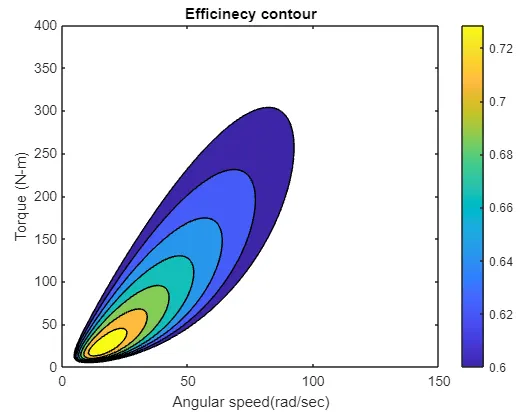
From the Toque, Speed and Efficiency contour, increase in angular speed and Torque results in decrese in the efficiency. The Efficiency is higher in the low speed and torque values.