Week-11 Challenge: Braking
For a defined driving cycle, calculate the energy required for braking.
Braking system in EVs: Braking in EV is done by 2 ways, regenartive braking and mechincal braking.
For a calucation of braking energy, we need to study the drive cycle of the particular vehicle.
To finding the braking energy from x kmph to zero kmph for a vehicle BREAKING ENERGY is given by = 0.5*mass of the vehicle*(vf^2-vi^2).
where vf is final velocity and vi is the intial velocity in m/s.
To convert into kwh, divide by 3600 to KJ.
For this type of custom drive cycle made in excel sheet. The following braking energy is plotted below.
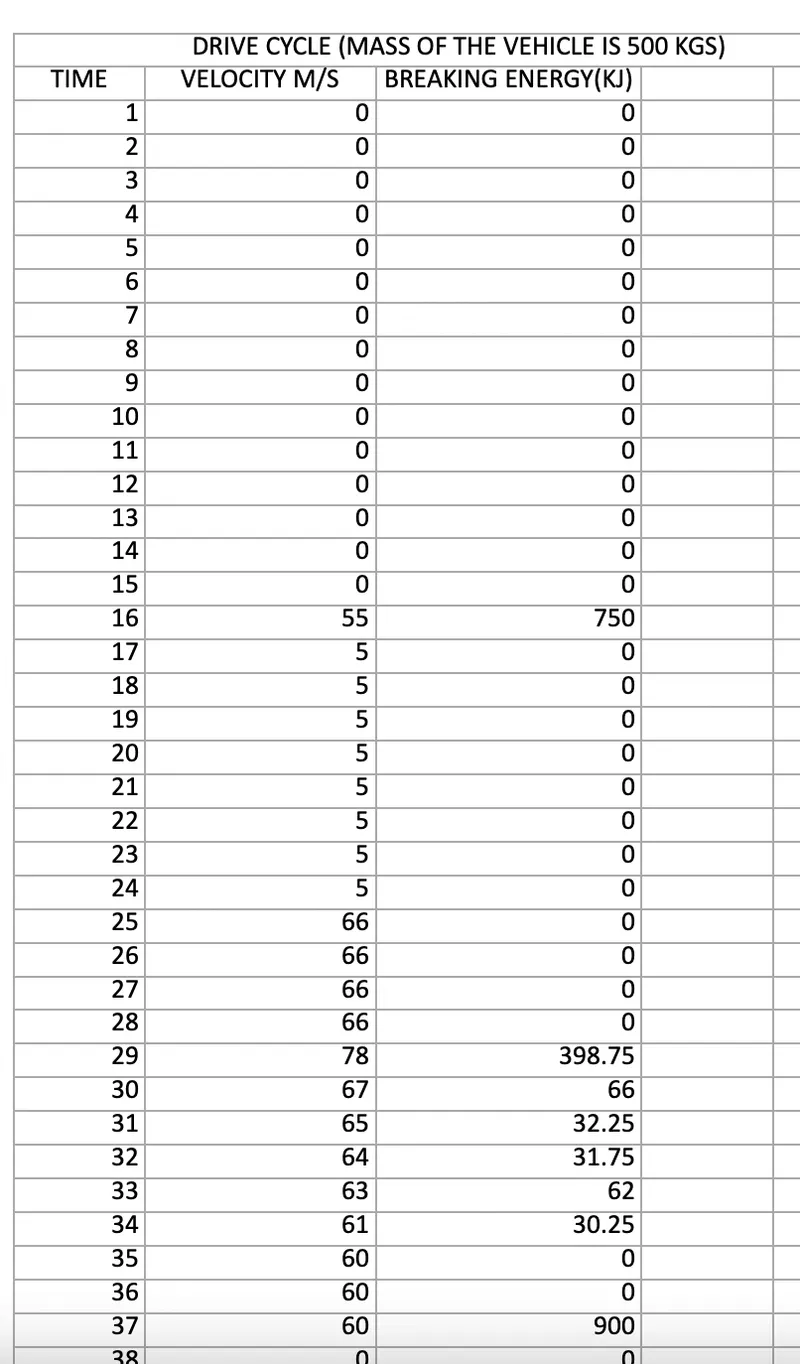
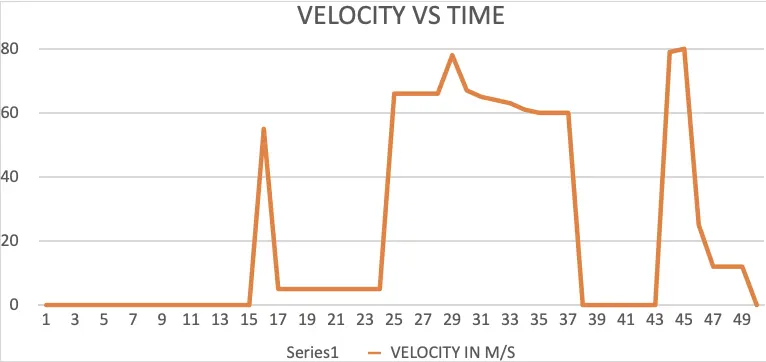
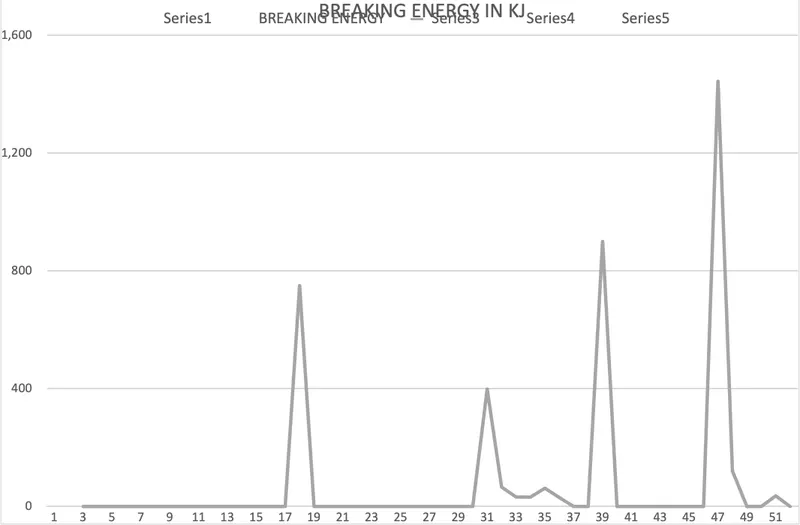
The following data excel sheet is uploaded for the review.
The total braking energy required for this drive cycle is3870.75 KJ and is equal to 1.0752kwh.
Why electric motor can’t develop braking torque at high speed similar to starting? How electric and mechanical brakes are coordinated?
At starting induction current is high which results in mataining high torque in the rotor which the motor cannot develop braking torque and it is similar at high speeds the torque is low but the speed of the vehicle maintains the flows which results into not developing the braking torque .
we know that,
BRAKING IN ELECTRIC VEHICLES ARE DONE BY two ways 1) Regenarative braking 2) mechanical braking.
Depending upon the vehicles operation, both braking are used.
REGENERATIVE BRAKING: Regenerative braking often used in electric vehicles commonly. In this braking a negative torque is developed to stop vehicle from moving. During conventional brakes the braking energy is lost due to friction applied to the wheels. In regenerative braking the wasted energy is converted and restored into battery which makes motor eventually stops the vehicle.
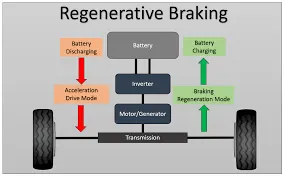
The level of regenerative braking is limited due to the high rate of charge transffered to the battery causes damage to the vehicle. So, both electrical brakes(regeneartive brakes) and mechanical brakes are used to stop the vehicle. Therefore both braking system works together to stop the vehicle very smoothly and efficiently.
Both regenerative braking and mechanical brakes are used in proposion during the breaking period. Generally when the vehicle is in high run then 40% of regen and 60% of friction brakes are used. Mostly in lower speeds, regen brakes make the work done.
Electric brakes and friction brakes are co ordinated in two ways
1) series
2) parallel
1) In series modes, one after the another are applied in that particular conditions.
2)In parallel modes, both are applied simuntaloesy which leads to sudden stop in the vehicles.
Nissan has developed a new braking system called electric driven intelligent brake
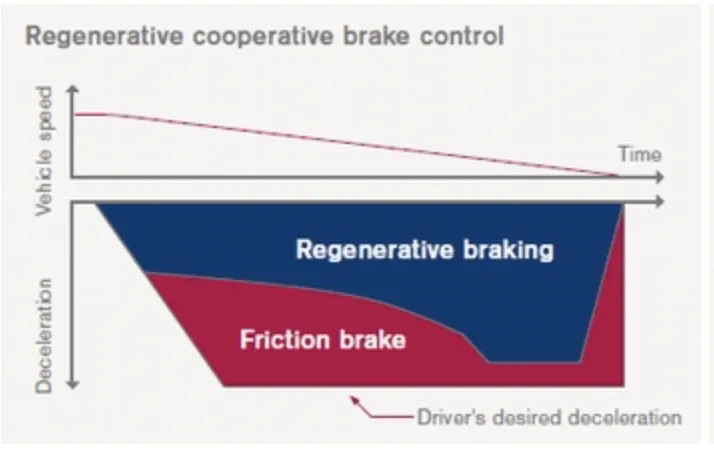
It controls both friction brakes and regen brakes that corresponds to the operation. It also controls the level of regen during the brake period.
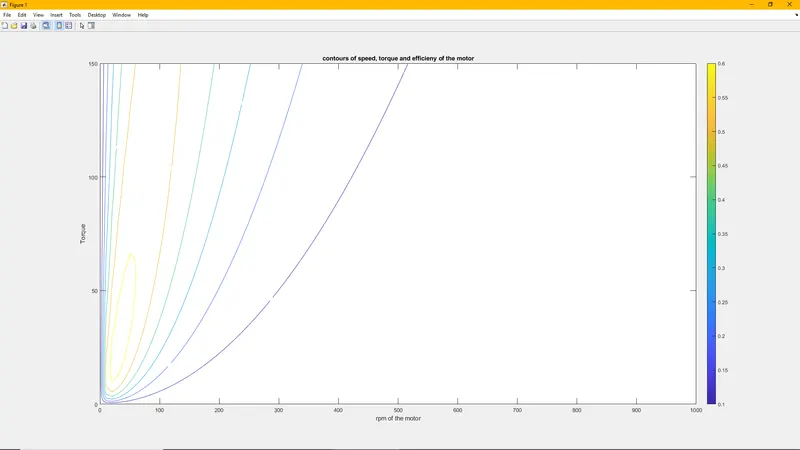
Make a MATLAB program which plots contour of given motor speed, torque and efficiency values. Attach the code as a .m file attach a screenshot of all the plots.
For finding the efficiency we need to know the INput power and the output power.
The output power can be calaculated by W*T( speed and the torque).
The input power is equal to output power + losses
losses includes copper losses, iron constant losses, windage losses and friction.
MATLAB CODE
ki= 0.05;%iron loss constant%
kc=0.346;%copper loss constant%
kw=0.005;%windage loss constant%
constant= 50;%constant losses%
w= linspace(0,1000);% rpm of the rotor varies from 0 to 1000 rpm%
T= linspace(0,150);%Torque%
[w,T]= meshgrid(w,T);%meshing into matrix%
Pout= w.*T;%output power%
pc= kc*(T.^2);%copper loss%
pio= kc.*w;%iron loss%
pw= kw*(w.^3);%windage loss%
ploses= pc+pio+pw+50;%Total losses%
Pin= Pout+ploses;% input power%
eff= Pout./Pin;%efficient of the motor%
contour(w,T,eff);%plotting contour %
colorbar;
title('contours of speed, torque and efficieny of the motor');
xlabel('rpm of the motor');
ylabel('Torque');