Project-1: Powertrain for aircraft in runways
Part A:
1. Search and list out the total weight of various types of aircrafts.
2. Is there any difference between ground speed and air speed?
3. z4. How an aircraft is pushed to runway when its ready to take off?
5. Learn about take off power, tyre design, rolling resistance, tyre pressure, brake forces when landing.
AIRCRAFT: The machine that able to fly with the support of the air that counters the gravity of weight and dynamic pressure.
Examples of aircrafts are airships, helicopters, aeroplanes,gliders and hot ballons etc .. are commonly called as aircrafts.
MANUFACTURES'S EMPTY WEIGHT:
It is the weight of the aircraft "as built" and includes the weight of the structure, power plant, furnishings, installations, systems and other equipment that are considered an integral part of an aircraft.
This excludes any baggage, passengers, or usable fuel.
Zero-fuel weight (ZFW)
This is the total weight of the airplane and all its contents (including unusable fuel), but excluding the total weight of the usable fuel on board.
As a flight progresses and fuel is consumed, the total weight of the airplane reduces, but the ZFW remains constant.
Maximum zero fuel weight (MZFW) is the maximum weight allowed before usable fuel and other specified usable agents (engine injection fluid, and other consumable propulsion agents) are loaded.
Operating empty weight (OEW) (Roughly equivalent to basic empty weight on light aircraft)
It is the basic weight of an aircraft including the crew, all fluids necessary for operation such as engine oil, engine coolant, water, unusable fuel and all operator items and equipment required for flight but excluding usable fuel and the payload.
It is the carrying capacity of an aircraft. It includes cargo, people, extra fuel. In the case of a commercial airliner, it may refer only to revenue-generating cargo or paying passengers.
Maximum takeoff weight (MTOW)
This is the maximum weight at which the pilot of the aircraft is allowed to attempt to take off.
Regulated takeoff weight (RTOW)
Depending on different factors (e.g. flap setting, altitude, air temperature, length of runway), RTOW or maximum permissible takeoff weight varies for each takeoff. It can never be higher than MTOW.
Maximum landing weight (MLW)
This maximum weight at which an aircraft is permitted to land.
The following image depicts takeoff weight components.
Maximum ramp weight (MRW)
also called maximum taxi weight (MTW)
It is the maximum weight authorized for maneuvering (taxiing or towing) an aircraft on the ground.
It is the total aircraft weight at any moment during the flight or ground operation. This decreases during flight due to fuel and oil consumption.
TYPES OF AIR CRAFTS AND THIER WEIGHTS:
- TURBOPROP
- PISTON
- JETS
- NARROW BODY
- WIDE BODY AIRLIINERS
- REGIONAL
- COMMUTER LINERS
- AIRBUS
- CONCORDE
- TUPOLEV TU 144
- MILITARY
- FIGHTER
- WATER BOMBER
- MARITIME PATROL
- MUTLI ROLE COMBAT
- TRANSPORT
DIFFERENCE BETWEEN GROUND SPEED AND AIR SPEED :
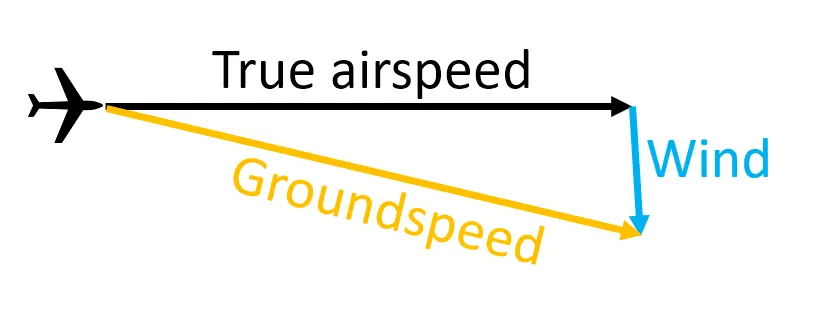
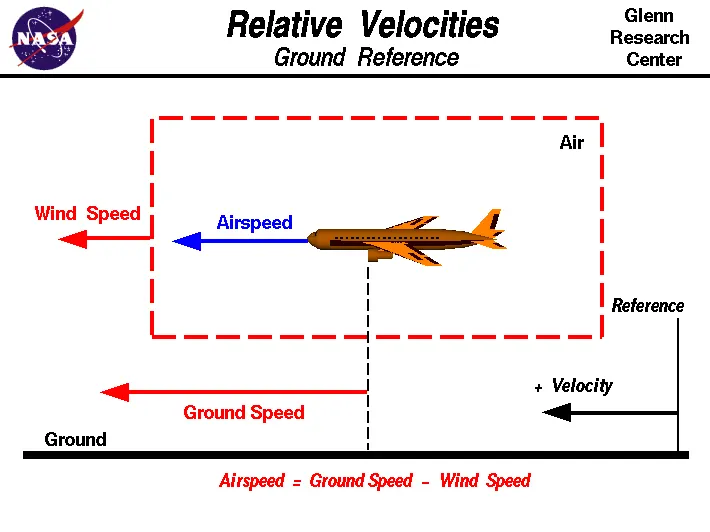
Air speed: It is the speed at which aircraft moves in stand/air still position.
Ground speed: Ground speed is same as the air speed. when wind blows in the direction of the air craft then the overall speed of the vehicle increses then the condition is called tailwind.. and if the the wind blows opppsite to the air craft then the overall speed of the aircraft decreases. Let say, when no wind condition: Air speed is equal to Ground speed. Air speed remains constant , it is irrespective of the ground speed. The ground speed changes with the direction of the wind.
The ground speed is calucalated by the vector addition of wind speed and the air speed.
 \..
\..
.,
why it is not required to use aircraft powee engine to move it on the ground:
The blasts from the engine can damage the buildings nerby and create maasive heat.
engines can blow or suck in sand and other waste materials to damage the turbines in the wings.
The plane engines are very loud.
It is difficult to navigate the huge structures. The pilots are not having direct visible from the front.
Aircrafts are usually pushed to runways by using trucks for reversing the air crafts.It is mainly used to reverse the vehicle from the terminl area. mostly ground vehicles are used to navigate the air planes untill it get back to the path.
Learn about take off power, tyre design, rolling resistance, tyre pressure, brake forces when landing:
Thrust, friction and the areo drag are the main reasons to accelerate the aircraft to fly.
THRUST: It is produced by the engine power to move forward.
DRAG: It is the aero drag that opposes the motion of the moving body.
RESISTANCE: It is due to the contact betwwen the ground and the wheels.
When thrust force dominates the drag and the resitance then the plane moves forward.
therefore , T-D-R= M*Dv/Dt.
where, M = mass of the airplane
v= velocity of the ground speed.
T= thrust force
D= Air drag force
R = rolling resistance force.
Therfore the take off power is force* velocity
= (T-D-R)*velocity
where S is the displacement of the runway to take off.
Braking forces in landing:
In the landing time, the touching velocity should be equal to stall velocity. The aim is to bring down velocity to zero in the short distance and the short time.
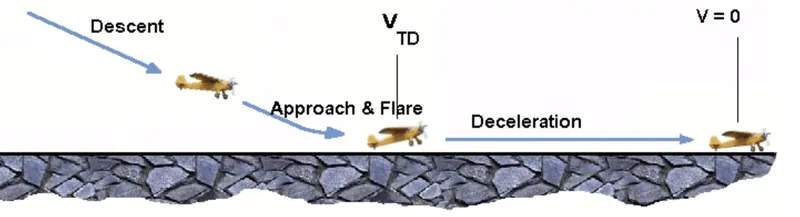
This is achieved by braking and the reverse thrust.
Therefore the total equation is -m*dv/dt = T+D+R
where T is the reverse thrust while landing.