Week-11 Challenge: Braking
1) For a defined driving cycle, calculate the energy required for braking.
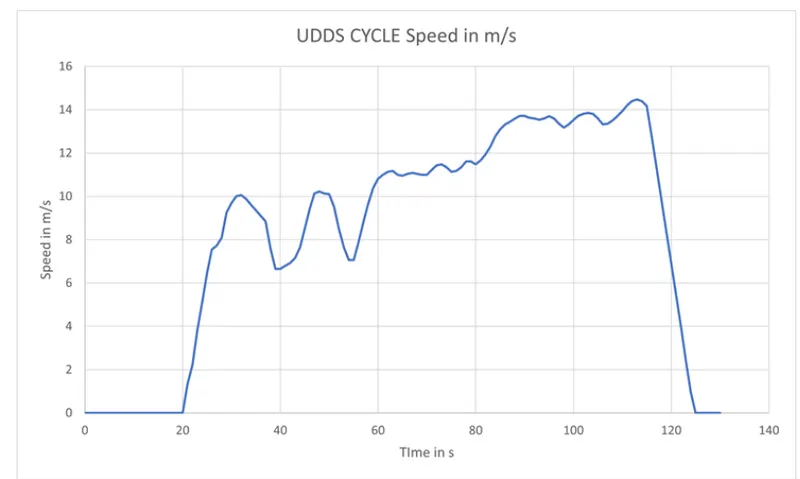
Drive cycle taken inot consideration is UDDS i.e Urban Dynamometer Driving Schedule. The drive cycle is given below.
Braking is calculated by the equation of the kinetic energy.
E=(1/2)mv²
here velocity is to be from final to initial.
E=(1/2)m(Vi-Vf)²
where,
m=mass of vehicle in Kg.
Vi=initial speed of the vehicle in m/s.
Vf=final speed of the vehicle in m/s.
The mass is set for 1500Kg and let us take 10 braking points in excel calculater.
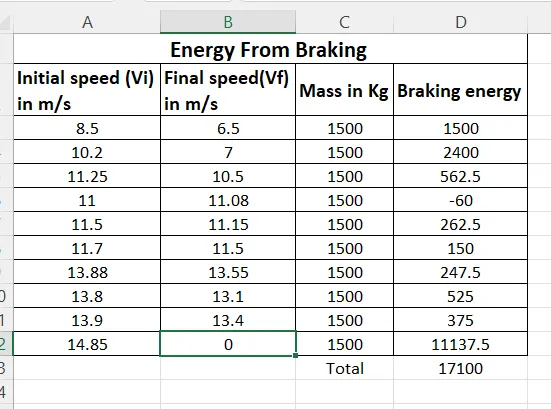
so the total energy requied for braking is 17.1KW
2) Why electric motor can’t develop braking torque at high speed similar to starting? How electric and mechanical brakes are coordinated?
Brakign is as important as acceleration for a vehicle. If we consider the electric motor application in the EV vehicles, braking of motor itself is the braking of the vehicle.
Let us consider the torque speed characteristics:
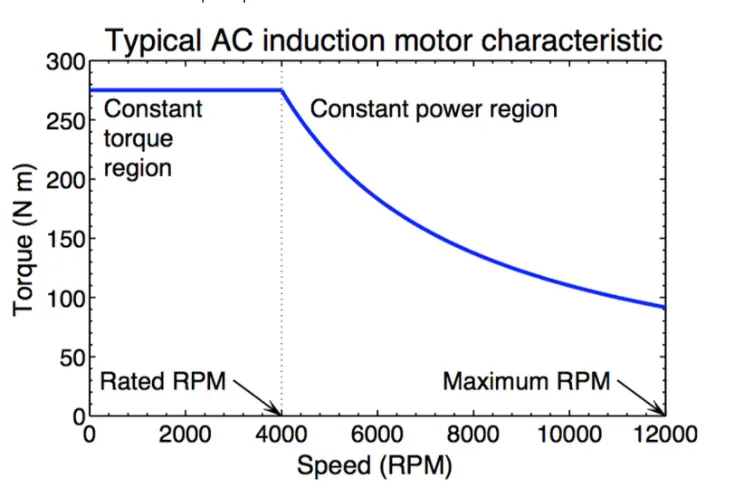
We can see from this curve, two regioins are available, constant torque region and constant power region. At the start motor achieves peak torque till the motor reaches to a certain point and takes a rapid drop. This is due to the motor shaft reaching critical speed and the region where the peak torque is constant is known as constant torque region of motor. And the region where the torque starts dropping is know as constant power region.
As we see the torque produced at the constant power is region very low, it is not possible to produce enough breaking at this region. braking torque starts increasing as the speed decreases.
In electrical vehicle, two types of braking systems are used.
- Electrical braking system
- Mechanical braking system
The coordination between electric and mechanical braking is explained by the brake force distribution between two. The brake force is distributed keeping the safety and dirve direction in consideration. We have understood by the torque speed curve, electric braking is possible at low speed with electric torque but in high speed combination of both electric and mechanical brakes is applied to make the speed zero. In high speed sharp changes in electric torque can cause friction, so for required braking proper combination and coordination of mechanical and electric brake is very important.
The combination of Electric and Mechanical brake can be connected in series and parallel connection. At low speed applying electric brake increases regeneration and at high speed combination braking is required.
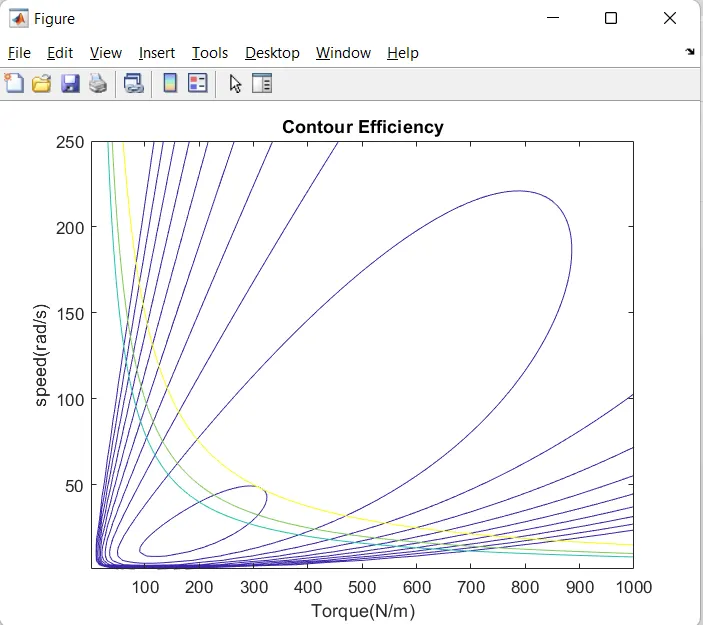
3) Make a MATLAB program which plots contour of given motor speed, torque and efficiency values. Attach the code as a .m file attach a screenshot of all the plots.
Considering the constants
Copper loss kc=0.2
Iron loss ki=0.008
Windage loss=0.00001
Constant loss C=20
%Plot contour effiiency of motor
close all
clc
%define torque, speed values
V=linspace(1,1000);
T=linspace(1,250);
%constant inputs
k_c=0.2; %copper loss constant
k_i=0.008; %iron loss constant
k_w=0.00001; %windage loss constant
c=20; %constant loss
%make meshgrid
[V,T]= meshgrid(V,T);
%calculation
c_l=k_c*(T.^2);
i_l=k_i*V;
w_l=k_w*(V.^3);
t_l=c_l+i_l+w_l+c;
%power output
p_out=T.*V;
%power input
p_in=p_out+t_l;
%efficiency
n_c=p_out./p_in;
%efficiency values
n=linspace(0.70,0.95,10);
%plot contour
%box off
%grid off
contour(V,T,n_c,n);
xlabel('Torque(N/m)')
ylabel('speed(rad/s)')
title('Contour Efficiency')
%power
p=[8000,10000,15000];
hold on
contour(V,T,p_out,p);