Week-11 Challenge: Braking
Aim:
- To calculate the energy required for braking for a defined driving cycle.
- To understand the analogy of the development of braking torque of electric motors at high speed similar to starting and the coordination of electric and mechanical brakes?
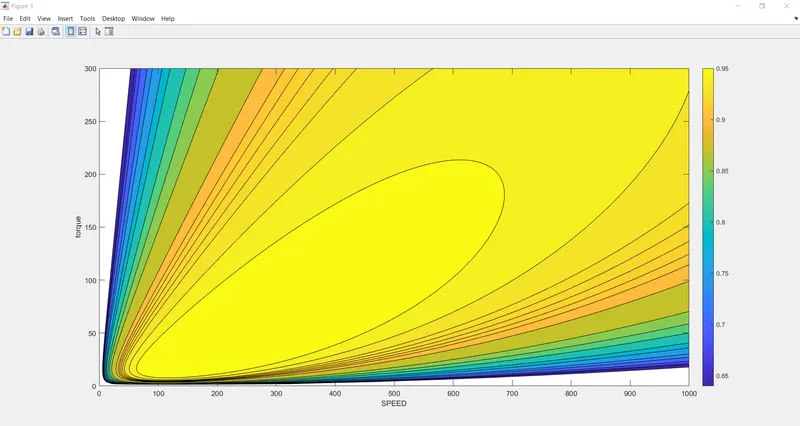
- To develop a MATLAB program that plots the contour of given motor speed, torque, and efficiency values.
Solution 1:
Case 1: Considering the velocity of a vehicle from 63 sec to 74 set
• Kerb Weight-800 kg
• Pay load - 400 kg
• Total weight-1200 kg
• Initial Velocity (V_i) - 80 kmph - 22.22 m/sec
• Final Velocity (V_f) = 0 kmph
• Time taken to decelerate the vehicle - 11 sec
Energy required for braking (E):
`E = 1/2 * m * (V_i - V_f)`
` = 1/2 times 1200 times (22.2-0)`
` = 13320kg`
`E = 13.320kJ`
Force required for braking (F):
`F = m-d (N)`
`F = 1200 * frac{22.2-0 11}{11}`
`F = 2.42kN`
Power required for braking (P):
`P = F * (V_i - V_f)`
`P = 2.42 * 22.2`
`P = 53.72kW`
Solution 2:
Braking is the change in the motion of a vehicle from a starting speed level to a lower speed level The act of braking, sustained for a sufficient time can either bring a vehicle to a slower speed than it started with or it can bring it to complete rest. So, the act of braking brings about deceleration which is a decrease in the speed of the vehicle over a period of time that corresponds to the speed values at those times Braking is an act that is desired in speed control applications and in the case of vehicles they are very much necessary to ensure the safety of the driver and the control of the vehicle. There are several methods for performing braking in vehicles whether they are conventional vehicles or HEVs/EVs.
Mechanical Braking
In a conventional IC engine vehicle, there is only one physical braking mechanism that can be performed and that is done with the bake pad/discs. The braking pedal is pressed by the driver, which results in the application of the brake pads/discs onto the wheels of the vehicle The fiction that arises between the rotating wheels and the stationary brake pads/discs will decrease the speed of the vehicle Another method of braking in conventional vehicles is called "engine braking in this method the throttle (accelerator pedal) is released, and the gear is changed to a lower gear (in manual transmission vehicles), which will result in the deceleration of the vehicle. This occurs via the "manifold effect whereby, the releasing of the accelerator pedal leads to the stopping of the fuel flow to the engine cylinder. This also stops the airflow resting in a negative traction torque in heavy-duty vehicles eg trucks, lorries, engine braking is very useful because it helps to prevent the high heat build-up in the brake pads/discs which would be generated if they were only used. So, engine braking is useful as it allows for the desired control while reducing wear and tears on the physical braking mechanism
Electric Braking
In motors and HEVs/EVs various methods of braking exist. One method is using a brake motor which consists of a DC rectifier a magnet. springs and a friction disc. The mechanism of the brake motor involves the rectifier giving a signal to disrupt a magnetic field which will influence the springs to expand and apply a force on the friction discs which will come into contact with the moving part that is in contact with the rotor. When the vehicle is accelerating or moving with constant speed, the motor still receives its 3-phase AC supply from the inverter and so the brakes are not applied This DC rectifier relays no signal to the magnetic field so that the springs stay in their stationary position and do not force any contact on to the friction discs. However, when the vehicle is not accelerating, the 3-phase AC supply from the inverter is cut off, causing the brakes to be applied. The DC magnetic field is disrupted by an air gap which causes the springs to get excited and expand and apply force to the friction disc to produce braking action.
EVs and HEVs have the brilliant feature of "regenerative braking" which is where during the act of braking the motor begins to operate as a generator and instead produces electrical energy. Essentially, when a vehicle decelerates the change in the kinetic energy of that vehicle is used to produce a torque on the motor thereby producing electrical energy via the generator effect which can be stored by the battery or be diverted for another powering purpose. The electricity generated by the regenerative braking phenomenon is referred to as the back end because it produces a current that travels in the opposite direction to the conventional current For regenerative braking to occur, the rotor of the motor has to rotate at a speed that is greater than the synchronous speed. This will result in the back emf being greater than the terminal voltage so that the potential difference is strong enough to influence the current to flow in the opposite direction Using regenerative braking not only decelerates the vehicle but also increases the efficiency and the energy savings of EVs and HEVs.
Another method of braking in EVs and HEVs is referred to as "dynamic braking in this method of braking, the supply voltage powering the motor is disconnected and instead, a resistor is connected. The absence of the resistor would result in significant fictional and windage losses which would decrease the efficiency of the vehicle and lead to longer braking times. This is not desirable because a good brake needs to bring the vehicle to rest within a certain amount of time and done in a safe manner. With the resistor fitted instead, the braking time can be reduced significantly.
In addition, another braking method in motors and EVHEVS is referred to as "terminal voltage reversal in this method of braking, two separate voltage sources are used with different polarities as well as a switch. When the motor is running normally, the first voltage source is the main supply of power to the motor and creates a current flow in the conventional current. When the braking action is desired the wish is closed to connect the second voltage supply into the circuit and disconnect the first voltage source. Because the second voltage source has a reversed polarity, the current flow in the circuit to the motor is reversed thereby slowing the motor down by making its rotor rotate in the reverse direction ie negative torque. This method is not always preferred due to the fact that it produces severe braking and generates high levels of braking torque. So, a braking resistor is also used in the circuit and will come in to use wherever the second voltage source is connected to power the motor
Control Strategies
From these various braking methods, it is obvious that both mechanical and electrical braking is useful and both have their benefits and drawbacks In regards to a vehicular application, depending on the type of vehicle either one of both types is utilized. In the case of conventional vehicles, only mechanical braking consisting of friction braking and engine braking is utilized whereas in HEVIEVS both are utilized In HEV/EVs using both mechanical and electrical braking means that the braking application can get the advantages of both types and minimize the disadvantages as much as possible. HEVs and EVs use controls strategies for controlling the braking method and deciding which brakes to apply and when to apply them. These control strategies are referred to as braking modes and they will find a compromise between the mechanical and electrical braking methods to see which is the most efficient at its job
For instance, at lower speed levels it may be more suitable to use mechanical brakes i.e. friction braking because these brakes will be more than capable to brake the vehicle and not generating too much heat and thus will not produce too much wear and tear for the brake pad/discs. However, at higher speed levels, it would be more suitable to use electrical braking. This is because electrical braking is more effective, it won't generate nearly as much heat as mechanical brakes would Electric braking also is more efficient and energy-saving because at higher speeds, more kinetic energy will be carried by the vehicle and thus, regenerative braking can occur to convert that kinetic energy into electrical energy to be stored back in the battery. If mechanical brakes were used instead, high amounts of heat would be generated and would lead to wear and tear of the brake pads/discs over time. The high heat generation also means that the dissipation of the kinetic energy is wasted into energy that cannot be reused which reiterates its inefficiency compared to the electric brakes. In addition, the electric brakes would also be smoother more gradual, and not sudden like the mechanical brakes would which would make the braking action more comfortable and safer for the passengers.
So these control strategies Le braking modes will know from the vehicle data, which type of braking is the best to use depending on its current state of motion. There are various braking modes for different situations the vehicle may face and by utilizing these control strategies, the vehicle can be operating at the highest efficiency at all times and make the best use of the 2 braking mechanisms without damaging or sacrificing one for the other.
Braking Torque
The starting torque of a motor is the torque developed by the motor at no speed and this is a moderately high value. At high speeds, electric motors cannot develop braking torques compared to their starting torques. This is because, the greater the speed of the vehicle, the greater the braking torque that is required to brake the vehicle. This is simply because at higher speeds, more force is needed to oppose the rotation of the rotor of the motor and this means a greater torque i.e. braking torque. So, when a vehicle is traveling at high speeds, larger braking torque is needed to brake the vehicle. However, when a motor is starting, its starting torque i.e. torque at no speed is the highest torque the motor can achieve. This is because the speed-torque characteristics of a motor are characterized by a linear relationship. If we were to plot a graph of the angular speed of the rotor on the y-axis and the torque on the x-axis, the plot would show a straight line with a negative gradient. The starting torque is represented by the x-intercept of this plot in the first quadrant i.e. the forward motoring region. In this way. the torque generated by the starting of the motor will not be similar to the braking torque that is generated at higher speeds. Also, at higher speeds, the terminal voltage of the voltage source increases, and so the torque values will differ further from the starting torque.
Solution 3:
Input:
clear all
close all
clc

%define torque and speed
Torque = linspace(0, 300,150);
Velocity = linspace(0, 1000, 1000);

%Ironloss
ki = 0.002;

%copperloss
kc = 0.1;

%windage
kw = 0.00001;

%constant motor loss
c = 25;

%creating contour
[w,t] = meshgrid(Velocity, Torque);

powerout = (w.*t);

%total loss
Loss = (((t.^2).*kc) + (ki.*w) + ((w.^3).*kw) + c)

Inputpower = Loss + powerout;
Efficiency = powerout./Inputpower;

%efficiency  curve value

E = [0.64,0.67,0.68,0.70,0.73,0.75,0.78,0.80,0.83,0.85,0.87,0.90,0.91,0.915,0.92,0.925,0.93,0.94,0.95];

%creating plots:
contourf(w,t,Efficiency, E)
colorbar
xlabel('SPEED')
ylabel('torque')
zlabel('efficiency')
Output: