Week-11 Challenge: Braking
- The energy required for Braking for a defined drive cycle
Braking: - Braking is the process of applying force to stop or slow down a vehicle. A commonly used technique to break a vehicle is applying friction. Braking consumes energy it is the same as that the kinetic energy should apply for accelerating the vehicle. The energy required to stop the vehicle,
Braking Energy=(1/2)*m*v^2
Braking energy to reduce the speed of the vehicle from Vi to Vo=(1/2)*m*(Vi-Vo)^2,in kw
Consider a vehicle with a kerb weight of 750kg and a payload of 250kg the vehicle moves with a minimum velocity of zero to maximum velocity of 100kmph here we have to calculate the braking energy applied for the drive cycle is given below
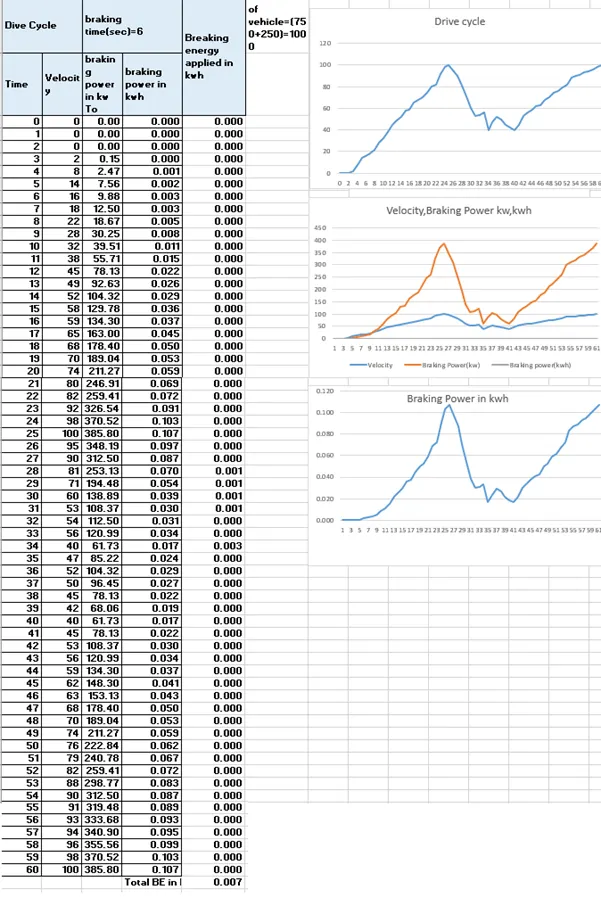
From the above drive cycle, the Braking energy applied for deceleration is 0.007kwh=7wh
- The electric motor can’t develop braking torque at high speed similar to starting
While considering the two-quadrant speed-torque characteristics of an EV motor, speed-torque characteristics are positive in the first quadrant, speed is positive and torque is negative in the second quadrant as shown in the below plot.
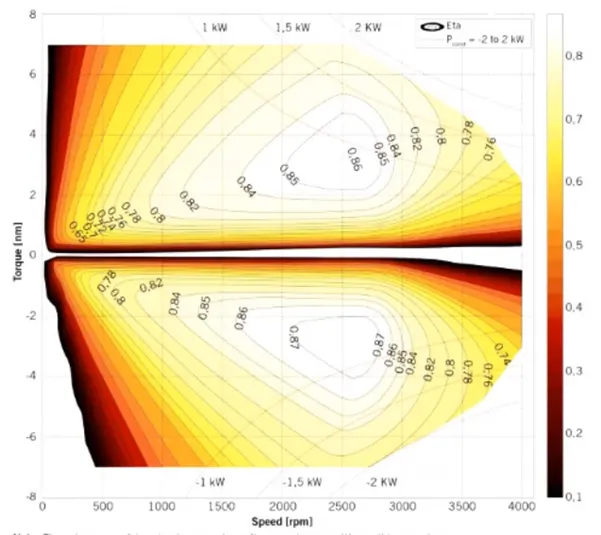
The electric vehicle achieves zero to maximum speed in seconds, low speed is in constant torque region and high acceleration is possible, but in the high speed it is in constant power region and the torque value is less. In the second quadrant (braking ) the value of torque is negative and the speed value is positive and high at the situation, hence peak acceleration torque and peak deceleration torque are not equal and the braking torque of EV is not as high as the acceleration torque.
Coordination of electric and mechanical brakes
Braking is the process of applying force or energy to slow down or stop the vehicle or motor. Most brakes use friction on the two sides of the wheel, the collective press of the wheel converts the kinetic energy of the moving object into heat. In the case of regenerative braking, it turns energy into electrical energy, which may store for later use. eddy current brakes use magnetic fields to turn kinetic energy into electrical current in the brake disc, blade, or rail, which is converted to heat.
The most common types of brakes used in modern cars are
- Hydraulic braking system
- Electromagnetic braking system
- Servo braking system
- Mechanical braking system
a)Disk brake
b)Drum brake
Hydraulic braking system: - This system runs on brake fluid, cylinders, and friction. By creating pressure within, glycol ethers or diethylene glycol forces the brake pads to stop the wheels from moving. The force generated in the hydraulic braking system is higher when compared to the mechanical braking system. The hydraulic braking system is considered one of the important braking systems for modern vehicles. The chance of brake failure is very less in the case of the hydraulic braking system. The direct connection between the actuator and the brake disc or drum makes very little chance of brake failure.
Electromagnetic braking system: - Electromagnetic braking systems can be found in many modern and hybrid vehicles. The electromagnetic braking system uses the principle of electromagnetism to achieve frictionless braking. This serves to increase the life span and reliability of brakes. Also, traditional braking systems are prone to slipping while this is backed with quick magnetic brakes. So without friction or need of lubrication, this technology is preferred in hybrids. Also, it is quite modest in size compared to the traditional braking systems. It is mostly used in trams and trains. To make electromagnetic brakes work, a magnetic flux when passed in a direction perpendicular to the rotating direction of the wheel, we see rapid current flowing in a direction opposite to the rotation of the wheel. This creates an opposing force to the wheel rotation and it slows down the wheel.
Servo Braking system: - It is Also known as vacuum or vacuum-assisted braking. Among this system, the pressure applied to the pedal by the driver is increased. They use the vacuum that is produced in petrol engines by the air intake system in the engine's intake pipe or via a vacuum pump in diesel engines. A brake where power assistance is used to reduce the human effort. In a car, an engine vacuum is often used to make a large diaphragm flex and operate the control cylinder. Servo braking system boosters are used with the hydraulic brake system. The size of the cylinder and the wheels are practically employed. Vacuum boosters increase the braking force. Pushing the brake pedal releases the vacuum on the side of the booster. The difference in the air pressure pushes the diaphragm for braking the wheel.
Mechanical braking system: - The mechanical braking system powers the hand brake or emergency brake. It is the type of braking system in which the brake force applied on the brake pedal is carried to the final brake drum or disc rotor by various mechanical linkages like cylindrical rods, fulcrums, springs, etc. In order to stop the vehicle. Mechanical brakes are mainly classified into two types Disc type and drum-type
Disc type: - The disc brake is a mechanism for slowing or stopping the rotation of a wheel from its motion. A disc brake is normally made of cast iron, but in some cases, it is also made of composites such as carbon-carbon or ceramic-matrix composites. This is linked to the wheel and/or the axle. To stop the wheel, friction material in the form of brake pads is forced against both sides of the disc. Friction caused, on the disc wheel will slow or stop.
Drum Brakes: - A drum brake is a traditional break in which the friction is caused by a set of shoes or pads that press against a rotating drum-shaped part called a brake drum. The term \"drum brake\" usually means a brake in which shoes press on the inner surface of the drum. Where the drum is pinched between two shoes, similar to a standard disk brake.
Electric and mechanical brakes are coordinated by two methods such as
Series strategy and
Parallel Strategy
Series Strategy: - in this method electric (regenerative brake )and Mechanical brakes are used one after another
Parallel strategy: - In the case of the parallel method Regenerative brakes and mechanical brakes uses in parallel
For Example: - in the case of Nissan leaf at higher speed, both regenerative braking and mechanical braking are applied together and at the condition of lower speed, only regenerative braking is applied. Here is the combination of series and parallel type braking and this type is called an Electric-type intelligent brake.
- MATLAB program which plots contour of given motor speed, torque, and efficiency values
MATLAB Script
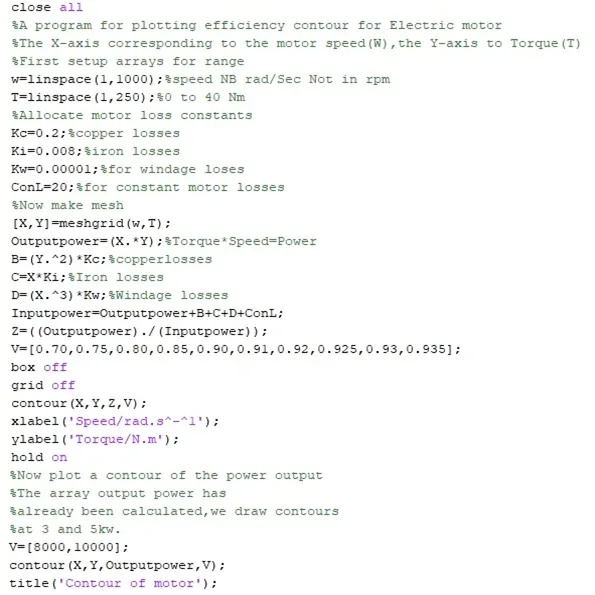
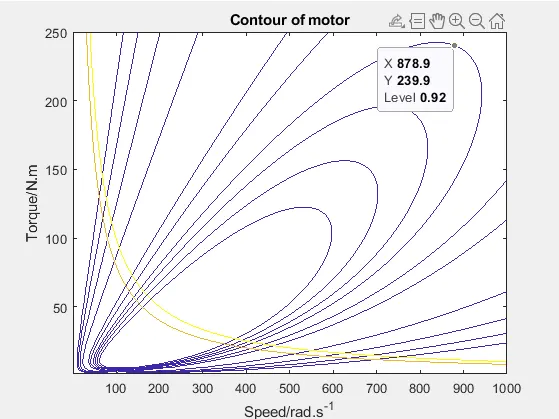
As per the above-mentioned MATLAB Script, the value in the X-axis is Torque, and the value in the Y-axis is the speed of the motor. For the speed value, it is considered in the range of 0 to 1000 rad/Sec and for the torque, it is considered from 0 to 250 Nm. The script is started with the array initiation of speed and torque then considering the losses associated with it such as copper losses, Iron losses, windage losses, and constant motor losses
Copper loses =Kc*T2
Kc is considered as constant of value 0.2 here and T is the torque value
Iron losses =Ki*w2
Ki is considered as constant with a value of 0.008 and w is the speed value
Windage loses =Kw*W3
Here the value of the windage coefficient is considered as constant and equal to 0.00001
Constant losses are assumed as a constant as 20 here,
Input power of the motor is equal to the sum of output power, and losses in the motor (such as Copper loss, Iron losses, windage losses, conduction losses)
Efficiency is calculated by dividing the value of output power by the value of input power.
And the contour is labeled as the contour of the motor and after running the script we will get the output as shown below