Week-11 Challenge: Braking
WEEK 11 BRAKING
1.For a defined driving cycle, calculate the energy required for braking.
Braking is the process of controlling the velocity of an object by inhibiting its motion. An object in motion possesses kinetic energy and to bring the object to a stop this kinetic energy must be removed. Removing the kinetic energy can be accomplished by dissipating the energy to the atmosphere through friction or by converting it into another form of energy. The most common type of braking is a mechanical brake which inhibits motion through friction brake pads. A mechanical brake applies a friction force to convert the kinetic energy of the vehicle into thermal energy which then dissipates into the atmosphere.
The energy present in an object in motion is given by the following equation:
Ekinetic=(mv2)2">E=0.5*(mv)^2
• m">m is the mass of the object in (kg).
• v">v is the velocity of the object in (m/s).
• Ekinetic">E is the kinetic energy in (J)
Friction braking is the most commonly used braking method in modern vehicles. It involves the conversion of kinetic energy to thermal energy by applying friction to the moving parts of a system. The friction force resists motion and in turn generates heat, eventually bringing the velocity to zero.
`E=F_f*d` Where
`F_f=`friction force
d = stopping distance
E = Thermal energy produced by the brakes
2.Why electric motor can’t develop braking torque at a high speed similar to starting? How electric and mechanical brakes are coordinated?
Why electric motor can’t develop braking torque at a high speed similar to starting?
The speed-torque characteristic of the motor is
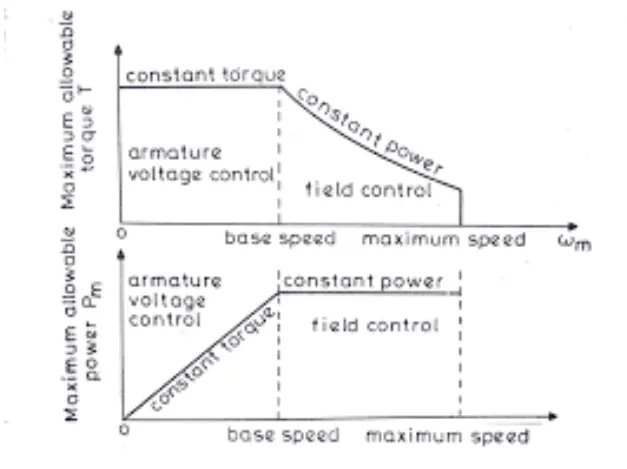
we can say that an EV can achieve 0 to 100kmph speed in 10 sec. Acceleration operation goes this way. with low speed and high torque constant torque, a region is achieved which has accelerating power and by reaching the critical speed it shifts to constant power region, and thus it easy for an EV to reach 0 to 100.
So Electric motor can't develop braking torque at a high speed similar to starting, because the Braking Torque of an EV Motor is not as high as the Acceleration Torque. Therefore Regenerative braking is cannot happen so effectively that we can get all the power back to the battery.
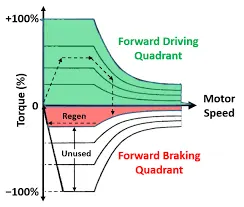
How electric and mechanical brakes are coordinated?
Electrical and mechanical co-ordination
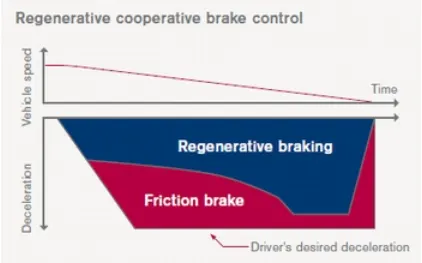
They are two brake control strategies 1) parallel and 2) series
SERIES:
Brakes will be applied one after another so they are connected in series. Either one brake strategy at the time either regenerative braking or mechanical braking
Parallel:
In the case of parallel both the brakes are applied simultaneously both at a time
ELECTRIC DRIVEN INTELLIGENT BRAKE
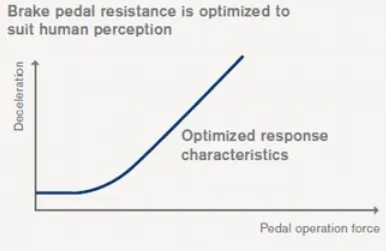
And Nissan has developed a practical brake strategy called (EDIB) electrical driven intelligent brake developed by Nissan leaf
3.Why electric motor can’t develop braking torque at a high speed similar to starting? How electric and mechanical brakes are coordinated?
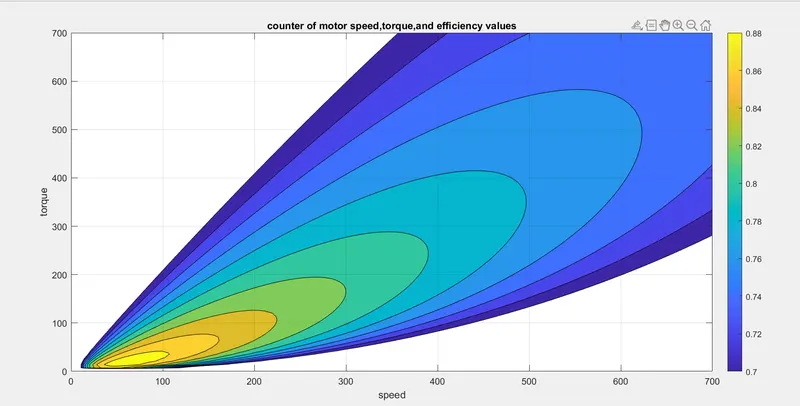
Matlab program which plots counter of a given motor speed torque and efficiency values.


RESULT:
The counter-plot for a motor with decreased constants is plotted in defined speed vs torque region based on efficiency it can be seen that for increasing speed and torque. the efficiency of the motor gradually decreases. the level of efficiency is depicted using a colorbar.