Week-11 Challenge: Braking
AIM :
1. To calculate the energy required for braking for a defined driving cycle.
2. To explain about the reason why electric motor can’t develop braking torque at high speed similar to starting? How electric and mechanical brakes are coordinated?
3. To make a MATLAB program which plots contour of given motor speed, torque and efficiency values.
THEORY :
Brake is a mechanical device. From a moving system, it absorbs energy and inhibits motion. It is used for reducing the speed of a wheel or axle. It works by means of friction. The maximum decelerating effect obtained is called peak force, which is the main characteristic of the braking system. The temperature of brakes gets high when they are typically used and this may lead to failure of the system.
SOLUTION :
1. To calculate the energy required for braking for a defined driving cycle.
A.) In a vehicle, the brake is the most important device to control the vehicle. It reduces the speed of any rotating parts of electrical and mechanical equipment. It is a crucial part of the safe operation of systems. It uses friction on the two surfaces of a vehicle. This converts kinetic energy into heat. The consumed Kinetic energy is given by :
Braking energy = 1/2 * m* v^2
where,
m = Total mass of the vehicle (Pay load weight + kerb load)
v = Total velocity of the vehicle (Final Velocity - Initial Velocity of vehicle)
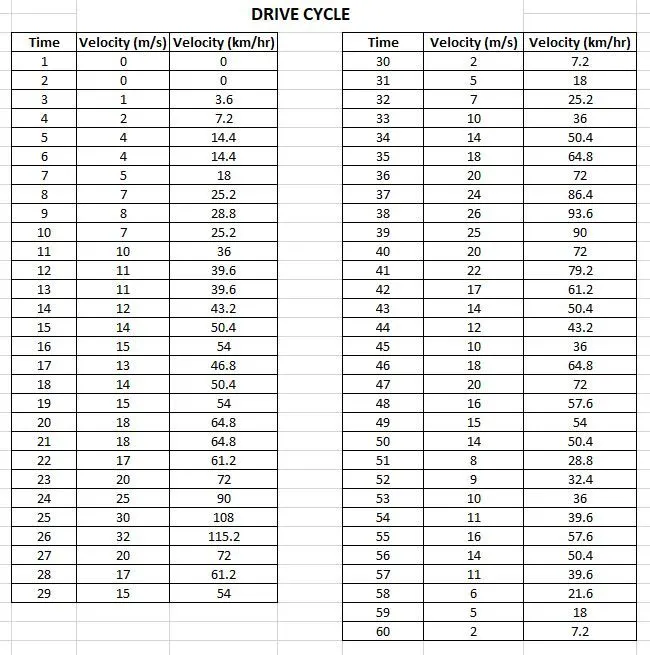
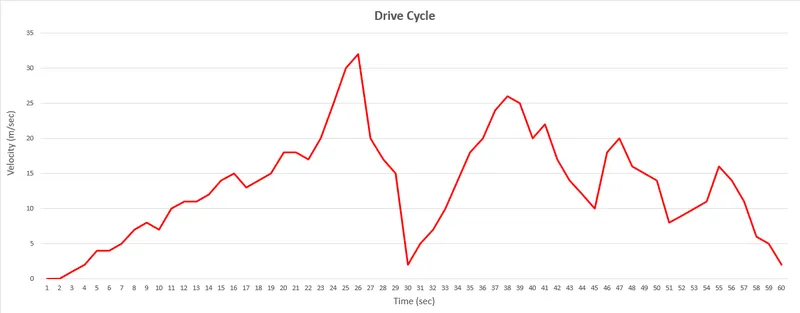
Let take a drive cycle as below in a excel file
Let's,
Total Mass of the vehicle is = Kerb weight + Pay load weight = 800 kg
Final velocity (Vf) = 15 m/s
Initial velocity (Vi) = 30 m/s
Then the required kinetic energy for the braking is given as = 1/2 * total mass * (Vf-Vi)^2
Braking energy = 0.5 * 800 * (15-30)^2
= 90KJ
2. To explain about the reason why electric motor can’t develop braking torque at high speed similar to starting? How electric and mechanical brakes are coordinated?
A.) Electric motor can't develop braking torque at high speeds similar to starting because braking torque is applied in the opposite direction of the rotation. So braking can be applied to the motor via mechanically or electrically.
Electrical Braking is divided in to three:
- Regenerative Braking.
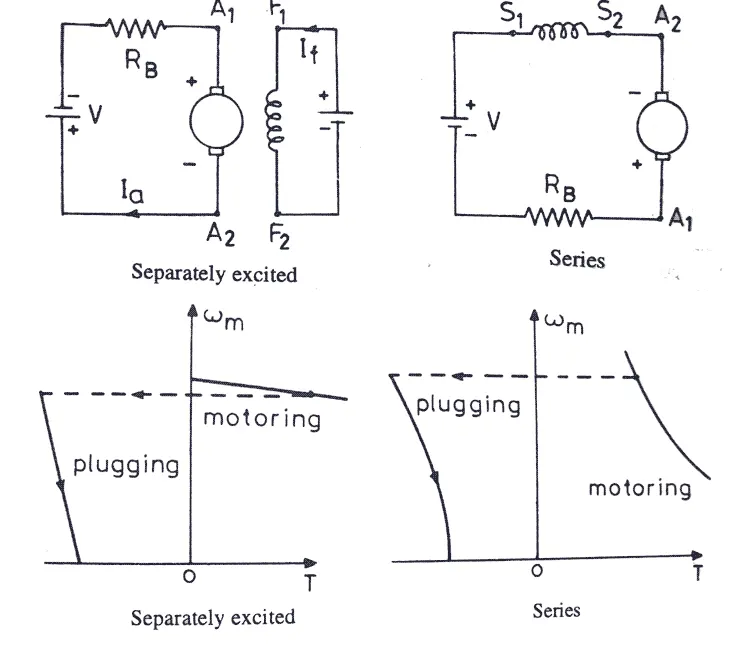
- Plugging type braking.
- Dynamic braking.
Regenerative Braking:
takes place whenever the speed of the motor exceeds the synchronous speed. This method is called regenerative braking because here the motor works as generator and supply itself is given power from the load, i.e. motors. The main criteria for regenerative braking is that the rotor has to rotate at a speed higher than synchronous speed, only then the motor will act as a generator and the direction of current flow through the circuit and direction of the torque reverses and braking takes place. The only disadvantage is that the motor has to run at super synchronous speed which may damage the motor mechanically and electrically, but regenerative braking can be done at sub synchronous speed if the variable frequency source is available.
Plugging type Braking:
In this method the terminals of supply are reversed, as a result the generator torque also reverses which resists the normal rotation of the motor and as a result the speed decreases. During plugging external resistanceis also introduced into the circuit to limit the flowing current. The main disadvantage of this method is that here power is wasted.
Dynamic Braking:
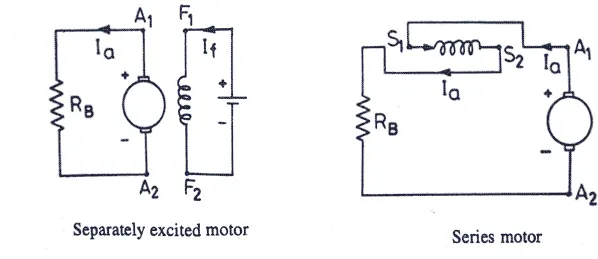
Another method of reversing the direction of torque and braking the motor is dynamic braking. In this method of braking the motor which is at a running condition is disconnected from the source and connected across a resistance. When the motor is disconnected from the source, the rotor keeps rotating due to inertia and it works as a self-excited generator. When the motor works as a generator the flow of the current and torque reverses. During braking to maintain the steady torque sectional resistances are cut out one by one.
Coordination between Electric and Mechanical Brake:
In electric motor the total brake distribution is intwo forms: Regenerative brake(Electrical brake) and Mechanical Brake with hydraulic cylindrical system. Brake force distribution must be uniform. If electric brake power requirement is more than the charging limit of the battery we must apply mechanical brakes. Practically, combination of both is used. Types of Brake control strategies are :
i. Series: The brake is applied one after the other i.e either of mechanical brake or regenerative brake is used
ii. Parallel: The brakes are applied parallel at a time.
3. To make a MATLAB program which plots contour of given motor speed, torque and efficiency values.
A.)
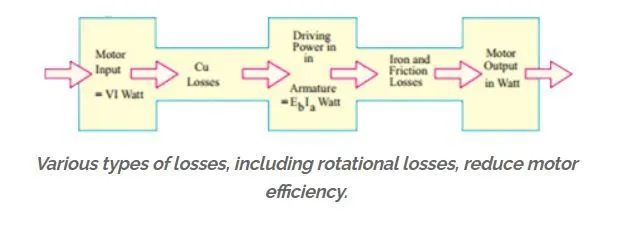
DC motors, like all machines, experience some losses when converting electrical power to mechanical power. While there are several ways in which manufacturers and experts group losses, one common method is to divide them into five categories: mechanical, magnetic, copper, brush, and stray losses.
Because mechancial losses and magnetic losses are approximately proportional to the motor’s rotational speed, they are often taken together and referred to as rotational losses.
Mechanical losses:
As their name suggests, mechanical losses are caused by movement of the motor. These include the friction in the motor bearings, friction between the brushes and the commutator, and drag on the rotor caused by turbulence of the air around it (sometimes referred to as windage loss). Mechanical losses increase with motor speed, but if speed is constant, these losses can be assumed to be constant.
Magnetic losses:
These losses are associated with magnetic paths of the motor. Magnetic losses include hysteresis losses, caused by the changing polarity of the flux in the core, and eddy currents, which are induced in the steel core by the changes in flux polarity. Magnetic losses are constant if the field current and speed are constant.
Copper losses:
These losses can be referred to by many names, including the term “I2R losses,” since they’re caused by the resistance of the field and armature windings. For both the field and the armature, copper losses are equal to the square of current times the resistance of the current’s path.
Brush losses:
During commutation, some losses occur between the commutator and the brushes. The magnitude of brush losses depends on the voltage drop at the contact point and on the armature current. Note that brush losses are sometimes included in the category of stray load losses.
Stray load losses:
Losses that cannot be easily accounted for are generally lumped into the “stray load” category. Common examples are short-circuit currents during commutation and flux distortion due to armature reaction.
Motor design is the primary influencer of rotational losses, and although they’re not easily controlled by the user, it’s important to understand these losses, as they have a significant impact on motor efficiency.
Let's take an example by writing a matlab program and considering the certain parameters:
The following is the matlab code
clc

w=linspace(0,1000);
T=linspace(0,250);

%motor constants
Kc=0.4; %cu loss
Ki=0.009; %iron loss
Kw=0.00002; %windage loss
conL=18; %constant motor loss

%making mesh
[X,Y] = meshgrid(w,T);
Outputpower = (X.*Y);% Torque *Speed=Power
B=(Y.^2)*Kc;%Copper loss
C=(X.^3)*Kw;%windage loss
D=(X*Ki);%iron loss
Inputpower = Outputpower + B + C + D + conL;
Z = Outputpower./Inputpower;
%Set the efficiences for which the control is plotted
V = [0.70,0.75,0.80,0.82,0.87,0.89,0.9,0.92];
box off
grid off
contour(X,Y,Z,V)
xlabel('Speed(rad/s)')
ylabel('Torque(N-m)')
hold on
V = [8000,10000];
contour(X,Y,Outputpower,V)
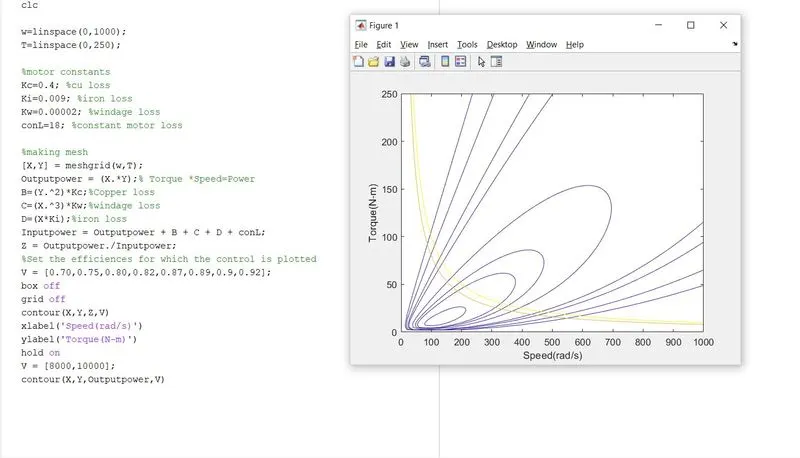
The reults obtained from the matlab code is as below:
CONCLUSION:
1. The energy required for braking of an vehicle is calculated.
2. The control strategies about electrical and mechanical brakes is explained.
3. A MATLAB program is made which plots contour of given motor speed, torque and efficiency values.