Week-4 Challenge WOT Condition Part-2
OBJECTIVES :
1. To find the difference between mapped and dynamic model of engine,motor and generator and to change the model type.
2. To find out how a model calculate miles per gallon and to understand the factors considered for model fuel flow.
3. To run the HEV reference application with WOT drive cycle by changing grade and wind velocity in environment block and comment on results.
4. By keeping all parameters same, to compare the simulated results of hybrid and pure electric powertrains.
AIM : To observe the HEV reference application with WOT drive cycle by running it and to comment the results.
CASE STUDY :
1. To find the difference between mapped and dynamic model of engine,motor and generator and to change the model type.
A )
| Type | Implementation | When to use | |
| Mapped | CiMappedEngine SiMappedEngine |
1. Model uses a set of steady state lookup tables to characterize engine performance 2. The table provide overall engine characteristics, including actual torque, fuel flow rate, BSFC, and engine-out exhaust emissions. |
For Quasi steady state engine simulators. |
| Dynamic | CiEngine SiEngine |
Model decomposes the engine behaviour into engine characteristics that are separated into lower-level components. By combining components in this way the models capture the dynamic effects. | To analyze the impact of individual engine components on the overall performance. |
To select the Mapped and Dynamic types, we can easily switch between them
i. Open th EV model in Simulink
ii. Enter the passenger car block by double clicking it.
iii. Go to electric plant block
iv. Inside the motor block right click to find the variant option and then we can select as we need.
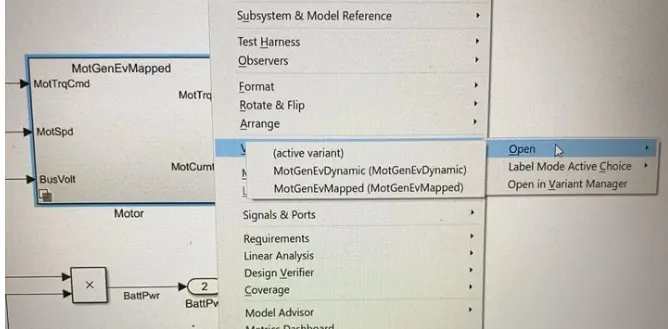
2. To find out how a model calculate miles per gallon and to understand the factors considered for model fuel flow.
A ) Miles per Gallon(MPG) is used to calculate the fuel efficiency for a conventional gasoline vehicle. But for hybrid models it is calculated as Mile Per Gallon Equivalent(MPGe). Generally, MPG means number of miles our car can drive per gallon of gas. But as we use electricity then MPGe should be used. MPGe means number of miles a vehicle can go using same energy content as one gallon of gas. For this equilant EPA set some standard i.e 33.7 kilowatthour of electricity is same as one gallon of gas. ( EPA means Environmental Protection Agency). We can observe this standard in our model. Open the Visualization block in the model and then select the Performance calculations block as below
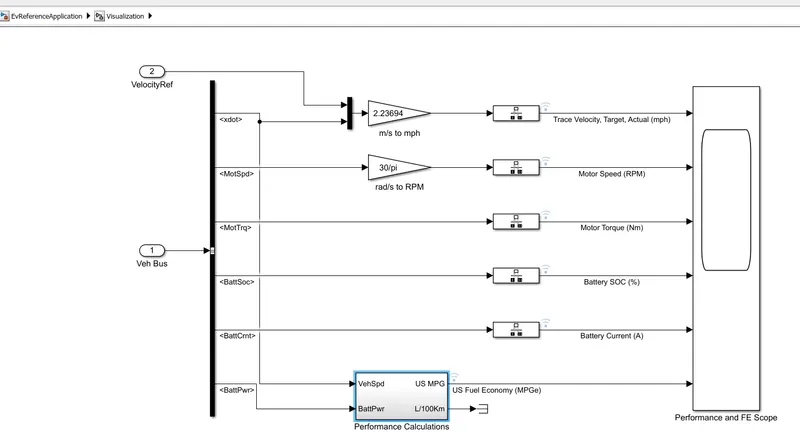
after opening it we can see the EPA standard mentioned as below
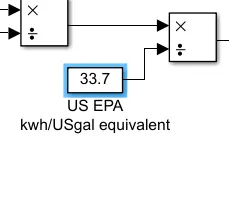
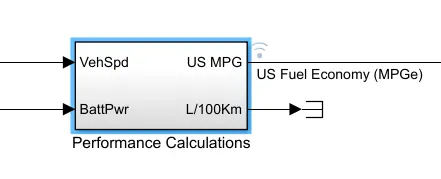
If we open the Performance calculations block then we can find the MPG calculations
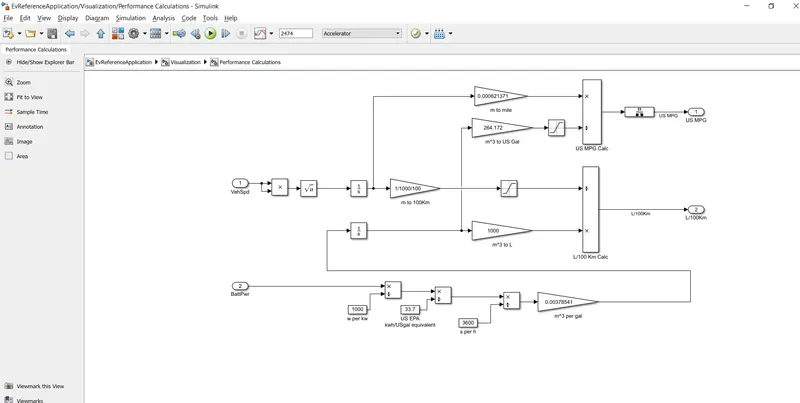
Here in this there are 3 types of inputs are considered.
i. Speed
ii. Fuel flow
iii. Battery Power
The speed of vehicle is in m/s which now converted into miles by multiplier block with 0.000621371.
Parallely, Kilogram of fuel is converted into meter cube by multiplying as 1/(1000*0.739) then this value is converted in gallons by multiplying with 264.172.
Battery value is converted from watts to kwh by dividing with 1000 an then divided by gallon equivalent value 33.7
To convert the result into seconds divide it by 3600 and then it is multiplied by 0.00378541 to get the value in Cubic meters per Gallons
This is how it is calculated.
Factors considered to model fuel flow:
i. One Gallon of gasoline is equivalent to 33.7 Kilowatt hours of Electricity according to EPA.
ii. Vehicle speed and Battery power are most considerable elements for calculating MPGe.
3. To run the HEV reference application with WOT drive cycle by changing grade and wind velocity in environment block and comment on results.
A ) The Hybrid Electric Vehicle reference application represents the Multimode HEV model with an internal combustion engine, transmission, battery, motor, generator, and associated powertrain control algorithms. Use the reference application for powertrain matching analysis and component selection, control and diagnostic algorithm design, and hardware-in-the-loop (HIL) testing.
By default, the HEV multimode reference application is configured with:
-
Mapped motor and generator
-
1.5–L spark-ignition (SI) dynamic engine
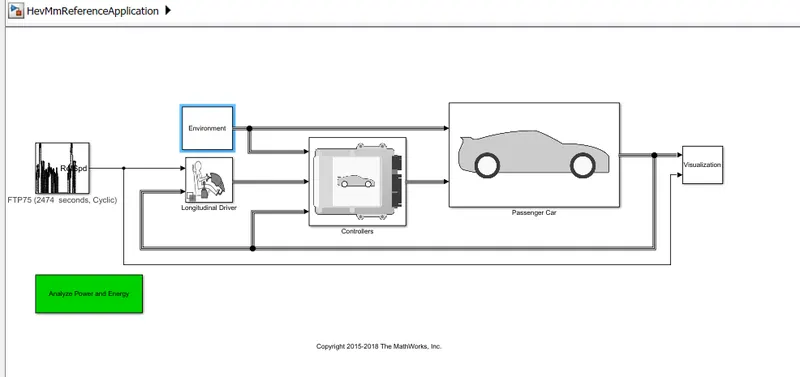
The powertrain configuration and model pics are shown below:
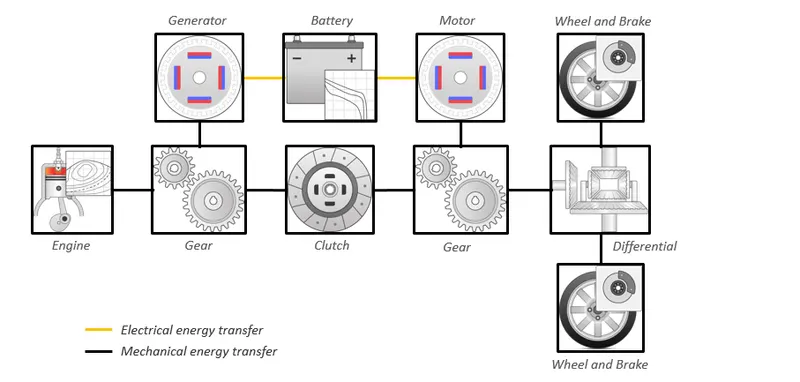
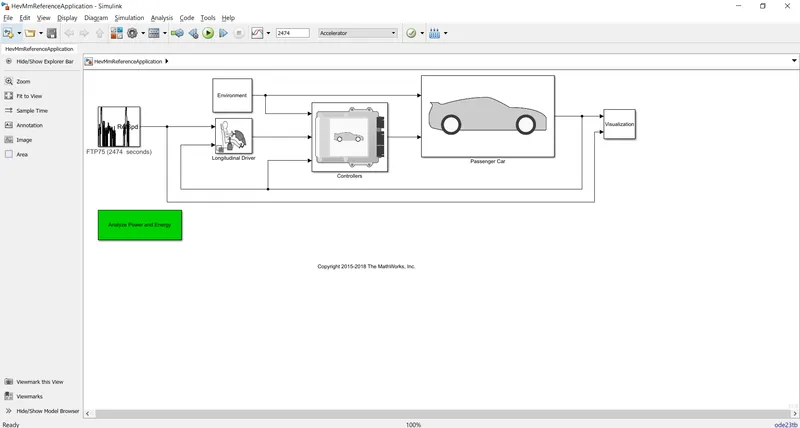
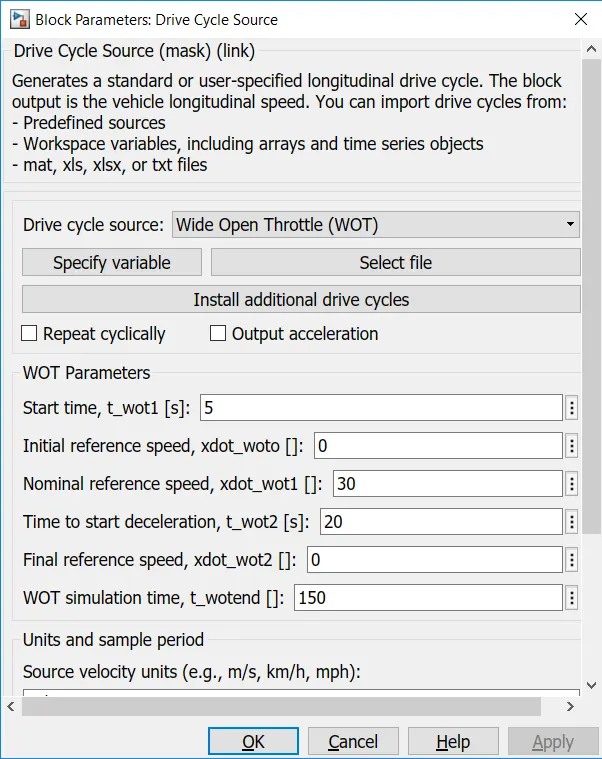
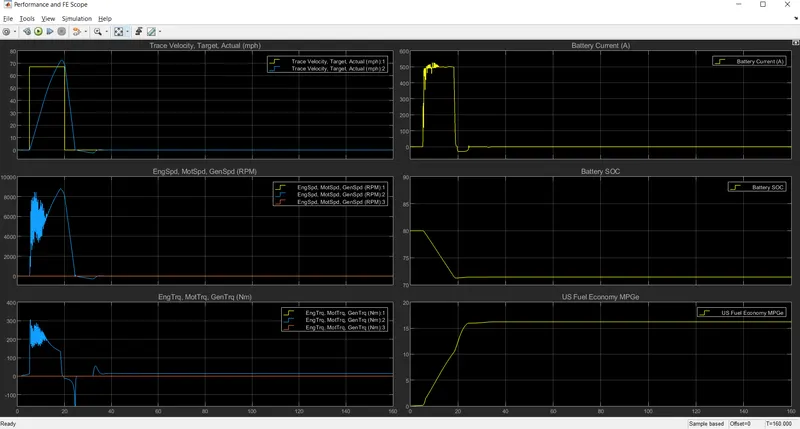
From the model we can see that the drive cycle is FTP75. So change it to the WOT drive cycle with 150 sec and run the application.
Observations:
i. The Trace velocity is at peak around 70mph at 20seconds and after that it starting falling gradually it becomes zero after 30seconds.
ii. The Engine speed, Motor speed, Generator speed reached upto 9000 RPM at 30 seconds around.
iii. The Engine torque, Motor torque, Generator torque are at peak 300 N-m at around 10 sec and after 20 sec it become negative.
iv. The battery current reached upto 500 for some seconds but at nearly 18 seconds it started to fall and after 20 sec current became negative.
v. The battery SOC initially is at 80 for some seconds and then it decreased to 72 approximately at nearly 18 seconds. After 20 sec it increased a little bit.
vi. The fuel economy is initially zero but after some time it gradually increased upto 16.
Now,
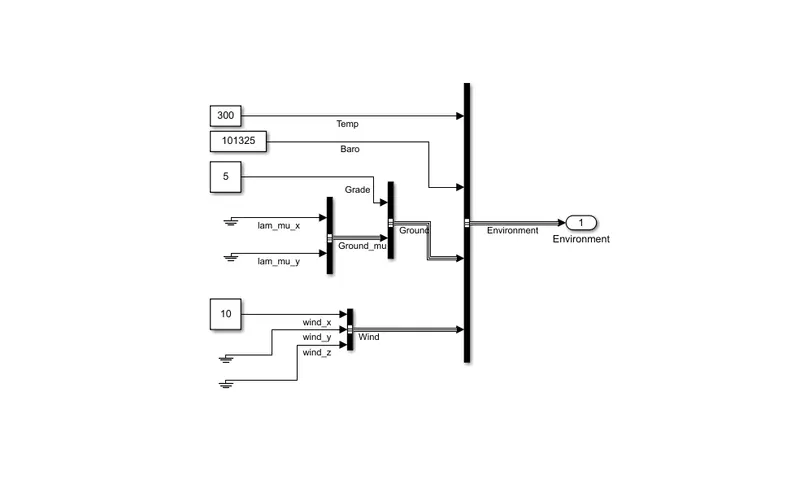
HEV model's grade and wind velocity are changed as below:
.) Open the Environment subsystem in HEV reference application.
.) Change the grade as 4 and wind velocity as 12.
Observations:
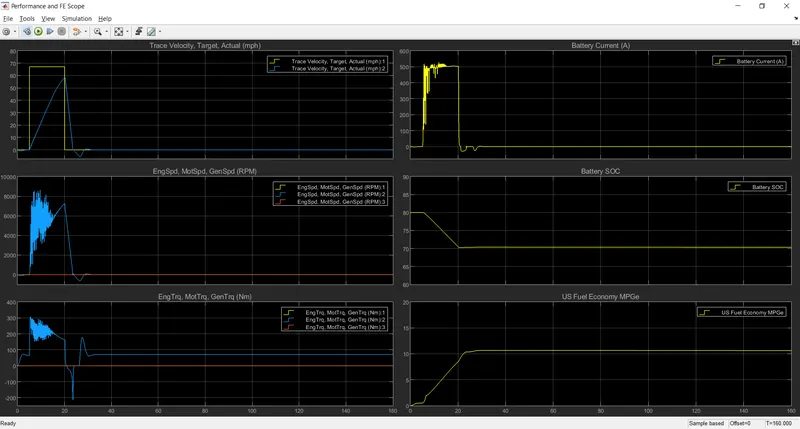
i. Trace velocity reached upto 60mph at 20 sec, after that it started decreasing gradually. Previously it reached upto 70mph in 18sec.
ii. The Engine speed, Motor speed, Generator speed reached upto 8200RPM
iii. The Engine torque, Motor torque, Generator torque is same as previous condition.
iv. Battery current reached upto 500, continued upto 20 sec.
v. Battery SOC decreases more due to power requirement is more. It decreased to 70 which is less than previous condition SOC.
vi. Due to change in grade and wind, the fuel economy increased only upto 10, it is less than previous condition.
4. By keeping all parameters same, to compare the simulated results of hybrid and pure electric powertrains.
A )
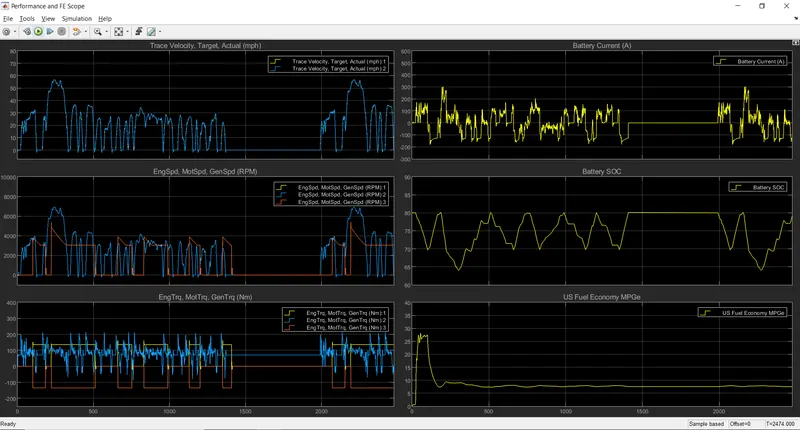
HEV REFERENCE APPLICATION :
i. Open the HEV reference application and keep all the parameters same.
ii. Just change the grade as 5 and wind velocity as 10.
iii. Drive cycle should be FTP75(2474 seconds)
Model:
Observations:
i. First plot is drive cycle
ii. Battery current reached upto 300 at peak in positive and -200 peak in negative. Around 1400sec the current is zero upto 1900sec approximately(decelearation period).
iii. Speed reached upto 7000 Rpm.
iv. Torque reached upto 200 Nm in both positive and negative sides.
v. Battery SOC decreases and increases through out the cycle and during decelearation battery charges.
vi. Fuel economy is upto 28 initially it is constant for some time, after that it decreases to 10 and is almost constant after 300sec.
EV REFERENCE APPLICATION:
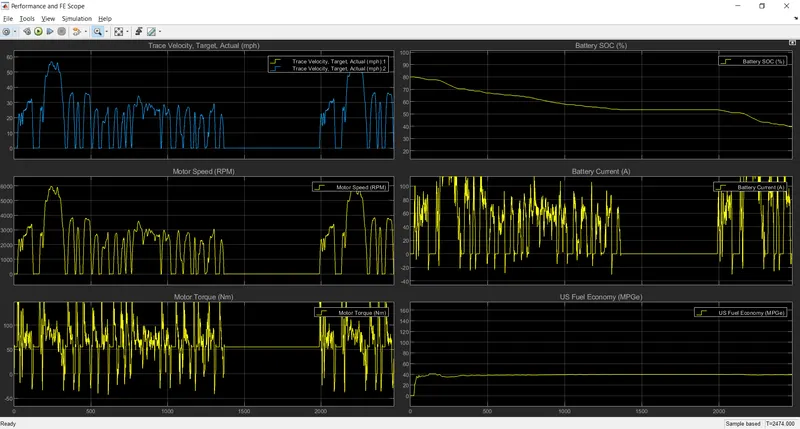
i. Open the EV reference application and keep all the parameters same.
ii. Just change the grade as 5 and wind velocity as 10.
iii. Drive cycle should be FTP75(2474 seconds)
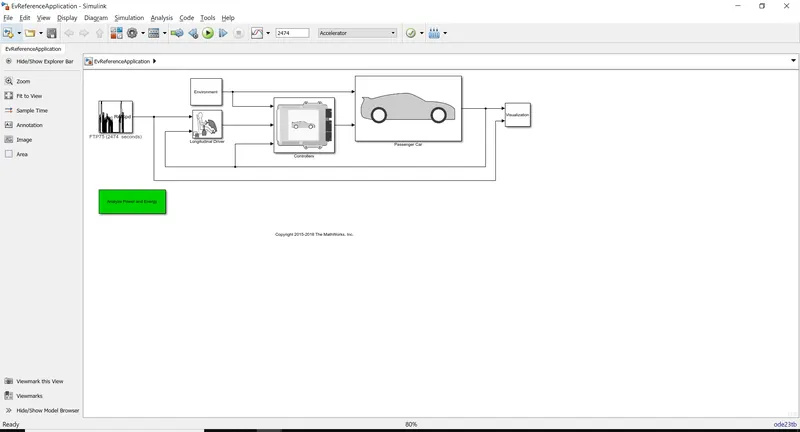
MODEL:
Observations:
i. First plot is drive cycle.
ii. Battery SOC falls from 80 to 40 slowly.
iii. Motor Speed reched upto 6000RPM
iv. Torque reached upto 200NM
v. Battery current is changing continuously between 0 to 200.
v. Fuel economy is initially at 38 approx. after that it become constant at 40.
CONCLUSION :
1. Difference between Mapped and Dynamic models are explained and changing the model is explained.
2. MPG - Miles Per Gallon in model are calculated and factors are also explained.
3. By running HEV reference applications results are obtained with grade & wind velocity and without grade & wind velocity.
4. Hybrid Electric Vehicle reference application and Pure Electric Vehicle reference application models are compared and results are obtained from plots.