Week-6 Challenge: EV Drivetrain
AIM : To understand the Electric Vehicle Drivetrain.
OBJECTIVES :
1. To understand the different types of power converter circuits employed in electric and hybrid electric vehicle.
2. To find the steady speed from the Electric Vehicle's powertrain data given .
3. To understand the author perspective on Induction Versus DC brushless motors by Wally Rippel, Tesla
THEORY :
Power Electronics made a complete change in controlling the electric power. Power electronics is based on switching which is really fast. On and Off is controlled in very less time so dissipation is less. So controlling is made easy.
SOLUTION :
1. To understand the different types of power converter circuits employed in electric and hybrid electric vehicle.
A.) Power converter is an electric circuit that changes electrical energy from one form into other desired form optimized according to the specific load. Power converter acts as a link or transforming stage between power source and power output
The input supply is averaged to required amount by using semiconductors and supplied to output load. Control is achieved here within time axis. Instead of limiting the supply voltage magnitude time axis is controlled. Switching based on time are called as duty cycles and represented as duty ratio.
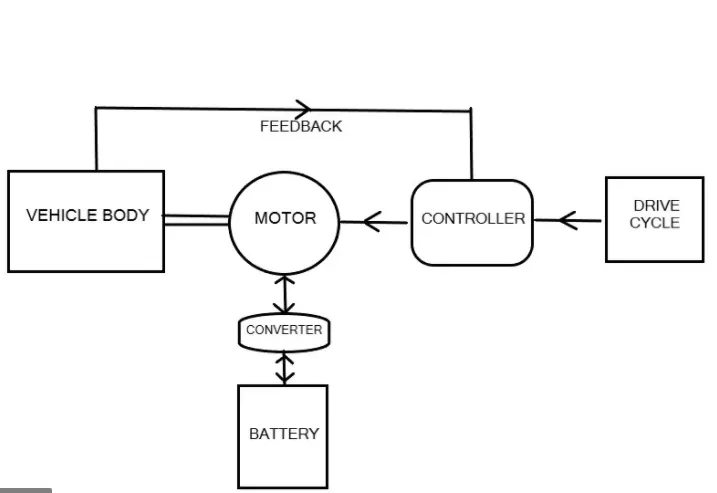
The figure shows a block diagram of an Electric Vehicle. The power conversion systems can be classified according to type of input and output power, which can be used to convert the forms and levels of electrical energy. Converters can convert AC-DC voltage, frequency, or both combined. Power converters are of three types:
a. AC to DC also known as Rectifier
b. DC to DC also known as Converter
c. DC to AC also known as Invertor
AC to DC - Rectifiers:
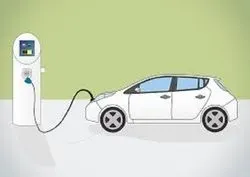
In electric vehicles, the converter is built inside the car. This type of arrangement is known as Onboard Charger. It converts power from AC to DC then feeds the power into car's battery.
DC to DC - Convertors:
Mostly used in Electric Vehicles to get the required voltage. For this reason these are called Choppers. These are used for:
i. To increase the input voltage i.e Booster converter
ii. To reduce the voltage i.e Buck converter
iii. Faster charging
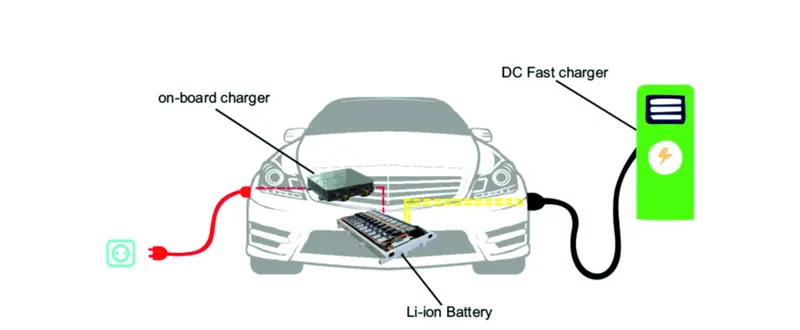
From figure we can understand that the DC fast charger can be directly fed to battery instead of Onboard charger. So this type of converters are more used in Electric Vehicles.
DC to AC - Invertors:
Frequency variations can be done in this as DC is converted to AC
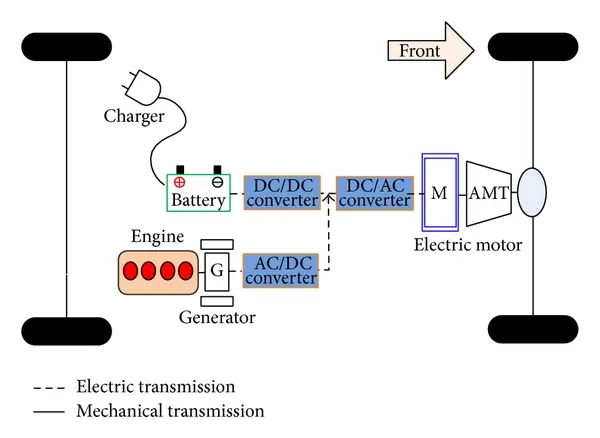
DC to AC inverter is placed between Battery and Motor because that inverter should control the power, torque, performance parameters by adjusting the AC supply. Generally for PluginHybrid Electric Vehicles uses this.
2. An Electric Vehicle's powertrain with 72V battery pack in shown in the diagram below. The duty ratio for acceleration operation is 'd1' and for the braking operation the duty ratio is 'd2'.
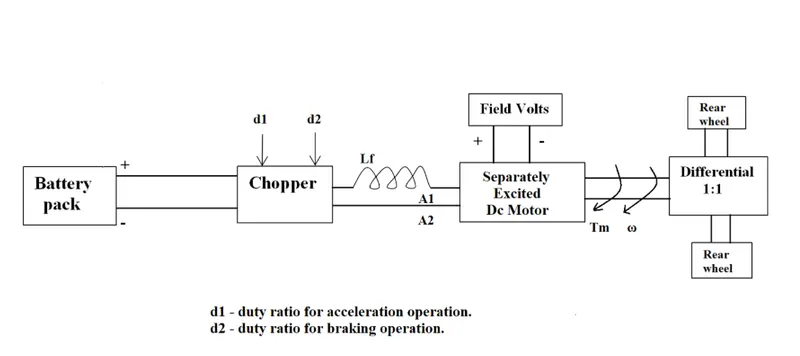
The other parameters of the electric vehicle is given below,
Motor and Controller Parameters:
Rated Armature voltage= 72 V
Rated armature current= 400 A
Ra= 0.5Ω, KΦ= 0.7 Volt second
Chopper Switching frequency= 400 Hz
The vehicle speed-torque characteristics are given by the below equation

What is EV steady state speed if duty cycle is 70%?
A.)
From the given data,
Duty cycle = 70% =0.7
Actual voltage = 0.7*72 = 50.4 V
The Torque Speed characteristic of DC motor relation is as below :
T = ((Vkϕ) / Ra ) - (((kϕ)^2) / Ra ) * ω
= ((50.4 *0.7) / 0.5 ) - ((0.7^2) / 0.5 ) * ω
T = 70.56 - 0.98ω........(1)
let the given equation be (2)
Tv = 24.7 + (0.0051)ω^2.........(2)
Now equate the both equations
(1) = (2)
70.56 - 0.98ω = 24.7 + (0.0051)ω^2
(0.0051)ω^2 + 0.98ω -45.86 = 0
By solving the quadratic equation,
We get roots as
ω = 38.89....rad/sec or ω = -230.98....rad/sec
Since the value ω can't be negative we take the value as 38.89
Therefore,
Speed of EV (ω) = 38.89....rad/sec
3. To understand the author perspective on Induction Versus DC brushless motors by Wally Rippel, Tesla
A.) Wally Ripple is Principal Power Electronics Engineer.
What he said is about the technology of present car's i.e an electric vehicle's future impact. At present the vehicles are running mostly on fuel. So he stresses about the Electric vehicles technology can't be predicted. He also told about the differences between Induction motor and DC brushless motor and their impacts.
Merits- Demerits-Comparison:
The author mentioned about the motors and their working; differentiating the two motors. The author emphasis on induction motors performance as how they withstand the loads, losses. In an Induction motor there are no magnets so the motor can start under load. No need to use of inverter. Also induction machine can withstant rough conditions and has high performance rate. Coming to losses the size of machine won't affect the losses. But the thing is it can't be operated in DC supply. Frequency variations can occur to AC. Also Induction motor has limited torque in comparison.
DC motos have some advantages like production of less heat, high peak point efficiency. Coming to real world applications DC motor brushless are most commonly used in Electric vehicles, Hybrid vehicles.
When it comes to Hybrid Electric vehicles, DC brushless motor drive is mostly used. If considering the performance wise mostly Induction motor drives are used
From author perspective, he clearly mentioned that there is no clear winner in future of EV and HEV technology, but there could be a mixture of both can form a new technology.
CONCLUSION :
1. The different types of power converter circuits employed in electric and hybrid electric vehicle are mentioned.
2. The steady speed of Electric Vehicle is calculated from given data.
3. The author perspective on Induction Vs DC brushless motors is explained.