Week-11 Challenge: Braking
WEEK 11: Challenge Braking
- For a defined driving cycle, calculate the energy required for braking.
The energy of traction of wheels mainly compromises of drag and braking energy. Where braking energy contributes the highest.
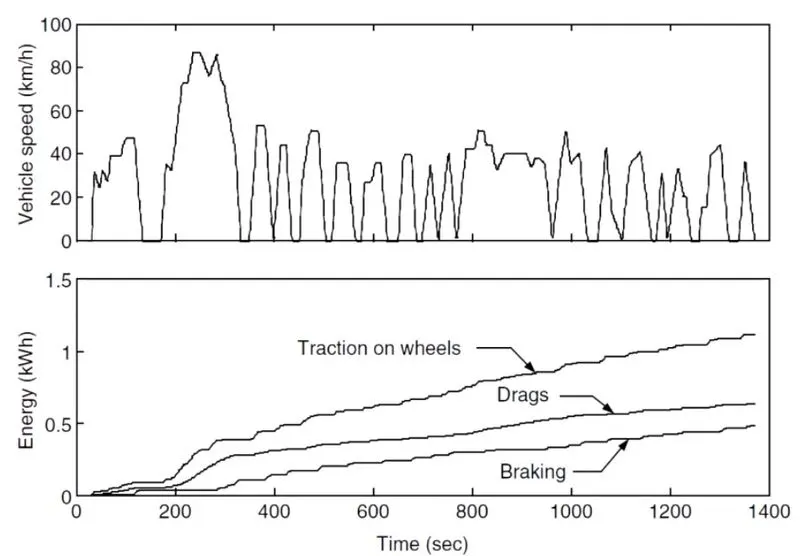
In the above driving cycle, gives a standard driving cycle undergoes changes in speed, acceleration, and deceleration. The vehicle at many points is brought to rest or decelerated from 80-0Km/hr within 10-15sec. hence high braking energy is required. Hence the braking energy is required. Hence the braking energy also increases with the deceleration of the vehicle.
So, from the fig, acceleration and deceleration at certain points are considered and the brake power is calculated. From the calculations, the braking energy requirement decreases as the difference in the deceleration speed decreases for a given set of time.
The calculation done in Excel file is uploaded to google drive and the access link to the file is
https://drive.google.com/file/d/1lgB0cZ-CaQGAqJB3SNUW3sfUANUV9R_1/view?usp=sharing
2. Why electric motor can’t develop braking at high speed similar to starting.
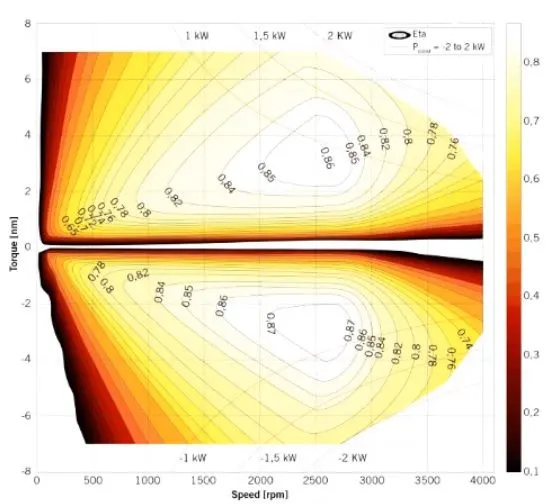
The above diagram which shows the characteristics of torque and speed represents forward motoring and forward braking. The torque of the induction motor is in inverse proportional to the square of the rotor speed. So at higher speed the torque will be less, it’s the reason that at high-speed electric motor cannot produce braking torque similar to starting.
The electric motor must be controlled to produce the proper amount of braking force to recover as much braking energy as possible and at the same time, the total braking force must be sufficient to meet vehicle deceleration commanded by the driver. To reach sufficient braking in EV vehicles was use brake control strategies.
Series brake control: Here mechanical brake and the electric brake is done one after another.
Parallel brake control: Here both brakes are applied simultaneously.
We need both mechanical and electrical braking system. In emergency braking or parking brake, we needed mechanical braking.
Mechanical Braking: it is nothing but friction brakes used in vehicles to slow down the vehicle. The most common type of brakes are drum brake and disc brake.
Electrical braking: it is used to reduce the speed of the motor depending upon the flux and torque. This kind of braking can be done in different methods.
- Plugging type braking
- Dynamic braking
- Regenerative braking
3. Make a MATLAB program that plots the contour of given motor speed, torque, and efficiency values.
The Matlab code is uploaded to google drive and the access link to the file is
https://drive.google.com/file/d/1Zji6_KtD9jISaG05OJMFfrOrdhsbxXtC/view?usp=sharing
MATLAB code:
clear all
close all
clc
x = linspace(1,1000,250);
y = linspace(1,250,250);
kc = 0.3; %copper loss constant
ki = 0.009; %tron loss constant
kw = 0.00005; %windage loss constant
conL = 30;
[X,Y] = meshgrid(x,y);
pout = X.*Y;
B = kc*(Y.^2);
C = ki*X;
D = kw*(X.^3);
pin = pout + B + C + D + conL;
eta = pout./pin; %efficiency
V = [0.5,0.55,0.6,0.65,0.7,0.75,0.8,0.85,0.9,0.95];
box off;
grid off;
contour(X,Y,eta,V);
xlabel('speed in rad/s');
ylabel('torque in N.m');
output:
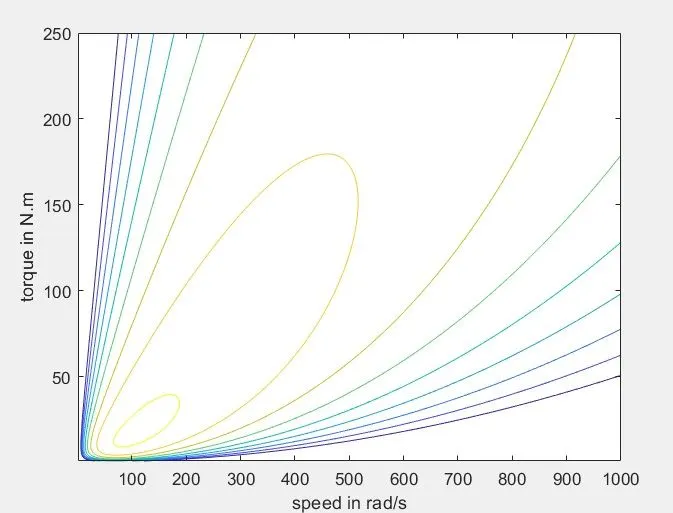
From the output graph you could notice that only at a particular speed and torque the efficiency is at maximum, i.e 90%, where speed x =157rad/s at 40Nm Torque. As the speed increases the efficiencies of the motor will be reduced. To attain maximum efficiency the motor has to constantly run at around 157 rad/s speed 40Nm.