Week 11- Broadband Noise modelling over Ahmed body
Aim
To simulate the flow over the given Ahmed body at a velocity of 110kmph and analyze the acoustic fields around the body using broadband noise source modeling.
Introduction
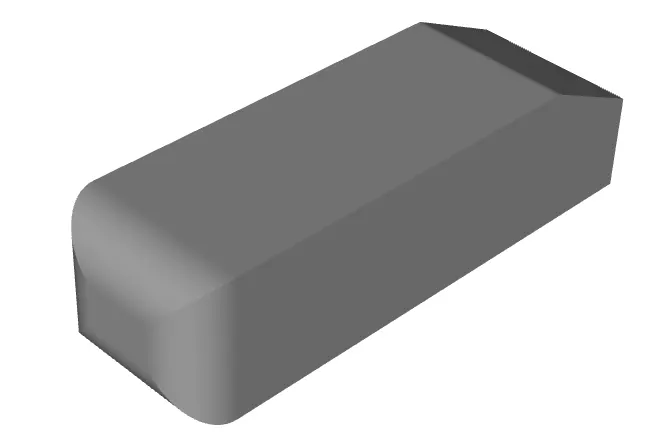
The Ahmed body, designed by SR Ahmed [1], is a generic car-shaped body that has all the major features of an automobile. The Ahmed body has now become a standardized body commonly used to validate CFD codes and evaluate the CFD code's capability to capture the flow around the Ahmed body. Since the airflow around the Ahmed body shows all the characteristics around that of an automobile, the CFD codes can then be confidently used to analyze modern automobiles. An illustration of the Ahmed body can be seen in the image below.
Method
Domain and Mesh
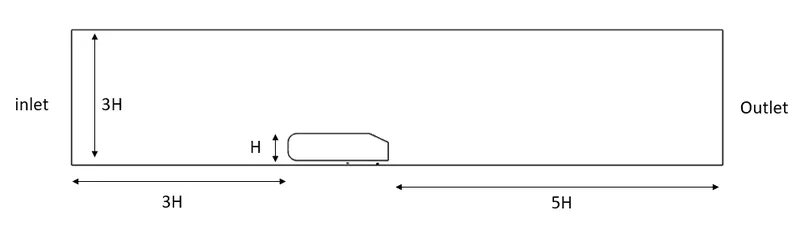
The domain was provided and can be seen in the schematic below. The characteristic length of the body is given by H and is equal to 0.297m. Due to the symmetric nature of the Ahmed body, only half-body simulation was conducted. The third dimension in the 3D domain was set to 1.5H (not seen in the 2D schematic).
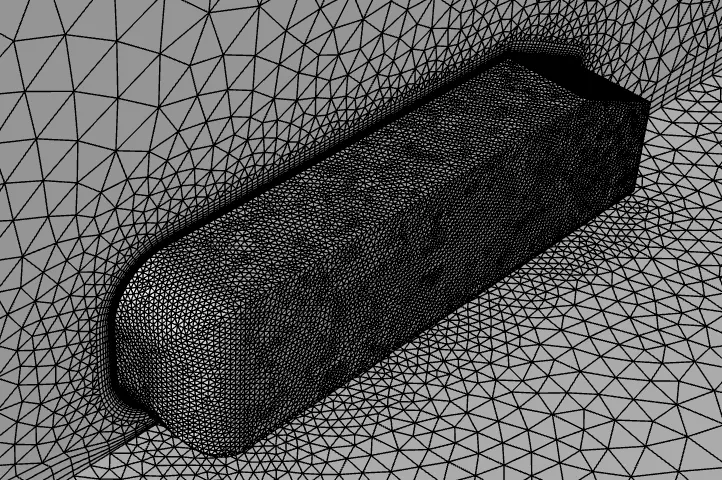
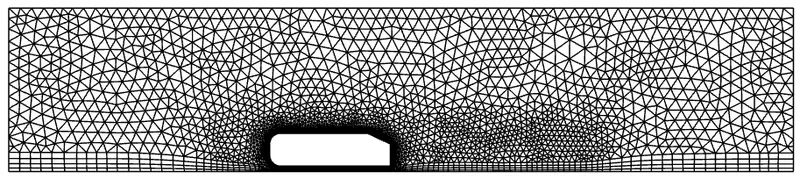
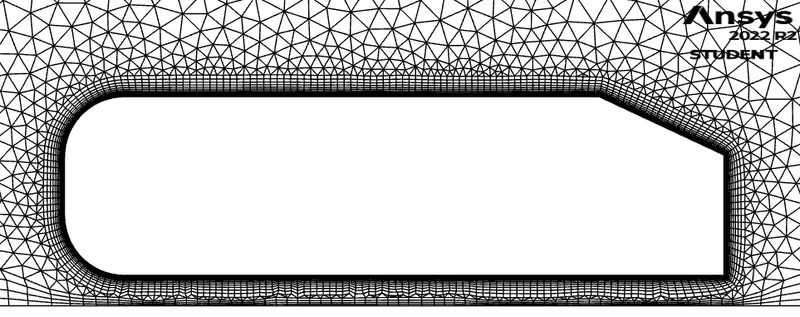
An unstructured tetrahedral mesh was generated around the body with a max element size of 0.1m. A body of influence was used to refine the mesh very close to the Ahmed body with a sizing of 0.05m. The surface of the Ahmed body was meshed with a sizing of 0.01m. 14 inflation layers were generated around the Ahmed body and 4 inflation layers were generated on the road surface with a smooth transition set to 0.6 to the bulk mesh. The resulting mesh contained 445k mesh elements and can be seen in the images below.
CFD Setup
All Simulations were conducted using Ansys Fluent 22 R2. The fluid used in the domain was air with default properties of density and viscosity. The velocity at the inlet was set to 31m/s (corresponding to 110kmph) and the pressure outlet was set to 0 gauge pressure. The walls of the Ahmed body were set to no-slip condition. The road surface was set to a translation velocity of 31 m/s and provided the no-slip condition. All other faces of the domain were given the symmetry boundary condition. The reference area was estimated using the projected area in the X-direction to be 0.052`m^2`.
The steady-state pressure-based PV-coupled solver was used for the spatial discretization of the flow parameters. Turbulence was estimated using the two-equation realizable K-Epsilon turbulence model with enhanced wall functions. The second-order scheme was used to estimate the pressure, the second-order upwind scheme was used to estimate momentum and turbulence parameters. The solution was initialized using standard initialization followed by an FMG initialization to quicken the simulation runtime. The pseudo-transient method was also used with an automatic conservative length scale. Acoustics in the flow was estimated using the broadband noise source model with 200 sampling realizations.
Convergence was monitored using the scaled residuals and the variations of lift, drag, maximum pressure, and average pressure on the surface of the Ahmed body. The simulations were assumed to be converged when the convergence quantities varied under 0.001 across 10 iterations and scaled residuals were all below 1e-3. The simulation ran for 140 iterations to achieve convergence.
Results
The images below show the convergence of the simulation using the scaled residuals, lift/drag coefficients, and static pressure estimations.
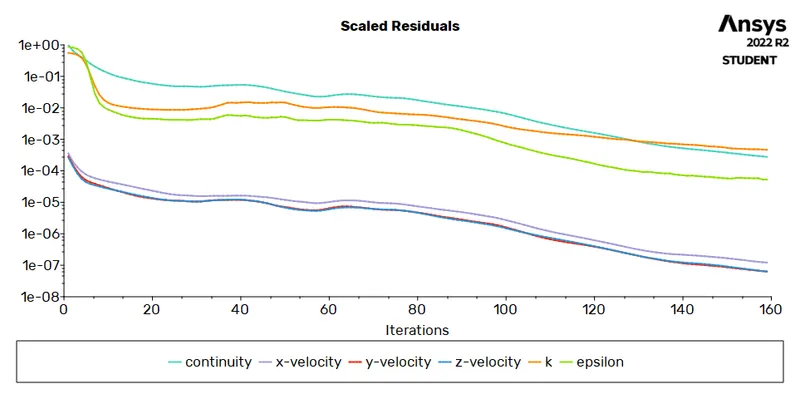
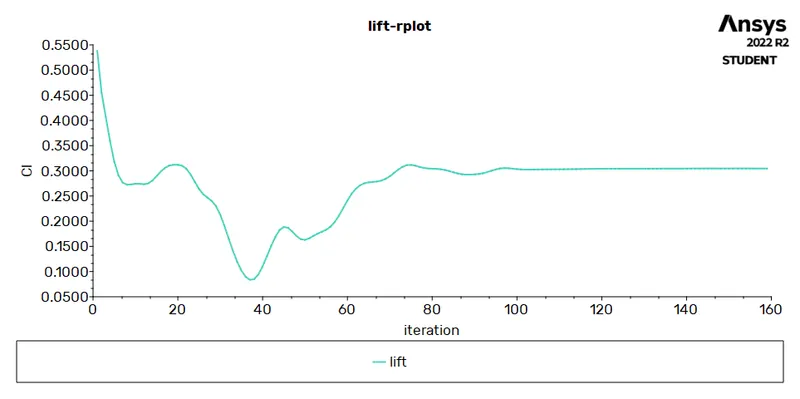
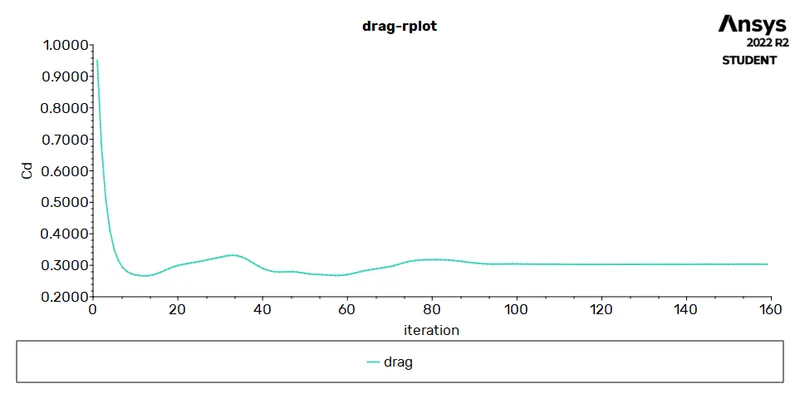
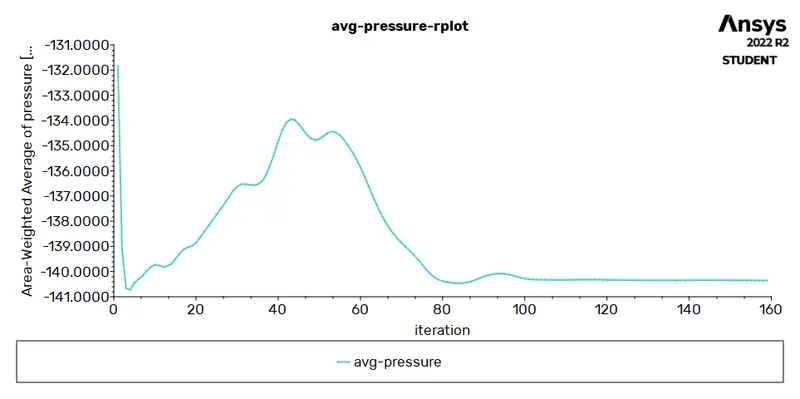
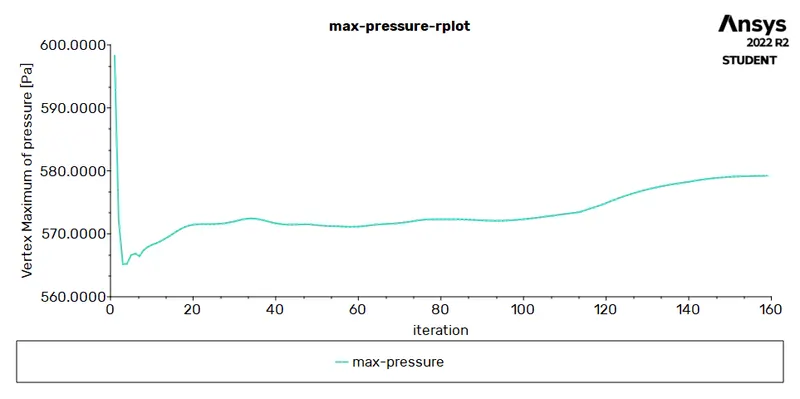
From the above plots, it can be deemed that the simulation has attained convergence.
The image below shows the distribution of the wall yplus.
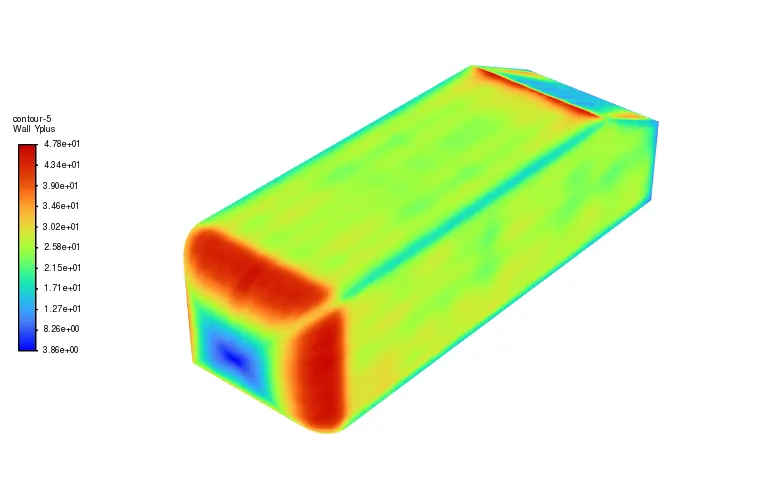
It can be seen that the majority of the surfaces have a wall yplus greater than 30. However, there are few regions with a yplus lower than 30. The enhanced wall treatment used in this case will be able to switch between wall functions and boundary layer resolution at the appropriate regions and hence the mesh on the boundary layer can be deemed sufficient for the simulation.
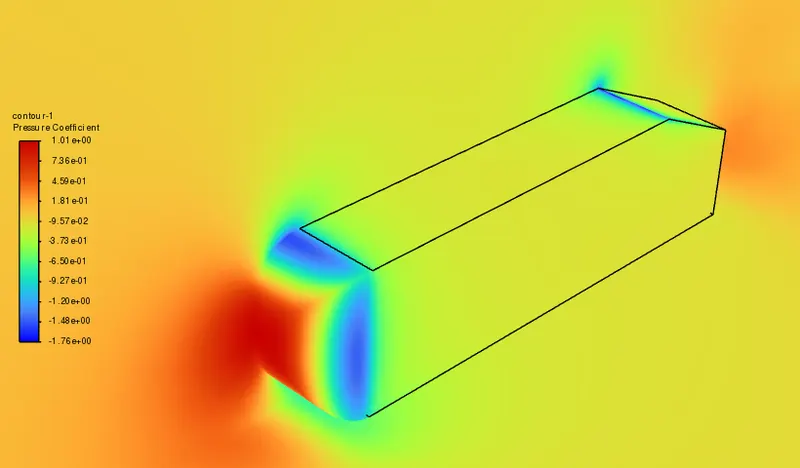
The images below show the distribution of the static pressure coefficient and total pressure coefficient.
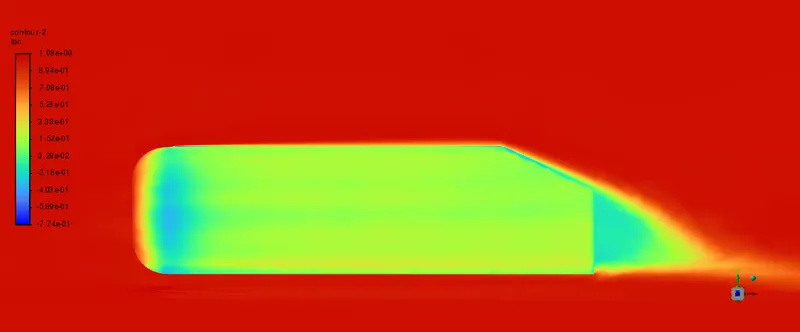
The image below shows the distribution of velocity magnitude.
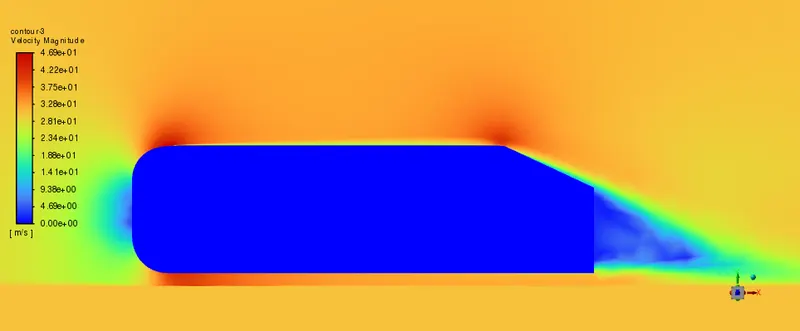
From the above pressure and velocity results, it can be seen that a large wake is created at the rear end of the Ahmed body. Regions of accelerated flow can be observed in the leading edge and slant of the Ahmed body and can be attributed to their convex shape relative to the flow stream.
The images below show the distribution of the acoustic power level derived from the broadband noise source model.
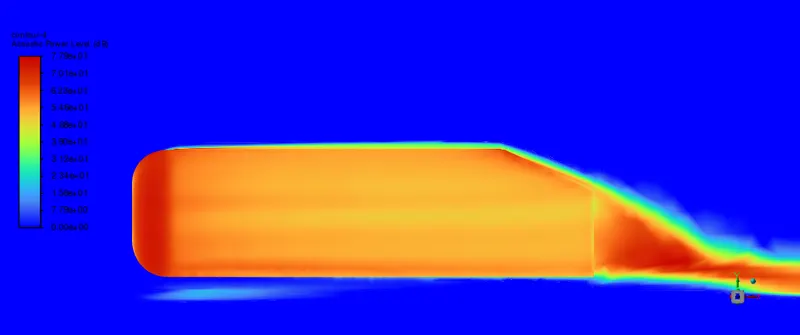
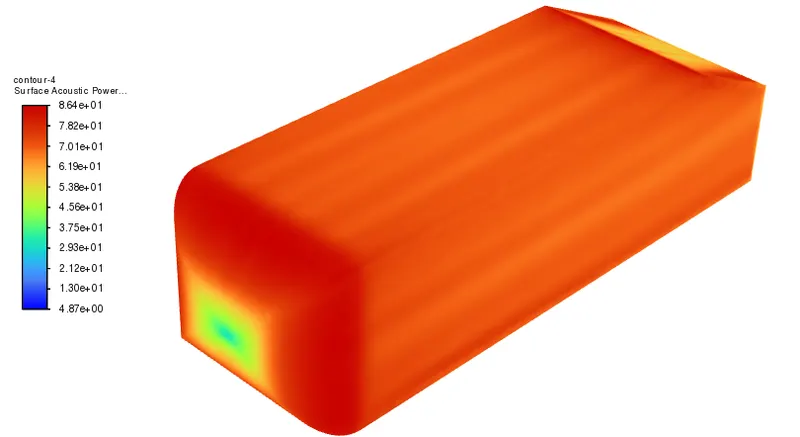
The above images show that the majority of the noise generated is from the leading edge of the Ahmed body and in the wake region behind it. A considerable amount of noise can also be seen on the thin boundary layer region attached to the Ahmed body walls.
The image below shows the distribution of Lilley's total noise source.
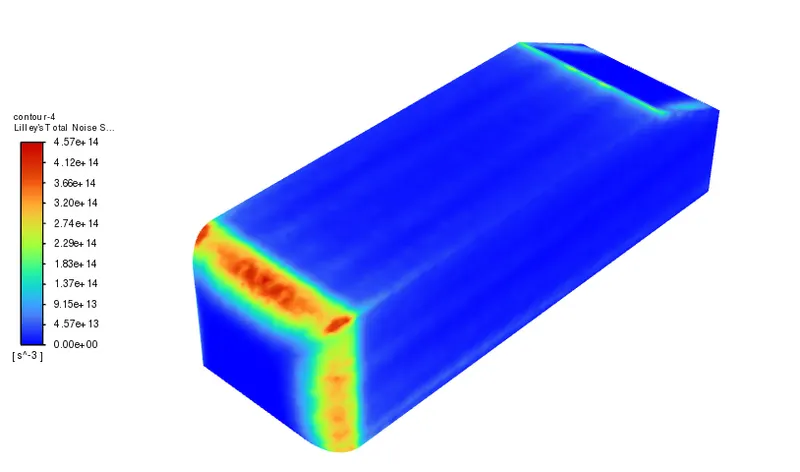
The image above provides further evidence of the noise generated from the leading edge of the Ahmed body. This region of increased noise generation can be attributed to the local increase in velocity (previously observed in the velocity distribution) caused by the convex nature of the leading edge.
Conclusion
The simulation of a flow over the given Ahmed body at a velocity of 110kmph was conducted. Distributions of pressure coefficients and velocity around the Ahmed body were analyzed to understand the flow behaviour. The broadband noise source model was used to analyze the aerodynamic acoustics around the Ahmed body. The leading edge of the Ahmed body and wake at the rear were seen to be the major sources of noise. The boundary layer region around the no-slip walls of the Ahmed body was also seen to generate a considerable amount of noise.
References
- Ahmed, S. R., Ramm, G., & Faltin, G. (1984). Some Salient Features of the Time-Averaged Ground Vehicle Wake. SAE Transactions, 93, 473–503. http://www.jstor.org/stable/44434262