Week 10 Thermal Management
1. AIM
Thermal management techniques for an electric car battery pack.
2. THEORY
Electric vehicles use large batteries to store energy. The energy flowing into the battery pack as it is charged either from regenerative braking or from the grid and discharged from the pack to power the vehicle and its accessories is measured by electrical current and voltage. The flow of current causes heating in the battery cells and their interconnection systems are proportional to the square of the current flowing multiplied by the internal resistance of the cells and the interconnect systems. The higher the current flow the more the heating effect will be. At AVID we design and manufacture lithium battery systems you can find out more about that here.
The performance of Lithium-Ion battery cells is greatly impacted by their temperature, they suffer from the Goldilocks effect, they do not perform well when too cold or too hot, which can lead to permanent and extreme damage of the cells or accelerated degradation. So in addition to cooling, heating of the cells may also be required at lower ambient temperatures to prevent damage during fast charging when the cells are too cold; this is because the internal resistance of the cells rises when they are cold. Most lithium battery cells cannot be fast-charged when they are less than 5oC and cannot be charged at all when they are below `0^oC`. Lithium cells also begin to degrade quickly when their temperature is above `45^oC`.
In the past, the largest battery packs did not necessarily need any special cooling as the physical size of the packs was sufficient and the relative flow of current was not large compared to the overall capacity of the pack. As ever faster battery charging rates are demanded with recharge power of over 200kW to deliver times of 30 minutes or less, higher performance electric vehicles with a requirement for consistent performance and adequate durability in global markets has meant that special thermal management methods for the battery pack are now required.
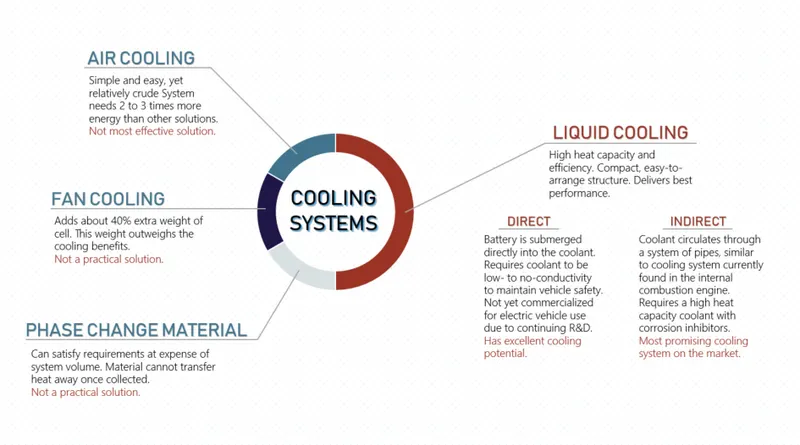 |
There are a few options to cool an electric car battery which are as follows:
Phase change material absorbs heat energy by changing state from solid to liquid. While changing phase, the material can absorb large amounts of heat with little change in temperature. Phase change material cooling systems can meet the cooling requirements of the battery pack, however, the volume change that occurs during a phase change restricts its application. Also, phase change material can only absorb heat generated, not transfer it away, which means that it won’t be able to reduce the overall temperature as well as other systems. Although not favorable for use in vehicles, phase change materials can be useful for improving thermal performance in buildings by reducing internal temperature fluctuations and reducing peak cooling loads.
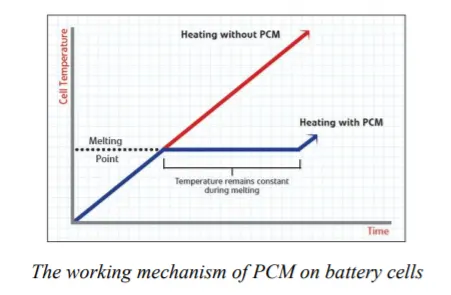 |
During melting, heat is absorbed by PCM and is stored as latent heat until the latent heat is up to the maximum. The temperature is kept at the melting point for a period and the temperature increase is delayed. Therefore, PCM is used as a conductor and buffer in battery thermal management systems. The figure shows the working mechanism of PCM on battery cells. Also, a PCM is always combined with an air cooling system or liquid cooling system to manage the battery temperature.
Cooling fins increase surface area to increase the rate of heat transfer. Heat is transferred from the battery pack to the fin through conduction, and from the fin to the air through convection. Fins have high thermal conductivity and can achieve cooling goals, but they add a lot of additional weight to the pack. The use of fins has found a lot of success in electronics, and traditionally they have been used as an additional cooling system on internal combustion engine vehicles. Using fins to cool the electric car battery has fallen out of favor since the additional weight of the fins outweighs the cooling benefits.
Air cooling uses the principle of convection to transfer heat away from the battery pack. As air runs over the surface, it will carry away the heat emitted by the pack. Air cooling is simple and easy, but not very efficient and relatively crude compared to liquid cooling. Air cooling is used in earlier versions of electric cars, such as the Nissan Leaf. As electric cars are now being used more commonly, safety issues have arisen with purely air-cooled battery packs, particularly in hot climates. Other car manufacturers, such as Tesla, insist that liquid cooling is the safest method.
Liquid coolants have higher heat conductivity and heat capacity (ability to store heat in the form of energy in its bonds) than air, and therefore performs very effectively and own advantages like compact structure and ease of arrangement. Out of these options, liquid coolants will deliver the best performance for maintaining a battery pack in the correct temperature range and uniformity. Liquid cooling systems have their own share of safety issues related to leaking and disposal, as glycol can be dangerous for the environment if handled improperly. These systems are currently used by Tesla, Jaguar, and BMW, to name a few.
As discussed above we can also distinguish the above options into Thermal Management Systems as follows:
1. Forced Air Systems
A forced-air cooling system with a simple structure has the advantage of high reliability and low cost as well as easy maintenance, while it has poor thermal management, i.e. beyond operating temperature, uneven uniformity of temperature distribution, and spread of thermal runaway.
In high ambient temperatures e.g. 45°C-50°C, the temperature inside the battery pack exceeds 55°C which is beyond the operating temperature and will result in thermal runaway. The uniformity of temperature distribution is also crucial due to the effect of degradation and cycle life. If one ignores the ambient temperature, the difference between cells is 2°C at the discharge current 2C-rate, and 4.8°C at the discharge current 6.67C-rate. The uniformity of temperature distribution is also affected by the flow rate. As the flow rate increase, the cell maximum temperature difference will increase, e.g. 3K at Re=136 and 4.8K at Re=1347. With the increasing flow rate, the cell maximum temperature difference can be even over 5K. (Sabbah, et al., 2008) It will give rise to degradation and the decrease of cycle life because the heat transfer between cells is quicker than the heat transfer from the battery pack to air. So if one cell fails, thermal runaway will spread over the battery pack.
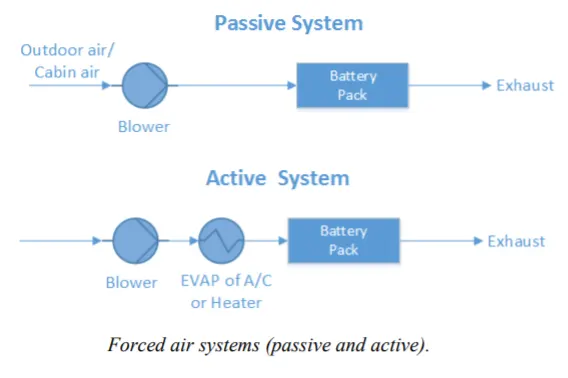 |
So for air cooling to dissipate heat as much as water cooling, it requires a higher volumetric flow rate which means more space and more power. Air cooling system takes up larger space and consumes much more energy comparing to a liquid cooling system.
2. Liquid Systems
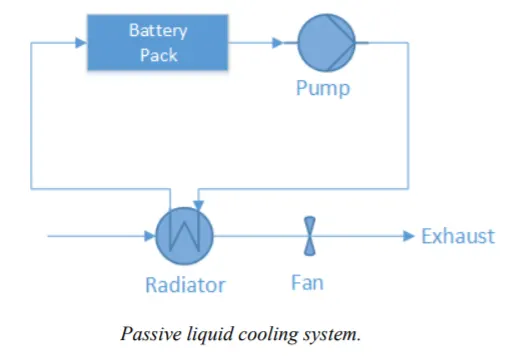
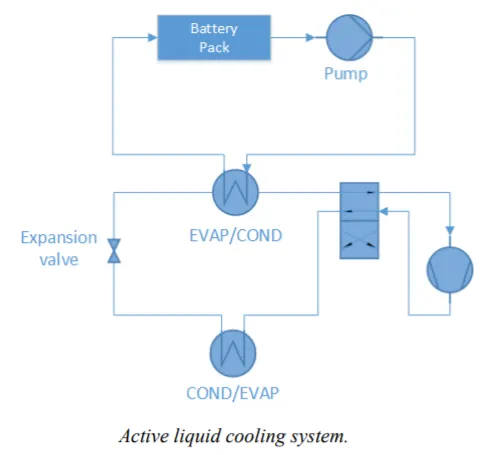
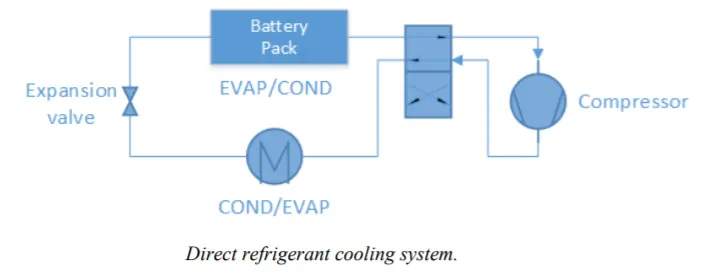
There are three types of cooling systems, namely passive cooling system, active cooling system, and refrigerant cooling system.
 |
 |
 |
|
The passive cooling system is affected by the ambient temperature because the heat dissipation is dependent on the radiator and the radiator dissipates heat through the temperature difference between liquid and the ambient temperature. Under normal circumstances, it works well, but under high ambient temperature, it is insufficient.
Active cooling systems have a good thermal performance which can keep the battery pack within the operating temperature and keep temperature distribution between cells even because of the high heat co-efficient of the coolant. Due to many auxiliaries and moving parts, the structure is complicated and difficult to maintain. It also has the tendency of leaking out.
Compared to active cooling systems, direct refrigerant cooling systems are more efficient because they use refrigerant directly to cool the system instead of using a refrigerant to cool coolant first and then using coolant to cool the system. The weaknesses of the refrigerant cooling systems are complicated structure and difficult maintenance, as well as potential to leak out and so on.
3. PCM system
PCM cooling systems perform well on thermal management. Even under high ambient temperatures from 45°C to 50°C, the temperature inside the cell pack is always below 55°C because of high thermal conductivity and latent heat. In the case of stressful situations e.g. at the current discharge rate 6.67C-rate and ambient temperatures of 45°C, the cell maximum temperature difference doesn’t exceed 0.5K. And at normal conditions the difference of temperature between cells is negligible. If one cell fails, thermal runaway will not propagate because the PCM-graphite matrix absorbs and spreads the heat quickly.
The weakness of PCM is that it is more suitable for cold conditions or in space. When the temperature of the battery pack is higher than the temperature of the PCM melting point, heat is stored as latent heat and will be released to the module of the battery when the ambient temperature is lower than the temperature of the PCM melting point.
The structure of PCM without new components is simple, light, and space-saving. But it still has the potential of flammability and electrical conductivity as well as volume change due to the characteristic of the PCM-graphite.
4. Thermo-electrics
Thermo-electrics have small and lightweight structures and can turn a heating element to an efficient cooling element by reversing the polarity. Without moving parts to wear, thermo-electrics are reliable, durable, and of low maintenance. And also easy to replace in case of failure. In addition, the operation is quiet and vibration-free.
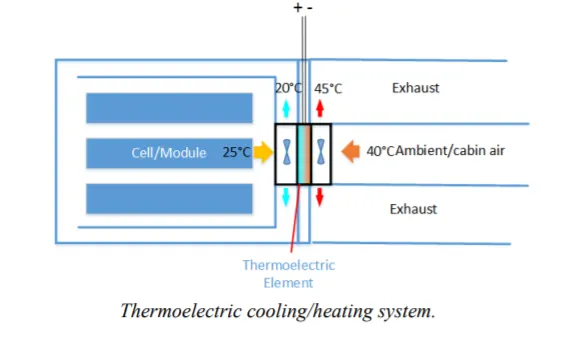 |
The weakness of thermo-electrics is low efficiency. The highest efficiency is up to 0.8 which means more power is needed than heat dissipated. The performance is associated with the required temperature difference. The greater the temperature difference is, the lower the pumping capacity is, until it stops working at 70K. So under high temperatures, the temperature difference is great and thermo-electrics perform badly. And there is one technical problem not solved: that the hot and cold sides are close to each other.
3. CONCLUSION
Since electric vehicles have become so widely used, there is a high demand for longer battery life and higher power output. To achieve this, the battery thermal management systems will need to be able to transfer heat away from the battery pack as they are charged and discharged at higher rates. The heat generated as the battery is used can pose safety threats to the passengers. Due to the high stress and temperatures generated by the batteries, there is even higher importance on having the correct coolant and additive package. While companies such as Tesla, BMW, and LG Chem can use a traditional liquid coolant for their indirect cooling systems, continued research and development will need to be done on battery packs and coolants to advance electric vehicle safety.