Week 10 Thermal Management
The thermal management system for an electric battery back can be of following types :
- Air Cooling
- Fin Cooling
- Phase Change Material Cooling
- Direct Liquid Cooling
- Indirect Liquid Cooling
Discussing each cooling type point wise:
1. Air Cooling : It uses the principle of heat convection for heat transfer through air. The air runs through the battery to dispose heat generated by the cells. It can be of forced convection type like using fans as in CPU or can be natural convection type by using air slots as in the case of lead acid battery enclosure. It is the simplest and easiest type of cooling but not very efficient as compared to liquid cooling. It is not advisable to deploy only this cooling method in hot climate region due to battery safety issues. Earlier version of nissan leaf used this type of cooling.
2. Fin Cooling : In this heat transfer is done more effectively by increasing the surface area to increase the heat transfer rate. Fins are in contact with battery which transfers heat through conduction and fins then transfer heat further to air or liquid. The high thermal conductivity of fins make them suitable for effective cooling but they add a lot of additional weight to the battery pack. Fins were even traditionally used in internal combustion engine vehicles as an additional cooling system and are also used in many electronic systems. The additional weight of fins still remain the drawback of this kind of system. In prevelant tesla models, thin solid aluminium cooling fins is used to treansfer heat to base plate, which then transfers to glycol.
3. Phase Change Material (PCM) Cooling : PCM changes it's phase state by absorbing heat, eg. if ice changes to water in contact with a hot object then it is acting as a PCM material. The material can absorb large amount of heat with little change in temperature. The volume change that occurs during phase change restricts it's application in electric vehicles. The other drawback is that it can only absorb generated heat but not transfer it away, thus is unable to reduce overall temperature. It is more prefered for thermal performance improvement in buildings.
4. Indirect Cooling Systems : Liquid coolants are more preferred in electric vehicles since they have higher heat conductivity and heat capacity due to it's ability to store heat in the form of energy in it's bonds as compared to air. Thus, has a very effective cooling and best performance amongst all the optons above. They own advantages like ease of arrangement and compact structure. But, they have safety hazards like leakage and disposal (as glycol can be dangerous for enviornement if handled improperly). In indirect cooling, it is simiar to ICE cooling systems where liquid coolant is circulated through a series of metal pipes. Shape and structure of cooling system signifiacntly affects the ability of cooling system to transfer heat uniformly and effectively. Eg. Tesla, Jaguar and BMW uses this cooling system.
5. Direct Cooling Systems : It places the battery cells in direct contact with the coolant liquid. It is also called immersion type cooling system. They have advantages of less weight, fire suppression properties since liquid gives cell to cell thermal protection, electrical isolation since have insulating properties to provide isolation between cells reducing chances of sparks during transients, effective cooling due to liquid turbulence and direct contact, and also improves cycle life due to effective cooling. It's disadvantage is that it's costly due to complexity of system and coolant. 3M NOVEC is one such coolant for direct cooling. Currently, no cars have commercialy used and it is under prototype stage.
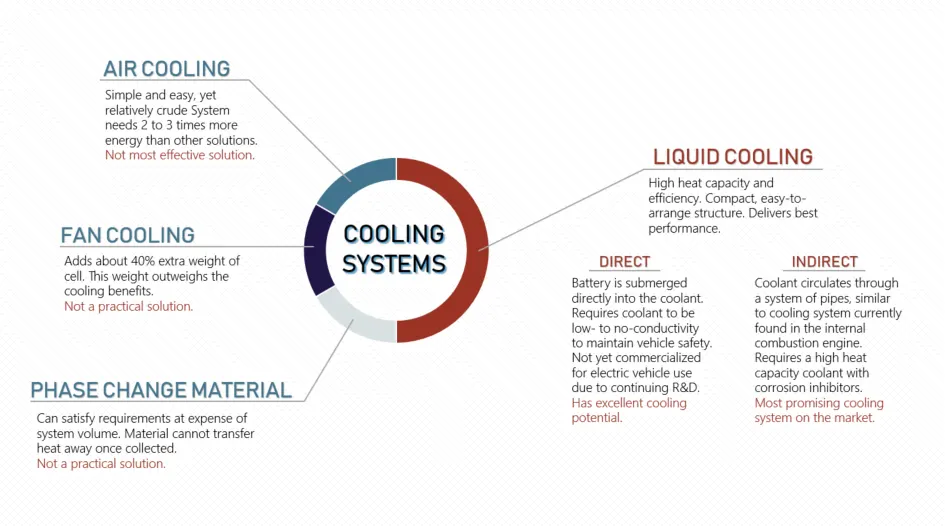
Thermal management system can also be classified as active or passive cooling as follows:
1. Active Cooling : In this type fo cooling, heat transfer takes place through forced convection. Forced air cooling (fans,..) or liquid cooling are some of the examples of active cooling. Most of the electric cars use active cooling for effective heat transfer to counter safety issues.
2. Passive Cooling : In this type of cooling, heat transfer takes place through natural convection. The enclosure of battery is designed in such a way to allow natural air flow or it's surface area contact with air is increased (as in the case of fins). Using Only Fin cooling / PCM cooling / natural air cooling are some of it's examples. These are used in low power applications such electric bike, electric scooter, electric rickshaw due to their low cooling requirements and low cost.