Week 10 Thermal Management
Thermal management techniques for electric car battery pack.
Battery Thermal Management System:
Thermal management systems are an important aspect of an electric vehhicle. as with the usage of motors, batteries and inverter which has to be cooled for optimal performance, as it has seen through various simulations that the battery functions best when operated near its optimal temperature range.
A battery pack is one of the most important and expensive component in the EV,HEV & PHEV. One of the most important factor that effecting the performance of the battery is operating temperature. All batteries depend for their action on an electrochemical process whether charging or discharging and we know that these chemical reactions are in some way dependent on temperature. Nominal battery performance is usually specified for working temperatures somewhere in the + 20°C to +30°C range however the actual performance can deviate substantially from this if the battery is operated at higher or lower temperatures. There are several designs used for cooling of batteries, primarly air, oil and water-glycol if the battery is very cold then the discharge curve will be very short and battery will discharge very quickly and if the battery gets heated above 50 degrees celsius then there will be a thermal runaway which means the rate of charge of heat will increase drastically and may even cause explosions. Lithium ion cells degrade quickly if operated above 45 degree celsius.
External Thermal Effects:
The thermal condition of the battery is also dependent on its environment. If its temperature is above the ambient temperature it will lose heat through conduction, convection and radiation. If the ambient temperature is higher, the battery will gain heat from its surroundings. When the ambient temperature is very high the thermal management system has to work very hard to keep the temperature under control. A single cell may work very well at room temperature on its own, but if it is part of a battery pack surrounded by similar cells all generating heat, even if it is carrying the same load, it could well exceed its temperature limits.
Thermal management has many advantages as it ensures the safety of the battery pack from thermal runaway or explosions due to heat, it ensures extended battery life with thermal management system.
Basically the heat transfer takes place in either of these three ways, Conduction, Convection and Radiation.
Hybrid Electric Vehicle (HEV) Battery Operating Requirements:
Capacity is less important with HEVs compared with EVs since the engine also provides capacity therefore the battery can be much smaller, saving weight. However the battery may still be required to provide the same instantaneous power as the EV battery from time to time. This means that the smaller battery must deliver much higher currents when called upon.
Plug in Hybrid Electric Vehicle (PHEV) Battery Operating Requirements:
Batteries for plug in hybrid vehicles must satisfy conflicting performance requirements.
Traction batteries are usually optimised for high capacity in the case of pure electric vehicles of for high power in the case of hybrid vehicles. The EV battery operates down to a deep depth of discharge (DOD) for long range whereas the HEV operates at a shallow DOD for long life.
The plug in hybrid is designed to be used both as an EV for city driving and as an HEV when the charge is depleted or for highway driving. The dual requirements for an extended all electric range, typically forty miles, as well as maintaining high power availability at low state of charge, (see below), impose very stressful conditions on the battery.
Battery thermal management systems are designed with four main essential functions to ensure the restriction of the thermal behaviour of the lithium ion cells within its allowable limits.
Cooling:
Cooling is an obvious essential function because when batteries are operating outside their limits, they become inefficient and generate unwanted heat. This heat has to be removed from the battery if the temperature of the cell has dropped below or exceeded a certain level. So, the BTMS needs to be able to cool the battery pack before its temperature can cross its allowable limits.
Heating:
Opposite to the cooling requirement, there are instances when the temperature of the battery pack may become too low which will also impair its performance. This may occur in environments with cold climates. As a result, the BTMS must have a heat function to increase the battery pack's temperature before it gets too low and keep it within the allowable limits so that its performance won't effected.
Insulation:
Insulation is important because if the temperature difference between the environment and the cell is too great, then the cell will get influenced by the environment's temperature. For instance, if the environment is hotter than the cell, the cell temperature will increase. Conversely, if the environment is much colder than the cell, the cell temperature will decrease. In either case, there is a risk of the cell temperature falling outside the allowable limits, and the BTMS needs to have insulation to prevent this.
Ventilation:
Ventilation is needed for two reasons. The first is that it will allow for cooling of the battery pack when it gets too hot and the another one is that the hazardous gases produced by the battery pack need to be removed and this is combined with the ventilation and cooling systems.
Three common types if thermal management systems:
- Convection to air either passively or forced
- Using dielecteric to feed the battery and pass on the heat to a heat exchanger
- Circulation using water-based cooling or glycol as coolant
Battery Thermal management techniques:
Air Cooling and Heating:
Air cooling and heating system will use air as the thermal medium. The air used by the system can be taken from the atmosphere which is done in passive air systems. Otherwise the cold air coming from the air conditioning systems in the vehicle can as is done in active air systems. Passive system can provide cooling and heating power in the order of hundreds od watts whereas active air systems can provide up to 1kW. In both systems, the air is supplied to the battery pack by a blower and so both systems come under the category of 'forced air system'. The diagrams below show the working of both systems.
In the passive system, we can see that outdoor air is taken in by the blower/fan and supplied directly to the battery pack. The used air becomes hot and is made to exit the air system through an exhaust port. This is the same process used in active systems with the only difference being that the blower will supply the evaporated air of the AC or the heater to the battery pack before leaving through the exhaust.
Air systems will provide the main functions of heating, cooling and ventilation with the exception of insulation. The air leaving through the exhaust port cannot be reused by the air system with the help of a modification, the air system can be fitted with an air-air heat exchanger to recover the heat from the exhaust air and prevent the exhaust air from mixing with the intake air. This is very useful as it can provide the the heating function to warm up a battery if it gets too cold. Also, this feature increase the efficiency of the air system in that the heat removed is used again.
Forced air system are benificial in that they have good reliability and low maintenance, although thet have poor thermal management. During high ambient temperatures, the battery pack operating temperature becomes even greater than that of the ambient temperature and this leads to the thermal runaway. The temperature gredient between the ambient air and cells is affected by the flow rate of air out of the forced air systems. At high flow rates, the maximum temperature difference between the cells increases which influences degradation and a decrease in the working life. Air also has a much lower heat transfer coefficien than water and for it to be able to dissipate as much heat as water can, it needs a higher flow rate which will take up more space and more power.
Liquid cooling and Heating:
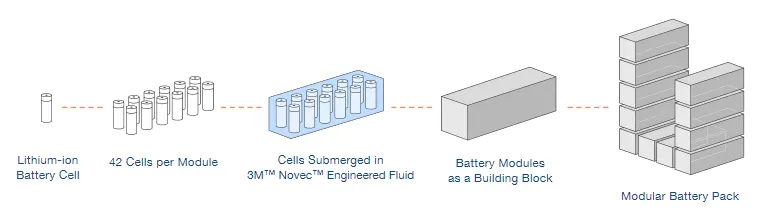
In these systems, the thermal medium used is a liquid and there are two mmain types of liquids used. The first is a dilelectric liquid which can come into direct contact with the cells and an example of such a liquid is mineral oil. The other type of liquid is conducting liquid which doesnot come into direct contact with the cells and an example of this type is a mixture of ethylene glycol and water. Depending on the type of liquid used, different constructions are used for the liquid systems. For instance, if the dielectric liquid is used, the battery modules are submerged in them whereas if the conducting liquid is used, they will flowthrough a jacket around the battery modules or a discrete tubing. The conductive liquid type is preferred over the dielectric type because it will ensure that the battery module is kept separate from the liquid which is safer.
Liquid systems can also be subdivided into passive and active systems both of which use heat sinks for cooling. In passive systems, the heat sink used as a radiator and it has no ability to heat. The liquid i.e; heat transfer fluid is circulated by a pump and will absorb the heat from the battery pack and will relese it through the radiatr. The heat transfer liquid circulates around a closed llop. Depending on the temperature between the ambient air and the cell temperature, the cooling power can be great or poor. Some systems may also implement a fan to aid the cooling process but if the ambient air is too hot or the temperature gradient between the ambient air and cell is too small, then the passive system becomes inefficient. The diagram below shows the working of passive lliquid system.
In active liquid systems, there are two loops used. The first loop is the primary loop which is same as that used in the passive system, where the pump will circulate the heat transfer liquid to remove the heat from the battery pack. The second loop is the second loop in which air conditioning occurs. There are tow heat exchangers which operate as either evaporators or cndensers. When the battery pack needs to be cooled, the upper heat exchanger works as an evaporator where heat absorbed by the heat transfer liquid is cooled. The upper heat exchanger will connect the two loops together. However, when the battery pack needs to be heated, the 4 way valve is switched on and the upper HE willwork as a condenser, where as lower HE will works as the evaporator. The diagram below shows the working of active lliquid system.
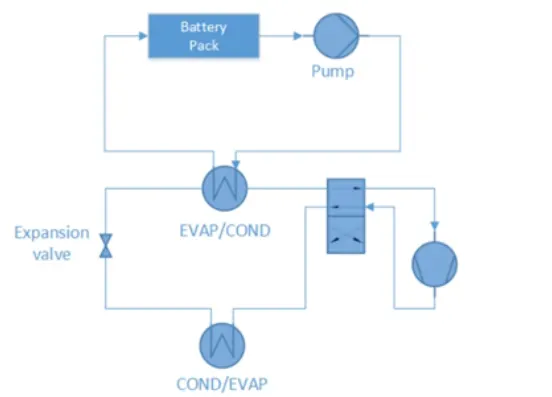
The passive cooling system is the only liquid cooling system which is effected by the ambient temp. because it is the only one that uses a radiator to dissipate the heat. Under normal conditions, this system works fine but if the ambient temp. becomes too hot, then the system becomes incapable of cooling. Active cooling cooling systems have better thermal performance because they are not as dependent on the ambient temperature beacuse it actively cools the liquid during recirculation. This will keep the cell temperature within the allowabe limits and also maintain an even temp. distribution between the cells due to the high heat transfer coefficient of water. However, these systems have more moving parts and so are more compicated and also have a risk of liquid medium leaking out.
Refrigent Cooling and Heating System:
These systems are quite similar to active liquid systems, in that thet will perfoem both heating and ccoling operations with a HE but instead of using a heat transfer liquid, a refrigerant is used instead to be circulated around the battery pack. These systems are also called direct refrigerant system (DRS). From the diagram below, we can see that they use a compressor, a 4 way valve and an expansion valve.
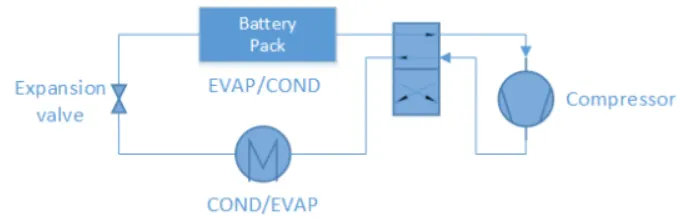
DRS are more efficient than liquid coold system. The main disadvantage of DRS is that they also have a complicated structure design and also have a riske of leaking out from the system.
Phase Change Materials (PCM):
Phase Change Materials (PCMs) store thermal energy by the phase change from solid to liquid, since the latent heat from melting or freezing is at least 1-2 orders of magnitude higher than the energy stored by the specific heat. During melting, heat is absorbed by PCM and is stored as latent heat until the letent heat is up to maximum. The temperature is kept at melting point for a period and the temp. increase is delay. Therefore, PCM is used as conductor and buffer in battery thetmal system. When comparing a traditional active cooling system to one that uses PCM, you will not likely see a difference in operating temperature, because both of them have to be designed to stop the cells from getting too hot. However, All Cells says that when you look at a pack with no thermal management versus a pack encased in PCM, the operating temperature is reduced by 10° C or more. Below figure shows the working mechanism of PCM on battery cells. Also, PCM always combines with air cooling system or liquid cooling system to manage the battery temperature.
Immersion cooled:
Immersion cooling involves submerging the battery cells in a liquid coolant, in doing so superior thermal contact and homogeneity can be achieved. Additionally, the flameretardant nature of the fluids acts as a safety feature, suppressing thermal runaway events before they propagete between cells. A key consideration here is obviously the choice of coolant fluid used, through primary research. These fluids are all dielectrics but vary in their properties with factors such as weight, thermal conductivity, environmental consideration and cost being extremely important. The expected outcome is to keep the cell temperature within the optimum range with a method that's both easier/cheaper and thus increase availabe power output/charging power and extend cell longevity.
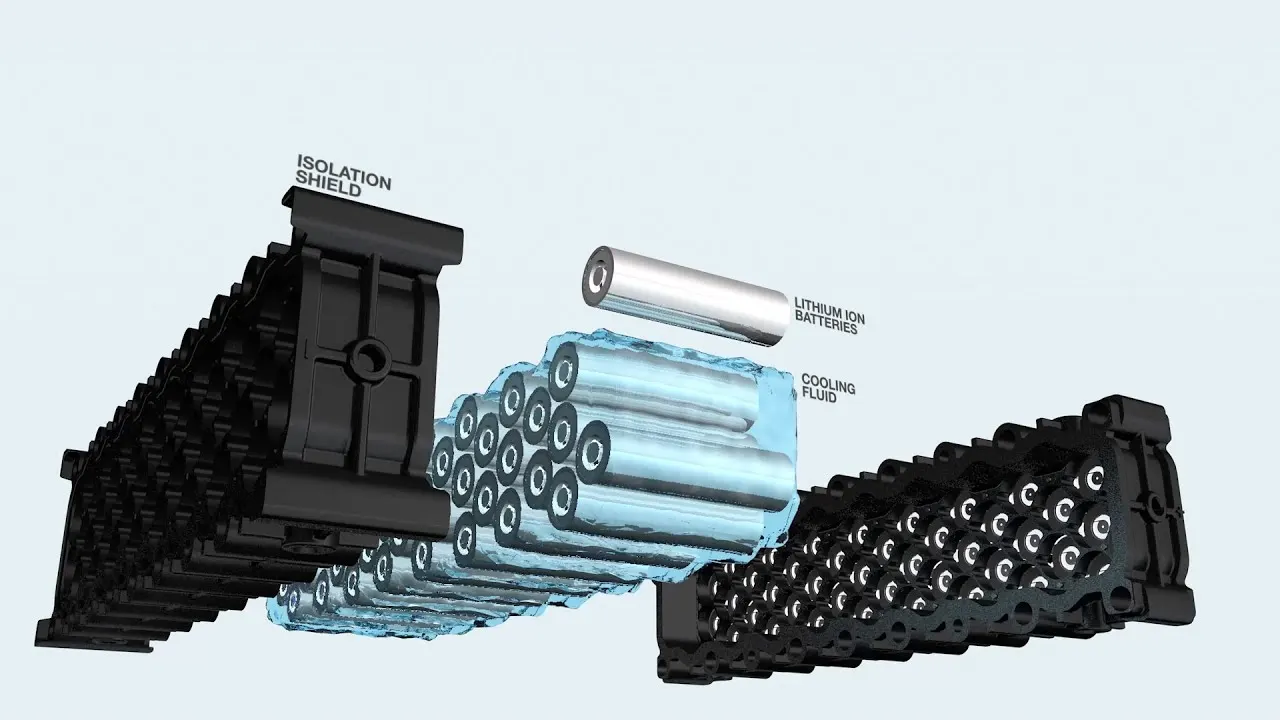
Benifits of Immersion cooling:
- Eliminates of all conductive fluids in the battery
- Increased thermal transfer through direct contact of the coolant with the entire casting and tabs of the battery (as opposed to just tab cooling with cold plates).
- Simplification of the internal battery structure as all the heat sinks, thermal transfer materials, complex support matricies and cold plates are eliminated and replaces with a simple container that surrounds the batteries and is filled with a minimum amount of fluid.
- Reduced weight through the elimination of the excess materials and complex systems.
- Icreased reliability through gretaer thermal transfer and elimination of the failure senarios.
- Better vehicle range and faster charging due to betterr thermal management.
The EV battery is large with good heat dissipation possibilities by convection and conduction and subject to a low temperature rise due to its high thermal capacity. On the other hand the HEV battery with fewer cells, but each carrying higher currents, must handle the same power as the EV battery in less than one tenth of the size. With a lower thermal capacity and lower heat dissipation properties this means that the HEV battery will be subject to a much higher temperature rise.
Battrey cooling system in Tesla Model S:
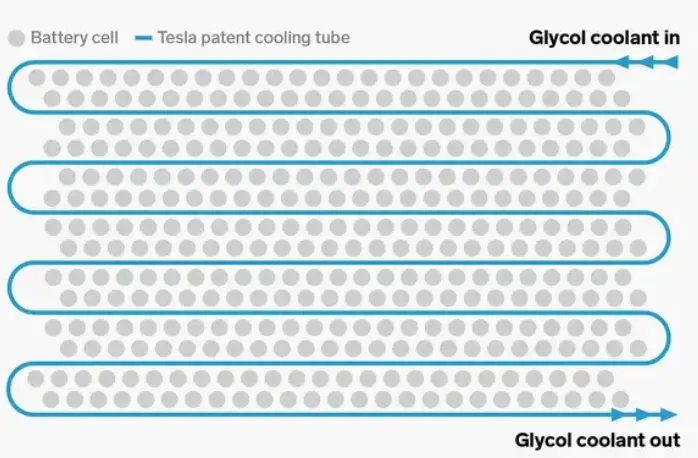
The Tesla Model S battery cooling system consists of a patented serpentine cooling pipe that winds through the battery back and carries a flow of water-glycol coolant, thermal contact with the cells is through their sides by thermal transfer material. Again this will remove heat from the side of the cells rather than from the tabs, and overheating a Tesla battery pack undr hard driving is easy to do.
Conclusion:
Battery Thermal Management System is very important in an any electrical appliances especially in electric vehicle, because the whole system is depends on the battery pack, if the battery temperature in imbalace there are sevier damages takes place. These are the some of the Battery thermal management techniques used in electrical vehicles. So, all the different management systems need to be work together in sync to ensure the battery pack gives its best performance.