Week - 10 Hyperelastic Material Models
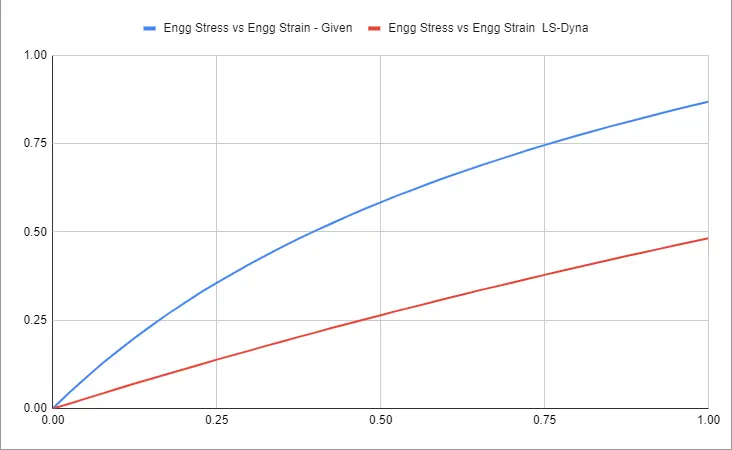
Objective: To create a Hyperelastic material model with stress-strain curve data and extract Mooney Rivlin and Ogden constant parameters and Evaluation the material constant with actual material data.
Introduction
Hyper-elastic Material
Hyperelastic material models are regularly used to represent the large deformation behavior of materials with FEA. They are commonly used to model mechanical behaviors of unfilled/filled elastomers. In addition to elastomers, hyperelastic material models are also used to approximate the material behavior of biological tissues, polymeric foams, etc.
Linearly elastic materials are described through two material constants (like Young’s modulus and Poisson ratio). In contrast, hyperelastic materials are described through a strain-energy density function. The strain-energy density can be used to derive a nonlinear constitutive model (i.e., stresses as a function of large strain deformation measures like deformation) which are derived by researches and some acceptable models we are using popularly such as Neo-Hookean, Mooney-Rivlin and Signorini models, Ogden, Yeoh, Arruda-Boyce.
MOONEY RIVLIN MODEL
The strain energy density function for an incompressible Mooney–Rivlin material is defined as

Where `Cij`are empirically determined material constants, `I1`and `I2` are the first and the second invariant. By varying the Index values of `i` and `j` we can change the constitutive equations and use it appropriately for our component. Similarly, we will be having multiple coefficients C. This changing of the index will be basically changing the order of the polynomial of the energy density equation
We need to find out the coefficients of these material models for a different order of the polynomial and extract the best fit curve data from the D3HSp file and compare it with the material curve.
Procedure:
- Hyper-elastic Material Card
*MAT_007 *MAT_BLATZ-KO_RUBBER- This is Material Type 7. This one parameter material allows the modeling of nearly incompressible continuum rubber. The Poisson’s ratio is fixed to 0.463.
*MAT_027 *MAT_MOONEY-RIVLIN_RUBBER-This is Material Type 27. A two-parametric material model for rubber can be defined.
*MAT_077_h *MAT_HYPERELASTIC_RUBBER This is Material Type 77. This material model provides a general hyperelastic rubber model combined optionally with linear viscoelasticity
*MAT_077_o *MAT_OGDEN_RUBBER This is also Material Type 77. This material model provides the Ogden rubber model combined optionally with linear viscoelasticity
Apart from these common hyperplastic materials for rubber there other material models too such as MAT_031, 038, 057, 063, 083, 092, 127, 129.
However, MAT_007 is a very simple rubber model with just one parameter to defined i.e. (Shear Modulus) and cannot be used for our case. MAT_027 represents Mooney Rivlin constitutive model but this will only solve with First order of polynomial.
So we will use MAT_077_h which represents Mooney Rivlin constitutive model and Different order of polynomial from 1 to 3 and find the material constant for each order. We can import a Load curve (experimental data value) and set SGL, SW, and ST parameters as 1 if the load curve is stress vs strain data.
DATA FROM D3HSP FILE:
- The Mooney Rivlin constants for each case are stored in the d3hsp file:
1. Case 1: N = 1 - First order polynomial
Fit to General Hyperelastic material ID= 1
Mooney constant c1 = 0.1768E+00
Mooney constant c2 = 0.1474E+00
2. Case 2: N = 2 - First order polynomial
Fit to General Hyperelastic material ID= 1
Hyperelastic Constant C10= 0.2595E+00
Hyperelastic Constant C01= 0.4594E-01
Hyperelastic Constant C11= -0.2092E-01
Hyperelastic Constant C20= 0.2914E-02
Hyperelastic Constant C02= 0.1016E-02
Hyperelastic Constant C30= 0.0000E+00
3. Case 3: N = 5 - First order polynomial
Fit to General Hyperelastic material ID= 1
Hyperelastic Constant C10= 0.2611E+00
Hyperelastic Constant C01= 0.4420E-01
Hyperelastic Constant C11= -0.6074E-02
Hyperelastic Constant C20= -0.2667E-02
Hyperelastic Constant C02= -0.9968E-02
Hyperelastic Constant C30= 0.1565E-03
OGDEN MODEL
Ogden Hyper-elastic model is the expressed the strain energy function W in terms of principal stretches:
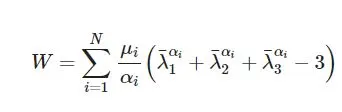
The same procedure is followed for building the Ogden Material Deck. Since there 8 order of polynomial in this material model we will use 1,3,5 order of polynomial for this case. Density, Passion ratio, SGL, SW, and ST parameters are set with the same value we used for MAT_077_h
DATA FROM D3HSP FILE:
- The Ogden constants for each case are stored in the d3hsp file:
1. Case 1: N = 1 - First order polynomial
Final approximate solution:
mu(1)= 9.1076024661337E-01, alpha(1)= 1.3427238801352E+00
2. Case 2: N = 3 - First order polynomial
Final approximate solution:
mu(1)=-3.1842578660770E-02 alpha(1)= 1.9263321415718E+00
mu(2)= 2.6137553188979E-01 alpha(2)= 1.5503405395029E+00
mu(3)= 6.8199192355454E-01 alpha(3)= 1.2887820956418E+00
3. Case 3: N = 5 - First order polynomial
Final approximate solution:
mu(1)= 4.0323924630373E+00 alpha(1)= 7.2546287513916E-01
mu(2)= 5.6430132457996E+00 alpha(2)=-7.6993042273283E-01
mu(3)=-2.0665861872825E+00 alpha(3)=-2.2776329295900E+00
mu(4)= 7.2195001697858E-01 alpha(4)=-3.8401971795454E+00
mu(5)=-1.3518352114994E-01 alpha(5)=-5.2265184394240E+00
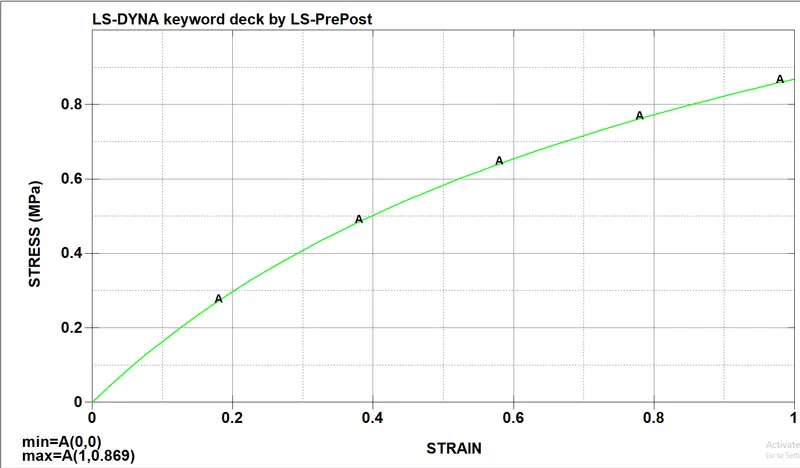
GIVEN CURVE DATA:
LS-DYNA DATA:
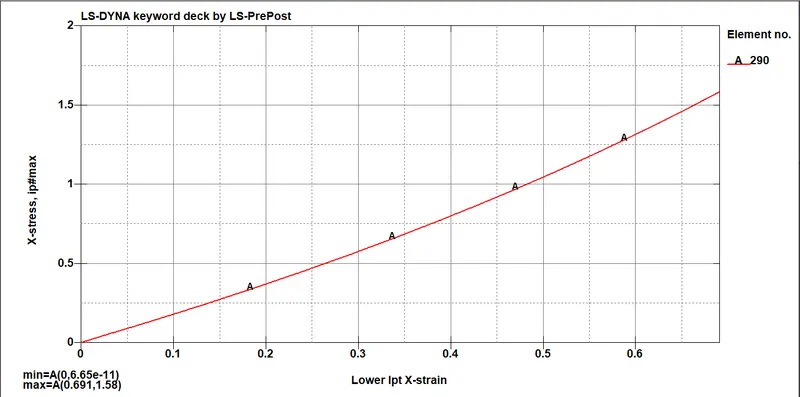
Curve comparison: