Week 1 Understanding Different Battery Chemistry
1) Lithium Ion Cells
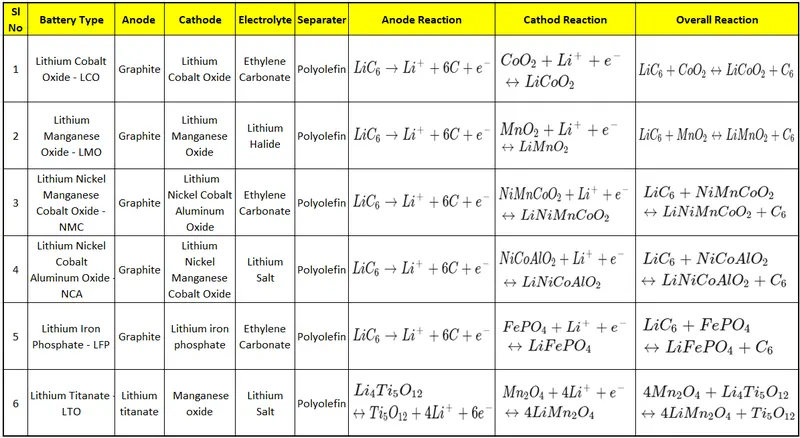
Lithium ion batteries work on a concept associated with metals called electrochemical potential. Electrochemical potential is the tendency of a metal to lose electrons.Lithium is the metal which has the highest tendency to lose electrons and it is used in lithium ion cells. It has only one electron in its outer shell and it wants always to lose this electron. Due to this reason, pure lithium is a highly reactive metal and it even reacts with water and air.lithium battery operation is the fact the lithium, in its pure form, is a reactive metal but when it is a part of a metal oxide is quite stable. If we assume that somehow we are able to separate the lithium atom from this oxide, since its instability, it will form a lithium ion and an electron. If we can provide two different paths for the electron and lithium ion flow between the lithium and the metal oxide, the lithium atom will automatically reach the lithium oxide part. During this path we have produced electricity from the electron flow through the one path. Hence, essentially, we can produce electricity from this metal oxide if we firstly separate the lithium atom and then we guide the electron separate from the atom through an external circuit.
In addition to metal oxide a lithium battery also uses electrolyte and graphite. Graphite has a layered structure. This layers are loosely bounded in order to easily store the lithium ions in them. The electrolyte, which is located between graphite and metal oxide, acts as a guard which allows only lithium ions through ( no electrons are allowed to pass). If we connect a power source between the two metals, the positive side will attract and remove electrons from the lithium atoms of the metal oxide. This electrons will flow through the external circuit, since they can not flow through the electrolyte, and reach the graphite layer. In the mean time the positively charged lithium ions will be attracted from the negative terminal and they will flow through the electrolyte reaching the graphite space. When the lithium ions reach the graphite sheet, the battery is fully charged. When the power source is removed and a load is connected; the lithium ions want to go back to their stable state as a part of the metal oxide. Due to this tendency the lithium ions move via the electrolyte and the electrons via the load. That's how we get an electrical current through the load.
- LCO or Lithium Cobalt Oxide (LiCoO2)
- LMO or Lithium Manganese Oxide (LiMn2O4)
- NMC or Lithium Nickel Manganese Cobalt Oxide (LiNiMnCoO2)
- NCA or Lithium Nickel Cobalt Aluminum Oxide (LiNiCoAlO2)
- LFP or Lithium Iron Phosphate (LiFePO4)
- LTO or Lithium Titanate (Li2TiO3)
1 . LCO or Lithium Cobalt Oxide (`LiCoO_2`)
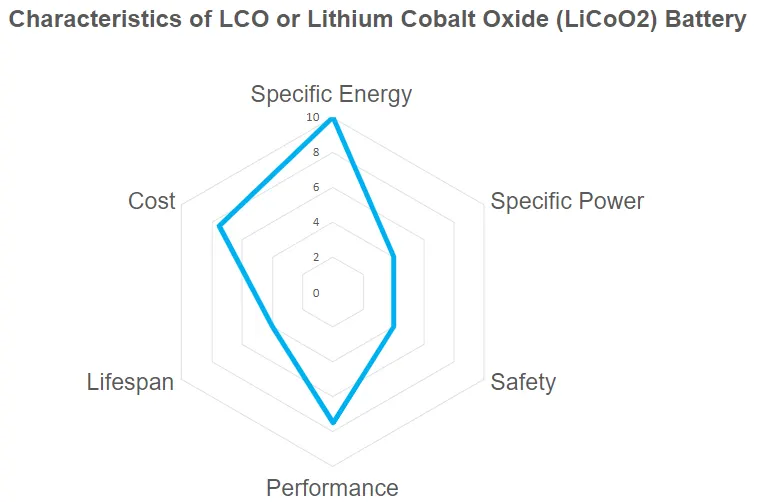
The specific combination of lithium, cobalt, and oxygen used in LCO cells provides high energy density, which means they can store a lot of energy relative to their size and weight.LCO cells have a cathode made of lithium cobalt oxide, an anode made of carbon, and an electrolyte that allows lithium ions to move between the cathode and anode during charging and discharging. During charging, lithium ions are extracted from the cathode and inserted into the anode, storing energy. During discharge, the process is reversed, and lithium ions move from the anode to the cathode, releasing energy that can be used to power devices.
The drawback of Li-cobalt is a relatively short life span, low thermal stability and limited specific power.
Applications : Camera, Laptops, Mobile phones, Tablets.
2. LMO or Lithium Manganese Oxide (`LiMn_2O_4`)
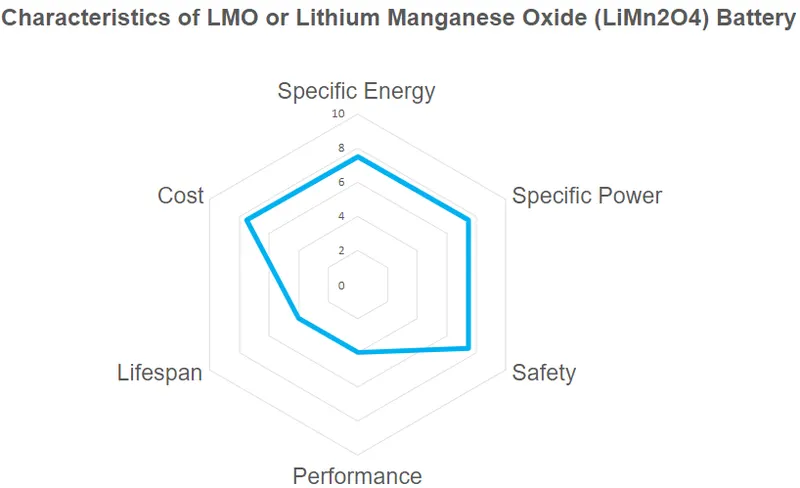
LMO cells have a cathode made of lithium manganese oxide, an anode made of graphite, and an electrolyte that allows lithium ions to move between the cathode and anode during charging and discharging.The cathode of LMO cells is made of a mix of lithium, manganese, and oxygen, which provides a stable structure and helps prevent the battery from overheating during charging and discharging. The anode is made of graphite, and the electrolyte is typically a lithium salt in an organic solvent.LMO cells are commonly used in power tools, electric bicycles, and other applications where safety and reliability are essential. They can also be used in electric vehicles, but their lower energy density makes them less efficient than other Lithium-ion battery types, such as Lithium Nickel Manganese Cobalt Oxide (NMC) or Lithium Iron Phosphate (LFP) cells.
Applications : Medical devices, Portable Power tools, Hybride and Electric Vehicles and Power trains.
3. NMC - Lithium Nickel Manganese Cobalt Oxide (`LiNiMnCoO_2`)
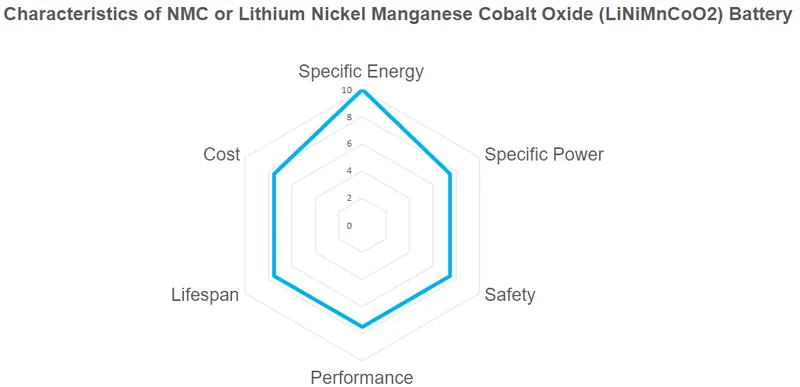
Lithium Nickel Manganese Cobalt Oxide, also known as NMC, is a type of cathode material used in lithium-ion batteries. It is a mixture of nickel, manganese, cobalt, and lithium oxide, typically with a chemical formula of LiNiMnCoO2.
NMC has become a popular choice for electric vehicle batteries and other high-energy applications due to its high energy density, good cycling stability, and low cost compared to other cathode materials.
The composition of NMC can vary, with different ratios of nickel, manganese, and cobalt used to optimize the material's performance for specific applications. For example, NMC with a higher nickel content generally provides higher energy density, while NMC with a higher manganese content tends to have better stability and safety.
Applications : E-Bikes, EV's, Medical devices, Industrial applications.
4. NCA - Lithium Nickel Cobalt Aluminum Oxide (`LiNiCoAlO_2`)
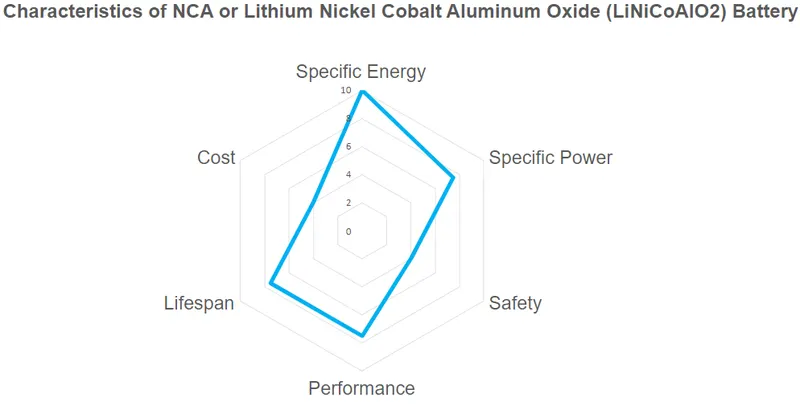
Lithium Nickel Cobalt Aluminum Oxide, also known as NCA, is a type of cathode material used in lithium-ion batteries. It is a mixture of nickel, cobalt, aluminum, and lithium oxide, typically with a chemical formula of LiNiCoAlO2.
NCA has gained popularity in electric vehicle batteries due to its high energy density, which enables longer driving ranges, and its excellent cycling stability, which allows for long battery lifetimes. NCA also has a high specific capacity, meaning it can store more energy per unit of weight than many other cathode materials.
The specific composition of NCA can vary depending on the desired performance characteristics. Generally, NCA with a higher nickel content provides higher energy density, while a higher cobalt content provides better stability and longer battery life.
Application : EV's, Medical devices, Power trains
5. LFP or Lithium Iron Phosphate (`LiFePO_4`)
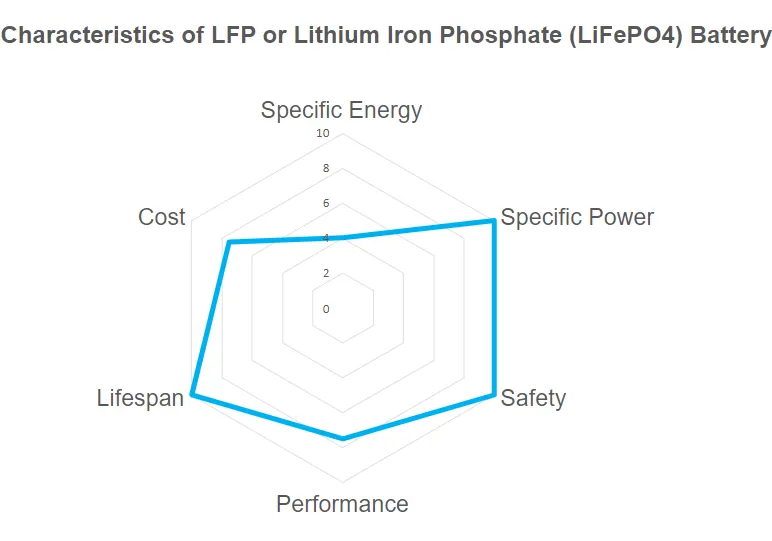
Lithium Iron Phosphate, also known as LFP, is a type of cathode material used in lithium-ion batteries. It is a mixture of iron, phosphorus, and lithium, typically with a chemical formula of LiFePO4.
LFP has gained popularity for its high thermal stability, excellent cycle life, and relatively low cost compared to other cathode materials. LFP is also known for its excellent safety characteristics, as it is less prone to thermal runaway and other safety hazards compared to other cathode materials.
LFP batteries are commonly used in applications where safety and reliability are critical, such as electric vehicles, backup power systems, and grid storage. However, LFP batteries generally have a lower energy density than other cathode materials, which limits their usefulness in some high-energy applications.
Despite its lower energy density, LFP remains a popular choice for many applications due to its excellent safety, reliability, and cost-effectiveness. As battery technology continues to advance, it is likely that LFP will continue to play an important role in the development of more efficient and affordable energy storage solutions.
Applications : Electric vehicles, Backup power systems, and Grid storage
6. LTO - Lithium Titanate (`Li_2TiO_3`)
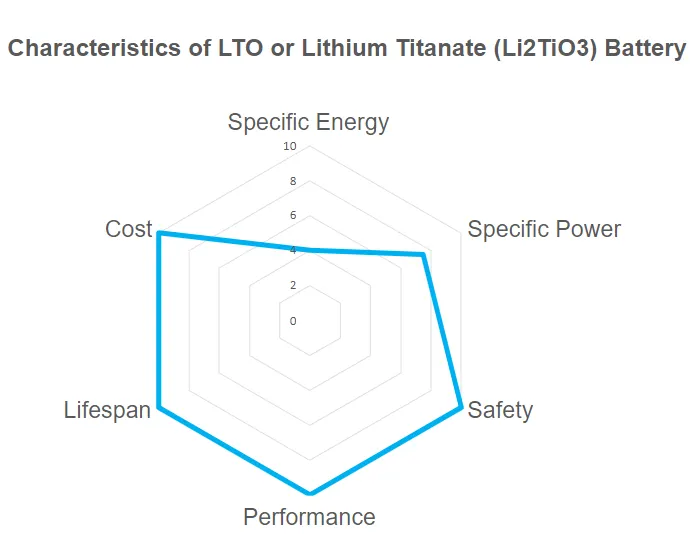
Lithium Titanate, also known as LTO, is a type of anode material used in lithium-ion batteries. It is a mixture of lithium and titanium oxide.
LTO is known for its excellent cycle life, fast charging capability, and low thermal instability. It also has a relatively low operating voltage, which makes it a safer option for many high-power applications.
LTO batteries are commonly used in applications where fast charging, high power output, and long cycle life are critical, such as electric buses, trucks, and other heavy-duty vehicles. LTO batteries are also used in some grid storage applications where reliability and safety are important.
Despite its many advantages, LTO has a lower energy density than many other anode materials, which limits its usefulness in some applications. However, ongoing research and development may lead to improvements in LTO technology that enable it to compete more effectively with other anode materials.
Applications : Aerospace and miltary equipments, EV's, Electric power trains,Solar powered street lights, Telecommunication systems, and UPS.
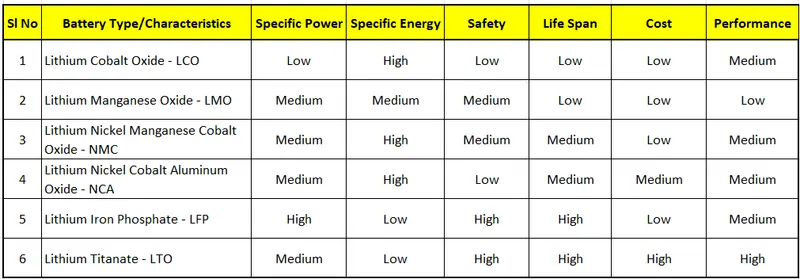
2) COMPARISION OF Li+ion Batteries