Week 1 Understanding Different Battery Chemistry
1.Prepare a table which includes materials & chemical reactions occurring at the anode and cathode of LCO, LMO, NCA, NMC, LFP and LTO type of lithium ion cells.Give your detailed explanation on it
A lithium-ion (Li-ion) battery is an advanced battery technology that uses lithium ions as a key component of its electrochemistry. During a discharge cycle, lithium atoms in the anode are ionized and separated from their electrons. The lithium ions move from the anode and pass through the electrolyte until they reach the cathode, where they recombine with their electrons and electrically neutralize. The lithium ions are small enough to be able to move through a micro-permeable separator between the anode and cathode. Li-ion batteries are capable of having a very high voltage and charge storage per unit mass and unit volume.
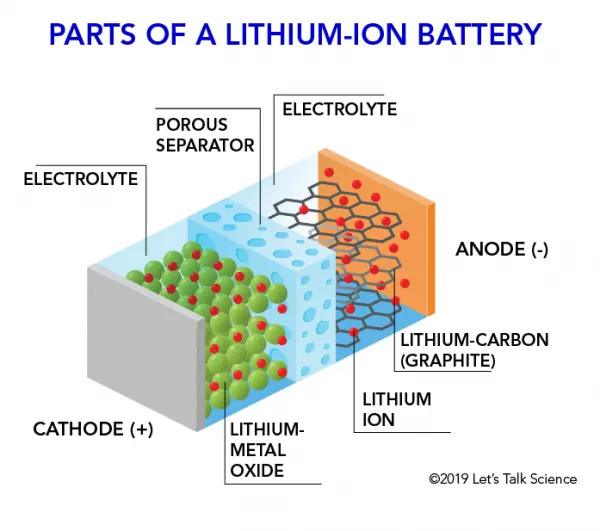
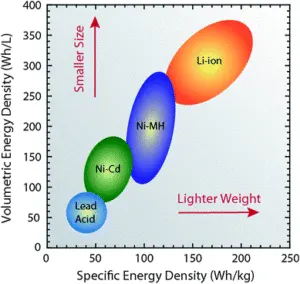
Compared to the other high-quality rechargeable battery technologies (nickel-cadmium or nickel-metal-hydride), Li-ion batteries have a number of advantages. They have one of the highest energy densities of any battery technology today (100-265 Wh/kg or 250-670 Wh/L). In addition, Li-ion battery cells can deliver up to 3.6 Volts, 3 times higher than technologies such as Ni-Cd or Ni-MH.
2.Compare the differences between each type of Li+ion batteries based on their characteristics
Types of Li-ion Battery
LCO or Lithium Cobalt Oxide (LiCoO2)
LCO battery has graphite carbon anode and cobalt oxide cathode. LCO has high specific energy and is widely used for consumer electronics such as digital cameras, mobile phones and laptops. The cathode has a layered structure and during discharge, lithium ions move from the anode to the cathode. The flow reverses on charge. The drawback of Li-cobalt is a relatively short life span, low thermal stability and limited load capabilities (specific power)
Main features of LCO is as given below
- High specific energy
- Limited specific power
- Low thermal stability
- Short lifespan
LMO or Lithium Manganese Oxide (LiMn2O4)
Li-ion cell with lithium manganese oxide as cathode material. The architecture forms a three-dimensional spinel structure that improves ion flow on the electrode, which results in lower internal resistance and improved current handling. A further advantage of spinel is high thermal stability and enhanced safety, but the cycle and calendar life are limited.
Characterestics of LMO are
- Enhanced safety
- High thermal stability
- Limited cycle life
- Moderate specific energy
- Moderate specific power
NCA or Lithium Nickel Cobalt Aluminum Oxide (LiNiCoAlO2)
NCA batteries are commonly used in EV powertrains due to their high specific energy and specific power and long lifespan. The NCA battery gains greater stability with the addition of Aluminum. NCA can deliver a high amount of current for extended periods.
main characteristics of NCA are
- High energy density
- Long lifespan
- Marginal safety
- good specific power
NMC or Lithium Nickel Manganese Cobalt Oxide (LiNiMnCoO2)
One of the most successful Li-ion systems is a cathode combination of nickel-manganese-cobalt (NMC). NMC is the battery of choice for power tools, e-bikes and other electric powertrains. The cathode combination is typically one-third nickel, one-third manganese and one-third cobalt, also known as 1-1-1. Cobalt is expensive and in limited supply. Battery manufacturers are reducing the cobalt content with some compromise in performance.There is a move towards NMC-blended Li-ion as the system can be built economically and it achieves a good performance. The three active materials of nickel, manganese and cobalt can easily be blended to suit a wide range of applications for automotive and energy storage systems (EES) that need frequent cycling. The NMC family is growing in its diversity.
- Excellent specific energy
- Good overall performance
- High specific power
- Lowest self heating rate
LFP or Lithium iron Phosphate (LiFePO4)
Li-phosphate offers good electrochemical performance with low resistance. This is made possible with nano-scale phosphate cathode material. Li-phosphate is more tolerant to full charge conditions and is less stressed than other lithium-ion systems if kept at high voltage for a prolonged time.Li-phosphate is often used to replace the lead acid starter battery. Four cells in series produce 12.80V, a similar voltage to six 2V lead acid cells in series.
LFP at a glance are
- Enhanced safety
- Good thermal stability
- High specific power
- Long cycle life
- low specific energy
LTO Lithium Titanate (Li2TiO3)
Batteries with lithium titanate anodes.Li-titanate replaces the graphite in the anode of a typical lithium-ion battery and the material forms into a spinel structure. The cathode can be lithium manganese oxide or NMC. Li-titanate has a nominal cell voltage of 2.40V, can be fast charged and delivers a high discharge current of 10C, or 10 times the rated capacity.LTO has advantages over the conventional cobalt-blended Li-ion with graphite anode by attaining zero-strain property, no SEI film formation and no lithium plating when fast charging and charging at low temperature. Thermal stability under high temperature is also better than other Li-ion systems; however, the battery is expensive.
Main characterestics are
- Excellent safety
- Fast charge
- High cost
- Long lifespan
- Low energy density