Understanding Different Battery Chemistry
AIM:
Prepare a table that includes materials and chemical reactions occurring at the anode and cathode of different Li-ion cells.
Battery: A battery is a device that stores energy and then discharges it by converting chemical energy into electricity. Typical batteries most often produce electricity by chemical means through the use of one or more electrochemical cells.
Different materials can and have been used in batteries, but the common battery types are alkaline, lithium-ion, lithium-polymer, and nickel-metal hydride. Batteries can be connected to each other in a series circuit or a parallel circuit based on the requirement.
Cells: An electrochemical cell is an apparatus that is used to generate electricity from a spontaneous oxidation-reduction reaction, or that uses electricity to drive a nonspontaneous reaction. An electrochemical cell is called such because it utilizes the principles of electrochemistry and is the smallest functional unit of an electrochemical system (a cell).
A typical cell has two terminals known as electrodes immersed into electrolyte and the two electrodes are separated by a separator which allows electric charge to pass from one side to the other through the electrolyte.
The anode the negative terminal gains electrons while the cathode the positive terminal loses electrons. This exchange of electrons allows a difference in potential or voltage difference to be developed between the two terminals allowing electricity to flow.
Cells are classified into two types,
Primary cell, In these cells a chemical action between the electrodes and electrolyte causes a permanent change hence these cells are one time use cells and cannot be recharged.
Secondary cell, these cells can be recharged, they can have their chemical reactions reversed by applying electric current to the cell and can be used for multiple number of times.
One such type of secondary cell is a Li-ion cell, which uses reverse reduction of Li-ions to store energy. Compared to other rechargeable battery technologies, Li-ion batteries have high energy densities, low self-discharge.
The anode or positive electrode is usually graphite also silicon is also being used alternatively. Lithium-ion batteries come in a variety of shapes and sizes, such as cylindrical, prismatic and pouch. Various types of Li-ion cells description with their compositions are mentioned below.
LCO (Lithium Cobalt Oxide)
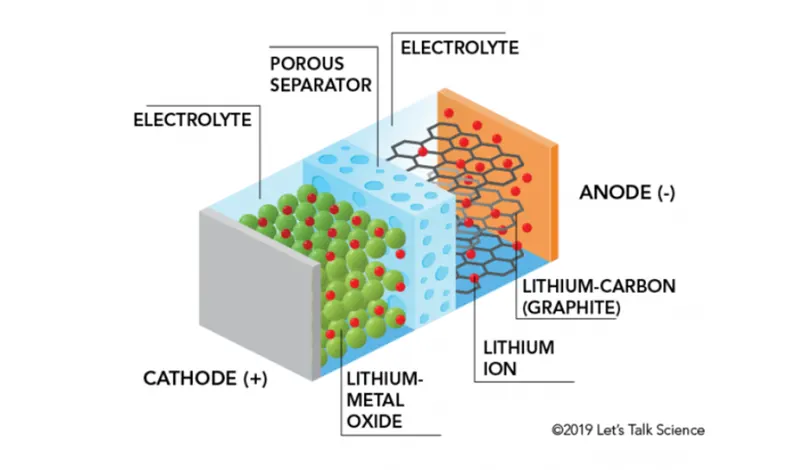
Lithium cobalt oxide batteries are manufactured from lithium carbonate and cobalt These batteries are used in cell phones, laptops, and electronic cameras because of their high specific energy. They have a cobalt oxide cathode and a graphite carbon anode, and lithium ions migrate from the anode to the cathode during discharge, with the flow reversing when the battery is charged.
Reduction takes place at the cathode. Cobalt oxide combines with lithium ions to form lithium-cobalt oxide. Oxidation takes place at the anode. The graphite intercalation compound LiC6 forms graphite and lithium ions.
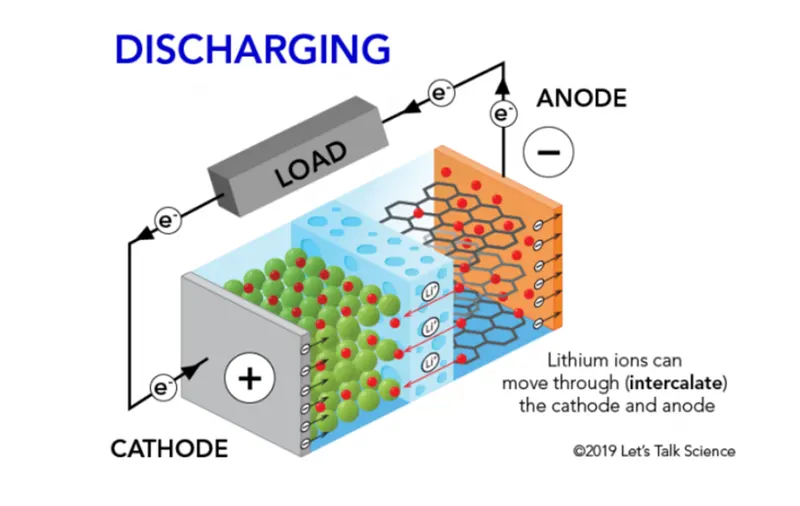
When the battery is in use, the lithium ions flow from the anode to the cathode, and the electrons move from the cathode to the anode.
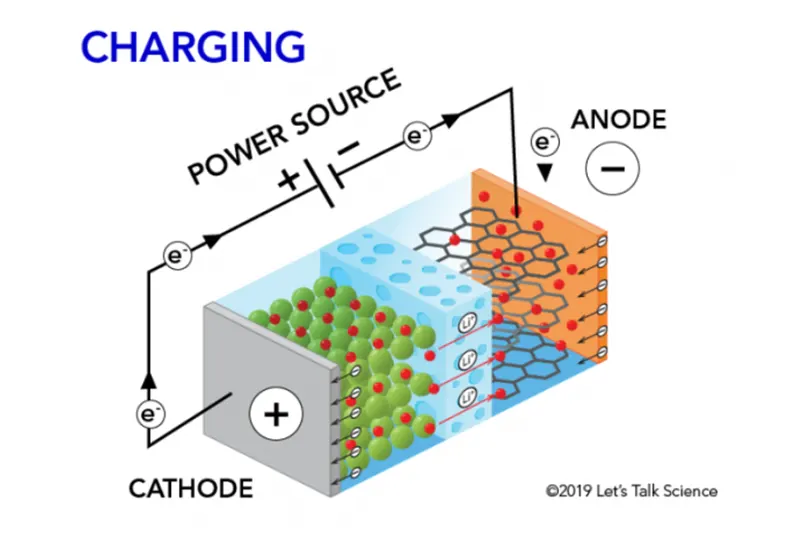
When the battery is charging, the lithium ions flow from the cathode to the anode, and the electrons move from the anode to the cathode.
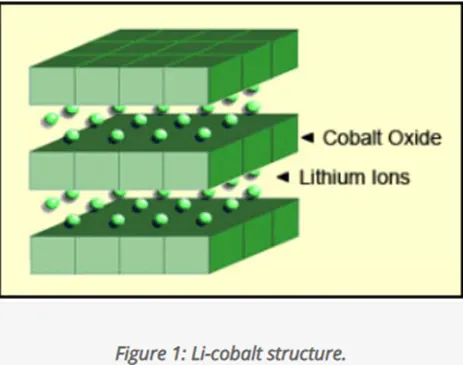
The above figure shows the structure of LCO. LCO has LiCoO2 as cathode (~60% Co) and graphite as anode
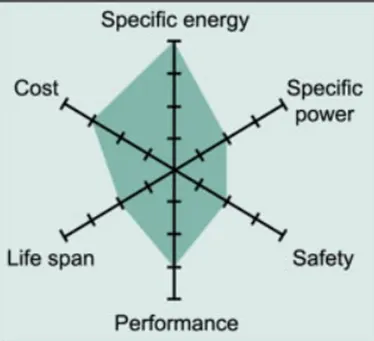
The above figure shows Li-cobalt excels on high specific energy but offers only moderate performance specific power, safety and life span.
LMO (Lithium Manganese Oxide)
The first commercial lithium-ion cells made with lithium manganese oxide as a cathode material were produced in 1996 by Moli Energy. The architecture forms a three-dimensional spinel structure that improves ion flow on the electrode, which results in lower internal resistance and improved current handling. Low internal cell resistance enables fast charging and high-current discharging. High-temperature stability distinguishes lithium manganese oxide batteries from others, which are also safer than other lithium-ion battery types.
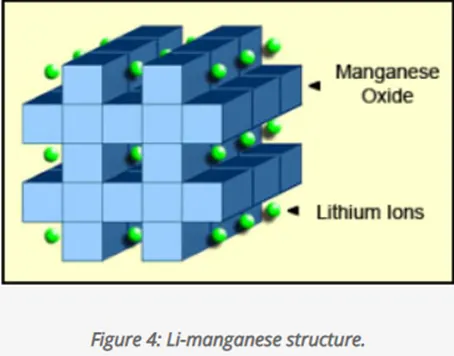
The above figure illustrates the formation of a three-dimensional crystalline framework on the cathode of a Li-manganese battery. LMO has LiMn2O4 as cathode and graphite as anode.
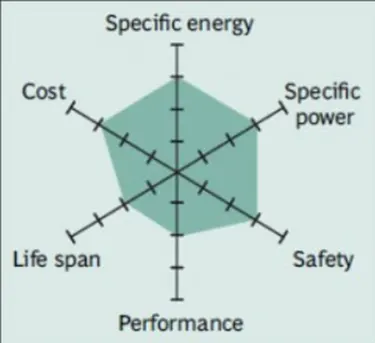
LMO have moderate overall performance such as specific power and specific energy and safety and life span can be improved.
NCA (Lithium Nickel Cobalt Aluminum Oxide)
A lithium nickel cobalt aluminum oxide, or NCA, battery shares similarities with the NMC by offering high specific energy, reasonably good specific power, and a relatively long life span, making NCA a candidate for EV powertrains. NCA has LiNiCoAlO2 as cathode (~9% Co) and graphite as anode
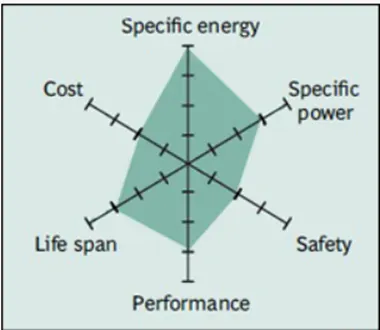
High energy, power densities and good life span are the positives and high cost and safety are the negatives.
NMC (Lithium Nickel Manganese Cobalt Oxide)
Lithium Nickel manganese Cobalt Oxide batteries, often known as NMC batteries, are constructed of a variety of materials that are universal in lithium-ion batteries. A cathode constructed of a mix of nickel, manganese, and cobalt is included. 60% nickel, 20% manganese, and 20% cobalt are commonly the cathode combination ratios. This means that the cost of the raw material is lower than for other lithium-ion battery solutions, as cobalt may be fairly costly. NMC has LiNiMnCoO2 as cathode and graphite as anode.
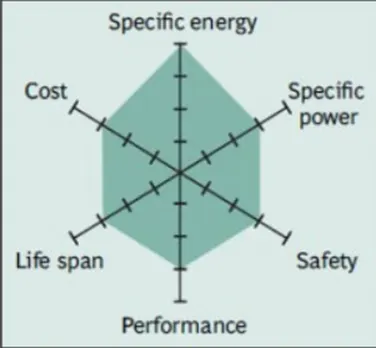
NMC has overall good performance and very good specific energy.
LFP (Lithium Iron Phosphate)
LFP is a popular, cost-effective cathode material for lithium-ion cells that are known to deliver excellent safety and long life span, which makes it particularly well-suited for specialty battery applications requiring high load currents and endurance. Lithium Iron Phosphate has LiFePO4 as the cathode and graphite as the anode.
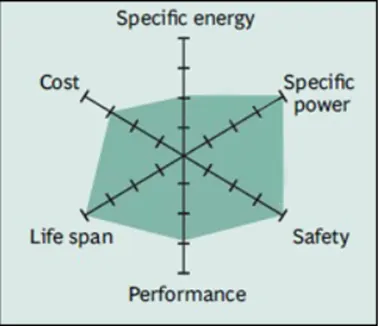
LFP has excellent life span safety and specific power but lacks in specific energy.
LTO (Lithium Titanate)
lithium titanate, often known as li-titanate, is a type of battery that has a growing number of uses. Because of its superior nanotechnology, the lithium-titanate battery has an extremely rapid recharge time. These batteries have a lower intrinsic voltage or energy density than other lithium-ion battery types, which might cause problems when it comes to efficiently power automobiles. In LTO Cathode can be lithium manganese oxide or NMC and Li2TiO3 (titanate) as anode.
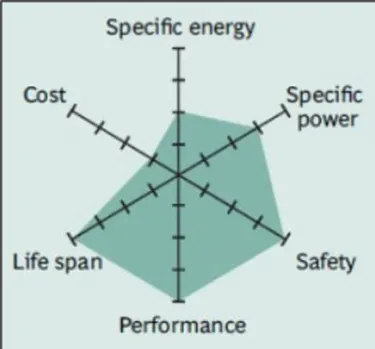
LTO has better safety, performance, life span and specific power but it is costly and has less specific energy.
The below table shows the anode and cathode as well as the reactions occurring at the anode and cathode of various Li-ion cells.
|
Type of cell |
Anode Reaction |
Cathode Reaction |
Overall Reaction |
|
LCO Lithium Cobalt Oxide |
LiC6 <---> C6 + Li+ + e- |
CoO2 + Li+ + e- <---> LiCoO2 |
LiCoO2 + C6 <---> LiC6 + CoO2 |
|
LMO Lithium Manganese Oxide |
LiC6 <---> C6 + Li+ + e- |
MnO2 + Li+ + e- <---> LiMnO2 |
LiMnO2 + C6 <---> LiC6 + MnO2 |
|
NCA Nickel Cobalt Aluminium Oxide |
LiC6 <---> C6 + Li+ + e- |
NiCoAlO2+ Li+ + e- <---> LiNiCoAlO2 |
LiNiCoAlO2 + C6 <---> LiC6 + NiCoAlO2 |
|
NMC Lithium Nickel Manganese Cobalt Oxide |
LiC6 <---> C6 + Li+ + e- |
NiMnCoO2+ Li+ + e- <---> LiNiMnCoO2 |
LiNiMnCoO2 + C6 <---> LiC6 + NiMnCoO2 |
|
LFP Lithium Iron Phosphate |
LiC6 <---> C6 + Li+ + e- |
FePO4+ Li+ + e- <---> LiFePO4 |
LiFePO4 + C6 <---> LiC6 + FePO4 |
|
LTO Lithium Titanate |
Li4Ti5O12 <---> Ti5O12 + 4Li+ + 4e- |
4Mn2O4+ 4Li+ + 4e- <---> 4LiMn2O4 |
4Mn2O4 + Li4Ti5O12 <---> 4LiMn2O4 + Ti5O12 |
Comparisons between Li-ion batteries.
|
Lithium-ion battery Types |
Specific Power |
Specific Energy |
Safety |
Life Span |
Cost |
Performance |
|
Lithium Cobalt Oxide |
Low |
High |
Low |
Low |
Low |
Medium |
|
Lithium Manganese Oxide |
Medium |
Medium |
Medium |
Low |
Low |
Low |
|
Lithium Nickel Manganese Cobalt Oxide |
Medium |
High |
Medium |
Medium |
Low |
Medium |
|
Lithium Iron Phosphate |
High |
Low |
High |
High |
Low |
Medium |
|
Lithium Nickel Cobalt Aluminum Oxide |
Medium |
High |
Low |
Medium |
Medium |
Medium |
|
Lithium Titanate |
Medium |
Low |
High |
High |
High |
High |
Lithium Cobalt Oxide has high specific energy compared to the other batteries, making it the preferred choice for laptops and mobile phones. It also has a low cost and a moderate performance. However, it is not favorable in all the other aspects when compared to the other lithium-ion batteries. It has low specific power, low safety, and a low lifespan.
Lithium Manganese Oxide has moderate specific power, moderate specific energy, and a moderate level of safety when compared to the other types of lithium-ion batteries. It has the added advantage of a low cost. The downsides are its low performance and low lifespan. It is usually used in medical devices and power tools.
Lithium Nickel Manganese Cobalt Oxide has two major advantages as compared to the other batteries. The first one is its high specific energy, which makes it desirable in electric powertrains, electric vehicles, and electric bikes. The other is its low cost. It is moderate in terms of specific power, safety, lifespan, and performance when compared to the other lithium-ion batteries. It can be optimized to either have high specific power or high specific energy.
Lithium Iron Phosphate only has one major disadvantage when compared to other types of lithium-ion batteries, and that is its low specific energy. Other than that, it has moderate to high ratings in all the other characteristics. It has high specific power, offers a high level of safety, has a high lifespan, and comes at a low cost. The performance of this battery is also moderate. It is often employed in electric motorcycles and other applications that require a long lifespan and a high level of safety.
Lithium Nickel Cobalt Aluminum Oxide offers one strong advantage compared to the five other batteries: high specific energy. It is pretty moderate in the rest of the characteristics like performance, cost, specific power, and lifespan. The only downside to this battery type is its low level of safety. Its high specific energy and moderate lifespan make it a good candidate for electric powertrains.
Lithium Titanate offers high safety, high performance, and a high lifespan which are very important features every battery should have. Its specific energy is low compared to the five other lithium-ion batteries, but it compensates for this with moderate specific power. The only major disadvantage of lithium titanate as compared to the other lithium-ion batteries is its extremely high cost. Another important feature of this battery worthy of mention is its remarkably fast recharge time. It can be used for storing solar energy and creating smart grids.
Reference:
https://batteryuniversity.com/article/bu-205-types-of-lithium-ion
https://letstalkscience.ca/educational-resources/stem-in-context/how-does-a-lithium-ion-battery-work
https://inverted.in/blog/types-of-lithium-ion-batteries-available-in-the-market