Week 1 Understanding Different Battery Chemistry
1. Table consists of materials & chemical reactions occurring at the anode and cathode of LCO, LMO, NCA, NMC, LFP, and LTO type of lithium-ion cells.
Li-ion Batteries: A lithium-ion battery or Li-ion battery is a type of rechargeable battery. Lithium-ion batteries are commonly used for portable electronics and electric vehicles and are growing in popularity for military and aerospace applications. Similar to the lead- and nickel-based architecture, lithium-ion uses a cathode (positive electrode), an anode (negative electrode), and an electrolyte as a conductor. The cathode is a metal oxide and the anode consists of porous carbon. During discharge, the ions flow from the anode to the cathode through the electrolyte and separator; the charge reverses the direction and the ions flow from the cathode to the anode.
|
Types |
Cathode Material | Chemical Reaction at the cathode(discharge) | Anode Material |
Chemical Reaction at the anode(discharge) |
Overall reaction |
| LCO | Lithium Cobalt Oxide |  |
Graphite carbon |  |
 |
| LMO | Lithium manganese oxide |  |
Graphite carbon | 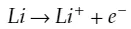 |
 |
| NCA | Lithium Nickel Cobalt Aluminum Oxide |  |
Graphite carbon |  |
 |
| NMC | Lithium Nickel Manganese Cobalt Oxide |  |
Graphite carbon |  |
 |
| LFP | Lithium iron phosphate |  |
Graphite carbon |  |
 |
| LTO | Manganese oxide |  |
Lithium titanium oxide |  |
 |
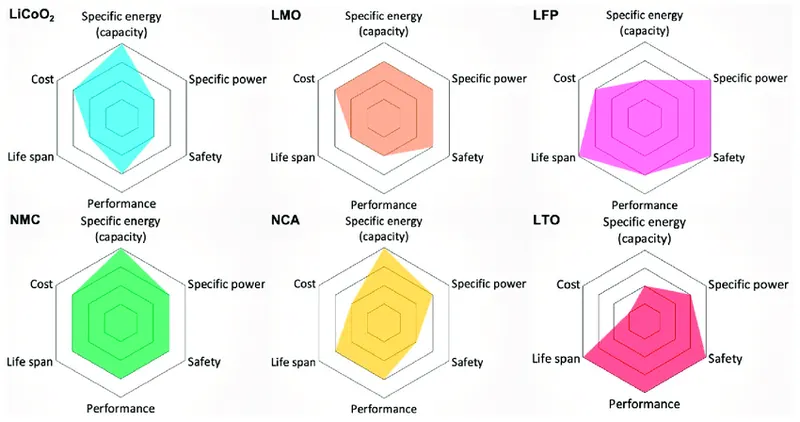
2. Comparison between each type of Li+ion battery based on their characteristics.
Types of Li-ion Cells:
- Lithium Cobalt Oxide(LiCoO2) — LCO
- Its high specific energy makes Li-cobalt the popular choice for mobile phones, laptops, and digital cameras.
- The battery consists of a cobalt oxide cathode and a graphite carbon anode.
- The drawback of Li-cobalt is a relatively short life span, low thermal stability, and limited load capabilities (specific power).
- Lithium Manganese Oxide (LiMn2O4) — LMO
- A Li-ion cell with lithium manganese oxide as cathode material.
- The architecture forms a three-dimensional spinel structure that improves ion flow on the electrode, which results in lower internal resistance and improved current handling.
- A further advantage of spinel is high thermal stability and enhanced safety, but the cycle and calendar life is limited.
- Lithium Nickel Cobalt Aluminum Oxide (LiNiCoAlO2) — NCA
- It offers high specific energy, reasonably good specific power, and a long lifespan.
- Less flattering are safety and cost.
- Lithium Nickel Manganese Cobalt Oxide (LiNiMnCoO2) — NMC
- Similar to Li-manganese, these systems can be tailored to serve as Energy Cells or Power Cells.
- Lithium Iron Phosphate(LiFePO4) — LFP
- Li-phosphate offers good electrochemical performance with low resistance.
- This is made possible with nano-scale phosphate cathode material.
- The key benefits are a high current rating and long cycle life, besides good thermal stability, and enhanced safety.
- Lithium Titanate (Li2TiO3) — LTO
- Li-titanate replaces the graphite in the anode of a typical lithium-ion battery and the material forms a spinel structure.
- The cycle count is said to be higher than that of a regular Li-ion. Li-titanate is safe, has excellent low-temperature discharge characteristics, and obtains a capacity of 80 percent at –30°C.
|
Types |
NOMINAL VOLTAGE (V) | CYCLE (LIFE) | CHARGE CURRENT RATE (C) | DISCHARGE CURRENT RATE (C) | THERMAL RUNAWAY (DEGREE CELSIUS) | SPECIFIC ENERGY (Wh/kg) |
| LCO | 3.6 | 1000+ | 0.7-1C | 1-2C | 220 | 150-220 |
| LMO | 3.2 | 2000+ | 1C | 1C | 270 | 90-120 |
| NCA | 3.6 | 500-1000 | 0.7C | 1C | 150 | 200-260 |
| NMC | 2.4 | 3000-7000 | 1C | 10C | HIGHEST | 50-80 |
| LFP | 3.6 | 500-1000 | 0.7-1C | 1C | 150 | 150-200 |
| LTO | 3.7 | 300-700 | 0.7-1C | 1C | 250 | 100-150 |
| Lithium-ion battery Types | SP | SE | SF | LS | CS | PF |
|---|---|---|---|---|---|---|
|
Lithium Cobalt Oxide |
L |
H |
L |
L |
L |
M |
|
Lithium Manganese Oxide |
M |
M |
M |
L |
L |
L |
|
Lithium Nickel Manganese Cobalt Oxide |
M |
H |
M |
M |
L |
M |
|
Lithium Iron Phosphate |
H |
L |
H |
H |
L |
M |
|
Lithium Nickel Cobalt Aluminum Oxide |
M |
H |
L |
M |
M |
M |
|
Lithium Titanate |
M |
L |
H |
H |
H |
H |
- SP stands for specific power
- SE stands for specific energy
- SF stands for safety
- LS stands for lifespan
- CS stands for cost
- PF stands for performance
- L stands for low
- M stands for moderate
- H stands for high