Week 1 Understanding Different Battery Chemistry
Aim : To understand differnt battery technic and theire working system.
objective : To discuss the following points and explain it .
General introductions :
Nowadays, electric vehicles (EVs) are booming, due to the existing environmental problems. Among the different storage technologies in electromobility, batteries stand out the most. Although there are other alternatives such as hydrogen storage, a battery is also required for DC bus voltage stabilization and switching on of other essential or auxiliary devices of the fuel cell system. High capital costs, limited lifetime, and relatively poor performance at low temperatures are the most important issues in EVs . Therefore, the development of efficient storage technologies is an essential part for electromobility.
Lithium technology is highlighted for electromobility among the studied batteries options. Its specific power and energy density are the highest, with the lowest self-discharge ratio. In addition, voltage by cell is higher, which is the major drawback of the low overcharging tolerance. Therefore, a specifically designed charging system is required for this type of battery. Lithium is the material basis of this type of battery, since lithium ions are carried from cathode to anode (charging) through a separator, and vice versa (discharging). However, lithium-ion (Li-Ion) batteries can be classified among different categories based on other elements, mainly those corresponding to the cathode chemical composition. Below figure shows a comparative summary of the best-known lithium ion batteries.
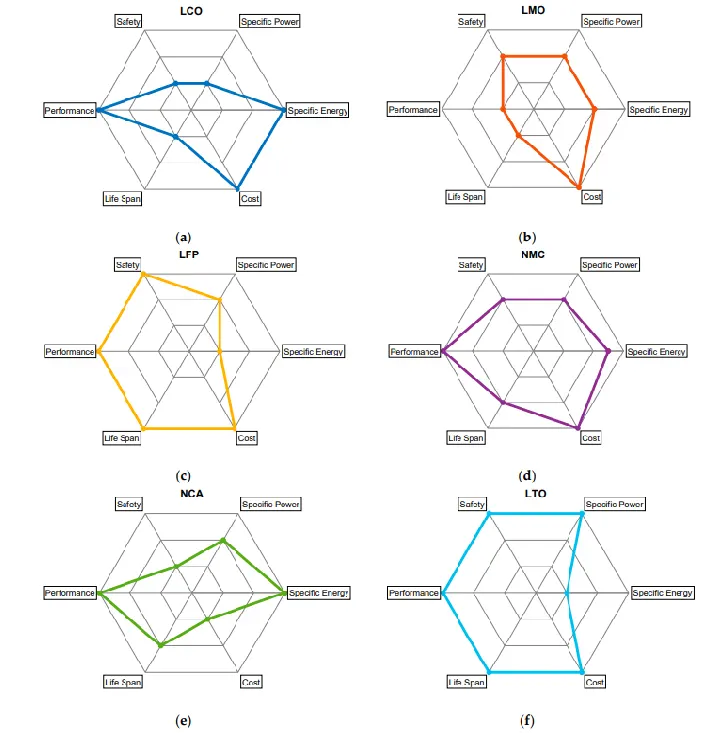
specific energy is a key factor in storage, as it defines the driving range of an EV. As it can be seen in above figure , lithium-cobalt-oxide (LCO), nickel-cobalt-aluminum (NCA), and nickel-manganese-cobalt (NMC) technologies stand out within specific energy, but LCO can practically be discarded due to Solid Electrolyte Interphase (SEI) problems and toxicity.
Working of lithium ion battery (discharging and charging):
Discharging process:
When the lithium-ion battery in your mobile phone is powering it, positively charged lithium ions (Li+) move from the negative anode to the positive cathode. They do this by moving through the electrolyte until they reach the positive electrode. There, they are deposited. The electrons, on the other hand, move from the anode to the cathode.
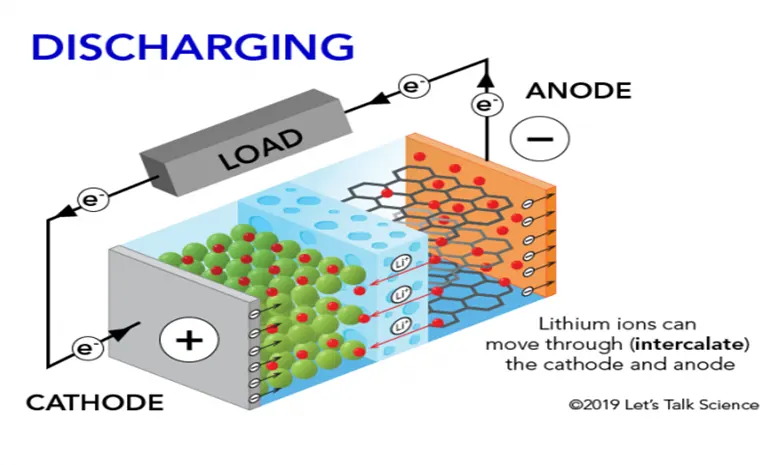
Charging process:
When you charge a lithium-ion battery, the exact opposite process happens. The lithium ions move back from the cathode to the anode. The electrons move from the anode to the cathode.
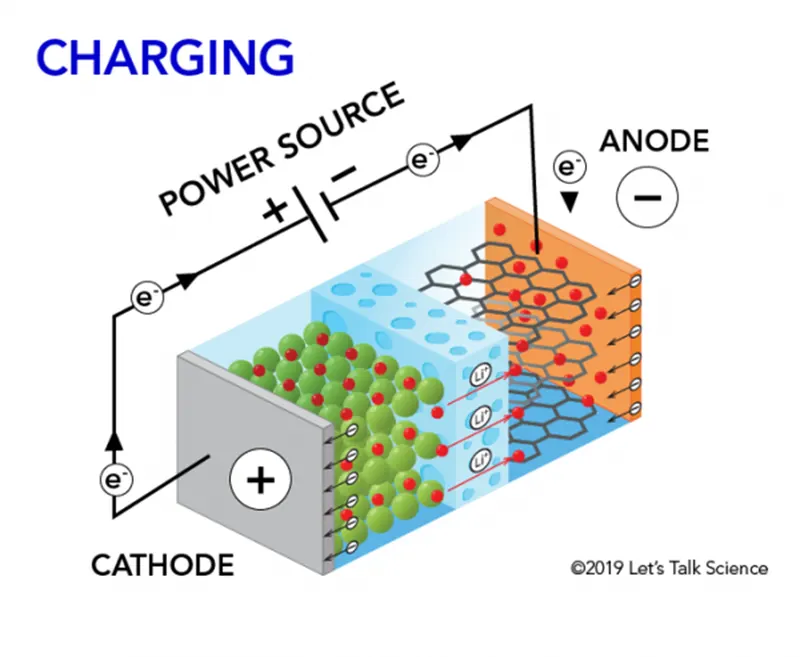
As long as lithium ions are making the trek from one electrode to another, there is a constant flow of electrons. This provides the energy to keep your device running. Since this cycle can be repeated hundreds of times, this type of battery is rechargeable.
MAJOR BATTERY CHARACTERISTICS:
Specific energy: This defines the battery capacity in weight (Wh/kg). The capacity relates to the runtime. Products requiring long runtimes at moderate load are optimized for high specific energy.
Specific power: It's the ability to deliver a high current and indicates loading capability. Batteries for power tools are made for high specific power and come with a reduced specific energy.
A high specific power usually comes with reduced specific energy and vice versa. The pouring of bottled water into a glass is a perfect analogy of the relationship between specific power and specific energy. The water in the bottle can be thought of as specific energy. Pouring the water at a slow rate doesn’t provide enough force (low specific power), but the water lasts longer in the bottle (high specific energy). On the other hand, if we pour the water out at a faster rate, it provides a greater impact (high specific power). However, the water wouldn’t last very long in the bottle ( low specific energy).
Performance: This measure how well the battery works over a wide range of temperatures. Most batteries are sensitive to heat and cold and require climate control. Heat reduces life, and cold lowers performance temporarily.
Lifespan: This reflects cycle life and longevity and is related to factors such as temperature, depth of discharge, and load. Hot climates accelerate capacity loss. Cobalt blended lithium-ion batteries also usually have a graphite anode that limits the cycle life.
Safety: This relates to factors such as the thermal stability of the materials used in the batteries. The materials should have the ability to sustain high temperatures before becoming unstable. Instability can lead to thermal runaway in which flaming gases are vented. Fully charging the battery and keeping it beyond the designated age reduces safety.
Cost: Demand for electric vehicles has generally been lower than anticipated, mainly due to the cost of lithium-ion batteries. Hence cost is a huge factor when selecting the type of lithium-ion battery.
TYPES OF LITHIUM-ION BATTERIES:
In general, the main sources of the active lithium ions in a battery are the positive electrode material or the cathode. Hence, to achieve high capacity, a huge amount of lithium is included in this material. Additionally, cathode materials follow a reversible process to exchange the lithium with slight structural modifications to its properties; in the electrolyte, the materials are prepared from reasonably-priced high lithium ions that have diffusivity, good conductivity and high efficiency. Those types of cathode materials involve in lithium ion battery so the classify in following type
- lithium cobalt oxide (LiCoO2),
- lithium manganese oxide (LiMn2O4),
- lithium iron phosphate (LiFePO4)
- lithium nickel–manganese-cobalt oxide (LiNiMnCoO2)
- lithium nickel cobalt aluminium oxide (LiNiCoAlO2)
- lithium titanate (Li4Ti5O12)
short explainations of lithium ion battery types:
1.LITHIUM COBALT OXIDE (LiCoO2)
Lithium cobalt oxide was created by Sony in 1991, and Mizushima improved the material, as mentioned in the progression of patents. Its high specific energy makes this type of battery the usual choice for cells, tablets, laptops and cameras. However, there is the constrained accessibility of cobalt, which makes the cost high so that a replacement of the cathode materials would be required to increase its applications, for example, in EVs . The battery is comprised of a cobalt oxide cathode and a graphite carbon anode in a layered structure that release lithium particles to travel between them during charging and discharging. It has a short life and restricted load capacities and is not able to be charged and discharged at currents out of its range. It requires protection against overheating and excessive stress while charging quickly, and the charge and discharge rate need to be limited to a secure level of approximately 1C.
2.LITHIUM MANGANESE OXIDE (LiMn2O4)
Lithium manganese oxide was first introduced in the materials research bulletin in 1983 by Li et al. In 1994, the Bellcore lab built the lithium manganese oxide battery. Its 3D spinel architecture was organized as a diamond shape which allows the particle to steam on the electrode so that it enhances current dealing and reduces internal resistance to charge quickly and discharges with a high current. Due to its spinel structure, it has positive impacts of high thermal stability and safety; however, it limits the life span. LiMn2O4 has more specific energy than cobalt. The capacity of Li-manganese is approximately 33% lower compared with Li-cobalt. However, this type of battery provides approximately 50% more energy than nickel-based batteries. Design compliance permits specialists to enhance the longevity and high current handling of this battery. Think EVs have used EnerDel fabricated Li-ion battery pack and Nissan leaf EVs have used NEC manufactured Li-ion battery pack. Lithium manganese oxide has a lower limit, 100 to 120 mAh/g, and a higher loss of capacity while charging or recharging cycle because of the extensive manganese disintegration in the electrolyte at raised temperatures.
3.LITHIUM IRON PHOSPHATE (LiFePO4)
The University of Texas found that phosphate could be used as a cathode material for lithium batteries in 1996. This cathode is steady in the overcharged condition and can tolerate high temperatures without breaking down; the cathode material in the lithium iron phosphate battery is more dependable and more secure than other cathode materials, e.g., LiCoO2 or LiMn2O4 batteries. Phosphates exhibits cell operating temperature range of −30◦C to +60◦C and cell packing temperature range of −50◦C to +60◦C that deteriorates thermal runaway and prevents from burning out. The lithium iron phosphate battery is made of nano-scale phosphate materials and exhibits a low resistance, long life span, high-load handling capability, improved security and thermic consistency, no toxic effects and less expense. It has less impact on the life cycle for overcharging and undercharging, although the specific energy is diminished marginally but is less than that found in LiMn2O4. It has some negative performance and service life properties due to temperature. Li-phosphate batteries are capable of providing a specific energy and nominal voltage of approximately 160 mAh/g and 3.40 V, respectively. These attributes make the battery performance simple to upgrade .
4.LITHIUM NICKEL MANGANESE COBALT OXIDE (LiNiMnCoO2)
Currently, battery companies concentrate on a cathode blend of nickel-manganese-cobalt (NMC). These cathode materials are oriented to establish either high specific energy or power with high density. For the silicon-based anode, the capacity and life cycle compromise each other. The combination of nickel and manganese exhibits good overall performance, drawing out the high specific energy of nickel and the low internal resistance effect of manganese, although nickel is low stable and manganese provides low specific energy. The cathode mixes of 33% nickel, 33% manganese and 34% cobalt offer a novel mix that brings lower raw material costs because of the decreased cobalt content. For the perfect mix, manufacturers protect their specific formulas. Presently, this battery is in great demand for EV applications due to their high specific energy and minimum self-heating rate.
5.LITHIUM NICKEL COBALT ALUMINIUM OXIDE (LiNiCoAlO2)
The lithium nickel cobalt aluminium oxide battery (NCA) has a small amount of the world market share. Now auto[1]mobile industries are emphasizing NCA battery production because of its high profile i.e., high specific energy and power densities and large life span considering cost and safety.
6.LITHIUM TITANATE (Li4Ti5O12)
Lithium-titanate anodes have been commonly used for batteries since the 1980s. It has a spinel architecture and is a substitution for the graphite anode of the Li-ion battery. It is normally 2.40 V and shows a high capacity, a high charge and discharge rate, and a high life span compared to that of a typical Li-ion battery. Moreover, Li4Ti5O12 batteries can be operated safely and have phenomenal features at cold temperatures. Because its specific energy is not high, unlike other Li-ions, the developments and research are focused on enhancing the specific energy and reducing the price.
Q.1. Prepare a table which includes materials & chemical reactions occurring at the anode and cathode of LCO, LMO, NCA, NMC, LFP and LTO type of lithium ion cells.

this table xlsx file upload in google drive so google drive link mention in below ans also file attach on below
in this table we mention all lithium ion battery type with thire chemical name and reaction with anode& cathode and theire full reactions and also mention materials used in each battery.
Q.2.Compare the differences between each type of Li+ion batteries based on their characteristics
as mention in above charactrristics we create a table for comparision between all type of lithium ion below is the priview of table
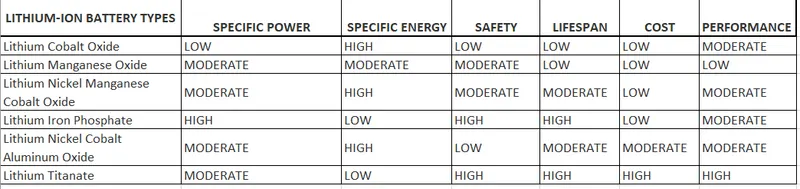
and this table xlsx file is uplod on google drive so i mention this google drive link in below also attach on this challenges