Week 1 Understanding Different Battery Chemistry
Different Battery Chemistry
Question :
1.Prepare a table which includes materials & chemical reactions occurring at the anode and cathode of LCO, LMO, NCA, NMC, LFP and LTO type of lithium ion cells. Give your detailed explanation on it
2.Compare the differences between each type of Li+ion batteries based on their characteristics
Aim :
Understand different types of Lithium-ion batteries and compare their properties.
Objective :
- Prepare a table which includes materials & chemical reactions occurring at the anode and cathode of LCO, LMO, NCA, NMC, LFP and LTO type of lithium ion cells. Give your detailed explanation on it
- Compare the differences between each type of Li+ion batteries based on their characteristics
Lithium-ion Battery
A lithium-ion battery or Li-ion battery is a type of rechargeable battery in which lithium ions move from the negative electrode through an electrolyte to the positive electrode through Lithium salts as electrolyte during discharge, and back when charging. Li-ion batteries use an intercalated lithium compound as the material at the positive electrode and typically graphite at the negative electrode.
First Li- ion batteries was introduced by a Japenese chemist named Akira Yoshino in 1985. Commercially the Li-ion battery was developed by SONY and Asahi Kase team in 1991.
A lithium-ion (Li-ion) battery is an advanced battery technology that uses lithium ions as a key component of its electrochemistry. During a discharge cycle, lithium atoms in the anode are ionized and separated from their electrons. The lithium ions move from the anode and pass through the electrolyte until they reach the cathode, where they recombine with their electrons and electrically neutralize. The lithium ions are small enough to be able to move through a micro-permeable separator between the anode and cathode. In part because of lithium’s small size (third only to hydrogen and helium), Li-ion batteries are capable of having a very high voltage and charge storage per unit mass and unit volume.
Lithium-ion Cells
As with most batteries have an outer case made of metal. The use of metal is particularly important here because the battery is pressurized. This metal case has some kind of pressure-sensitive vent hole. If the battery ever gets so hot that it risks exploding from over-pressure, this vent will release the extra pressure. The battery will probably be useless afterwards, so this is something to avoid. The vent is strictly there as a safety measure. So is the Positive Temperature Coefficient (PTC) switch, a device that is supposed to keep the battery from overheating.
This metal case holds a long spiral comprising three thin sheets pressed together:
- A Positive electrode
- A Negative electrode
- A separator
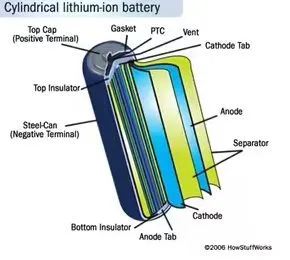
Inside the case these sheets are submerged in an organic solvent that acts as the electrolyte. Ether is one common solvent.
The separator is a very thin sheet of microperforated plastic. As the name implies, it separates the positive and negative electrodes while allowing ions to pass through.
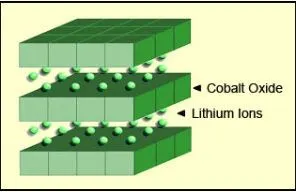
The positive electrode is made of Lithium cobalt oxide, or LiCoO2. The negative electrode is made of carbon. When the battery charges, ions of lithium move through the electrolyte from the positive electrode to the negative electrode and attach to the carbon. During discharge, the lithium ions move back to the LiCoO2 from the carbon.
Charging and Discharging:
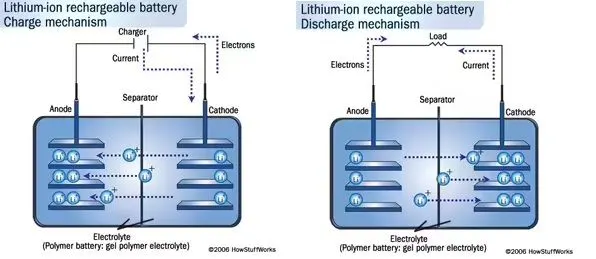
Both electrodes in a lithium-ion cell are made of materials which can intercalate or ‘absorb’ lithium ions (a bit like the hydride ions in the NiMH batteries). Intercalation is when charged ions of an element can be ‘held’ inside the structure of a host material without significantly disturbing it. In the case of a lithium-ion battery, the lithium ions are ‘tied’ to an electron within the structure of the anode. When the battery discharges, the intercalated lithium ions are released from the anode, and then travel through the electrolyte solution to be absorbed (intercalated) in the cathode.
A lithium-ion battery starts its life in a state of full discharge: all its lithium ions are intercalated within the cathode and its chemistry does not yet have the ability to produce any electricity. Before you can use the battery, you need to charge it. As the battery is charged, an oxidation reaction occurs at the cathode, meaning that it loses some negatively charged electrons. To maintain the charge balance in the cathode, an equal number of some of the positively charged intercalated lithium ions are dissolved into the electrolyte solution. These travel over to the anode, where they are intercalated within the graphite. This intercalation reaction also deposits electrons into the graphite anode, to ‘tie’ up the lithium ion.
During discharge, the lithium ions are de-intercalated from the anode and travel back through the electrolyte to the cathode. This also releases the electrons that were tying them to the anode, and these flow through an external wire, providing the electric current that we used to do work. It’s the connection of the external wire that enables the reaction to proceed—when the electrons are free to travel, so are the positively charged lithium ions that will balance the movement of their negative charge.
When the cathode becomes full of lithium ions, the reaction stops and the battery is flat. Then we recharge our lithium-ion batteries again, and the external electric charge that we apply pushes the lithium ions back into the anode from the cathode.
The electrolyte in a lithium-ion cell is usually a solution of lithium salts in a mixture of solvents (like dimethyl carbonate or diethyl carbonate) devised to improve battery performance. Having lithium salts dissolved in the electrolyte means the solution contains lithium ions. This means that individual lithium ions don’t have to make the complete journey from the anode to the cathode to complete the circuit. As ions are kicked out from the anode, others that are already hanging out in the electrolyte, near the electrode surface, can easily be absorbed (intercalated) into the cathode. The reverse happens during recharging.
Li-ion batteries can use a number of different materials as electrodes. The most common combination is that of lithium cobalt oxide (cathode) and graphite (anode), which is most commonly found in portable electronic devices such as cellphones and laptops. Other cathode materials include lithium manganese oxide (used in hybrid electric and electric automobiles) and lithium iron phosphate. Li-ion batteries typically use ether (a class of organic compounds) as an electrolyte.
Different types of Lithium-Ion Batteries:
Types depend on material used for cathode.
|
Name |
LCO |
LMO |
NCA |
NMC |
LFP |
LTO |
|
Full Form |
Lithium Cobalt Oxide |
Lithium Manganese Oxide |
Nickel Cobalt Aluminium |
Nickel Manganese Cobalt |
Lithium Ferrous (ion) Phospate |
Lithium Titanium Oxide |
|
Electrolyte |
Ethylene Carbonate |
Lithium Halide |
Ethylene Carbonate |
Lithium Salt |
Ethylene Carbonate |
Lithium Salt |
|
Cell Voltage |
3.6V Nominal 3 to 4.2 V/Cell |
3.7V Nominal, 3 to 4.2 V/Cell |
3.6V Nominal, 3 to 4.2 V/Cell |
3.7V Nominal, 3 to 4.2 V/Cell |
3.3V Nominal, 2.5 - 3.65 V/Cell |
2.4V Nominal, 1.8 to 2.85 V/Cell |
|
Life Cycle |
500 to 1000 |
300 to 700 |
500 |
1000 to 2000 |
More than 2,000 |
3000 to 7000 |
|
Specific Energy |
High |
High |
High |
High |
Low |
Low |
|
Drawbacks |
Not performed well in high load application |
Short Lifespan |
Expensive and less safe |
Lower Voltage |
Performance suffer at low temp |
Low energy density, Expensive |
|
Applications |
Mobile, Tablets, Laptop, Camera |
Power tools, Medical Device, Power trains |
Medical, Industrial, EV |
Medical, Industrial, EV, E-bike |
Stationary with high current and endurance |
UPS, EV, Solar street light |
|
Cell Type |
Cathode Reaction |
Anode Reaction |
|
LCO |
`CoO_2+Li^++e^-⇌LiCoO_2` | `LiC_6⇌C_6+Li^++e^-` |
|
LMO |
`MnO_2+Li^++e^-⇌LiMnO_2` | `LiC_6⇌C_6+Li^++e^-` |
|
NCA |
`NiCoAlO_2+Li^++e^-⇌LiNiCoAlO_2` | `LiC_6⇌C_6+Li^++e^-` |
|
NMC |
`NiMnCoO_2+Li^++e^-⇌LiNiMnCoO_2` | `LiC_6⇌C_6+Li^++e^-` |
|
LFP |
`FePO_4+Li^++e^-⇌LiFePO_4` | `LiC_6⇌C_6+Li^++e^-` |
|
LTO |
`MnO_2+Li^++e^-⇌LiMnO_2` | `〖Li〗_4 〖Ti〗_5 O_12⇌〖Ti〗_5 O_12+4Li^++4e^-` |
Characteristics of Lithium-Ion Batteries:
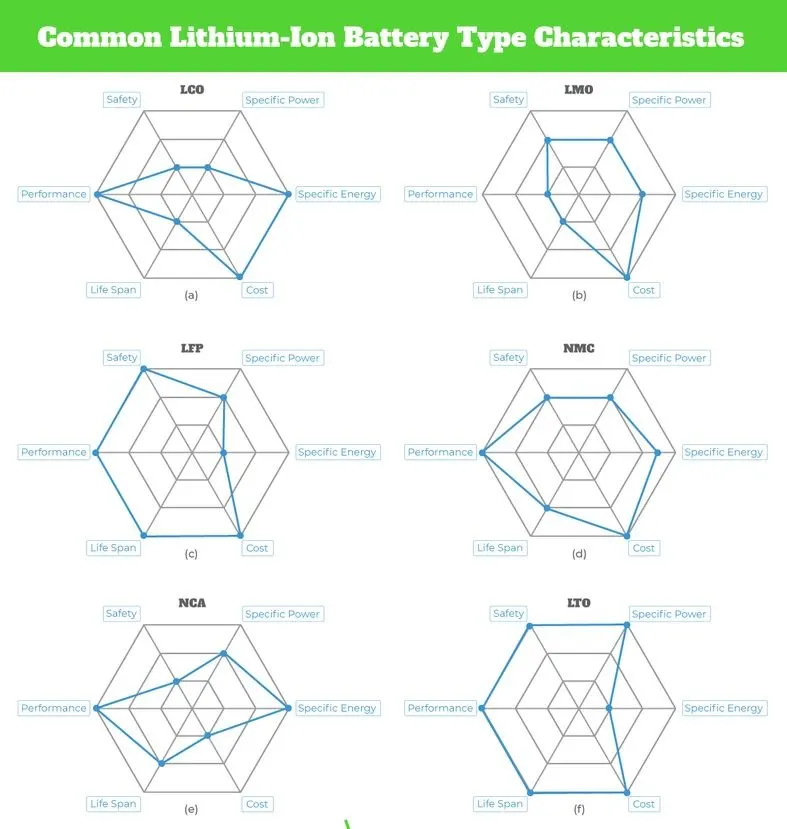
Specific energy: This defines the battery capacity in weight (Wh/kg). The capacity relates to the runtime. Products requiring long runtimes at moderate load are optimized for high specific energy.
Specific power: It's the ability to deliver a high current and indicates loading capability. Batteries for power tools are made for high specific power and come with a reduced specific energy.
A high specific power usually comes with reduced specific energy and vice versa. The pouring of bottled water in a glass is a perfect analogy of the relationship between specific power and specific energy. The water in the bottle can be thought of as specific energy. Pouring the water at a slow rate doesn’t provide enough force (low specific power) but the water lasts longer in the bottle (high specific energy). On the other hand, if we pour the water out at a faster rate it provides a greater impact (high specific power). However, the water wouldn’t last very long in the bottle ( low specific energy).
Performance: This measures how well the battery works over a wide range of temperatures. Most batteries are sensitive to heat and cold and require climate control. Heat reduces life, and cold lowers performance temporarily.
Lifespan: This reflects cycle life and longevity and is related to factors such as temperature, depth of discharge, and load. Hot climates accelerate capacity loss. Cobalt blended lithium-ion batteries also usually have a graphite anode that limits the cycle life.
Safety: This relates to factors such as the thermal stability of the materials used in the batteries. The materials should have the ability to sustain high temperatures before becoming unstable. Instability can lead to thermal runaway in which flaming gases are vented. Fully charging the battery and keeping it beyond the designated age reduces safety.
Cost: Demand for electric vehicles has generally been lower than anticipated and this is mainly due to the cost of lithium-ion batteries. Hence cost is a huge factor when selecting the type of lithium-ion battery.
Lithium Cobalt Oxide has high specific energy as compared to the other batteries which make it the preferred choice for laptops and mobile phones. It also has a low cost and a moderate performance. However, it is highly unfavorable in all the other aspects when compared to the other lithium-ion batteries. It has low specific power, low safety, and a low lifespan.
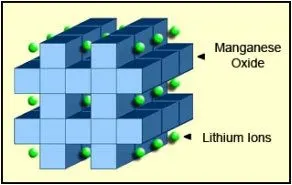
Lithium Manganese Oxide has moderate specific power, moderate specific energy, and a moderate level of safety when compared to the other types of lithium-ion batteries. It has the added advantage of a low cost. The downsides are its low performance and low lifespan. It is usually used in medical devices and power tools.
Lithium Nickel Cobalt Aluminum Oxide offers one strong advantage as compared to the five other batteries and that is high specific energy. It is pretty moderate in the rest of the characteristics like performance, cost, specific power, and lifespan. The only downside to this battery type is its low level of safety. Its high specific energy and moderate lifespan make it a good candidate for electric powertrains.
Lithium Nickel Manganese Cobalt Oxide has two major advantages as compared to the other batteries. The first one is its high specific energy which makes it desirable in electric powertrains, electric vehicles, and electric bikes. The other is its low cost. It is moderate in terms of specific power, safety, lifespan, and performance when compared to the other lithium-ion batteries. It can be optimized to either have high specific power or high specific energy.
Lithium Iron Phosphate only has one major disadvantage when compared to other types of lithium-ion batteries and that is its low specific energy. Other than that, it has moderate to high ratings in all the other characteristics. It has high specific power, offers a high level of safety, has a high lifespan, and comes at a low cost. The performance of this battery is also moderate. It is often employed in electric motorcycles and other applications that require a long lifespan and a high level of safety.
Lithium Titanate offers high safety, high performance, and a high lifespan which are very important features every battery should have. Its specific energy is low compared to the five other lithium-ion batteries but it compensates for this with moderate specific power. The only major disadvantage of lithium titanate as compared to the other lithium-ion batteries is its extremely high cost. Another important feature of this battery worthy of mention is its remarkably fast recharge time. It can be used for storing solar energy and creating smart grids.
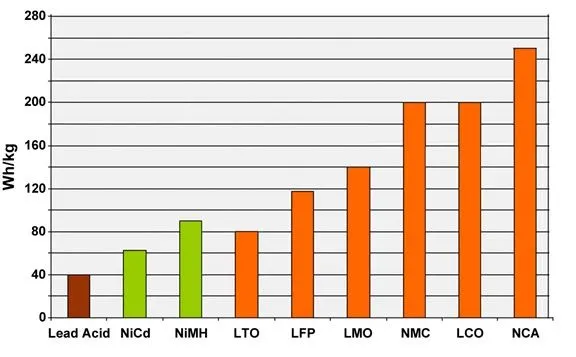
Above fig. compares the specific energy of lead-, nickel- and lithium-based systems. While Li-aluminum (NCA) is the clear winner by storing more capacity than other systems, this only applies to specific energy. In terms of specific power and thermal stability, Li-manganese (LMO) and Li-phosphate (LFP) are superior. Li-titanate (LTO) may have low capacity but this chemistry outlives most other batteries in terms of life span and also has the best cold temperature performance. Moving towards the electric powertrain, safety and cycle life will gain dominance over capacity. (LCO stands for Li-cobalt, the original Li-ion.)
References:
- https://dragonflyenergy.com/types-of-lithium-batteries-guide/
- https://batteryuniversity.com/article/bu-205-types-of-lithium-ion
- https://owlcation.com/stem/Comparing-6-Lithium-ion-Battery-Types
- https://www.electronics-notes.com/articles/electronic_components/battery-technology/li-ion-lithium-ion-types.php
- https://electronics.howstuffworks.com/everyday-tech/lithium-ion-battery.htm