Week 1 Understanding Different Battery Chemistry
AIM :1.To Prepare a table which includes detailed Explanation of materials & chemical reactions occurring at the anode and cathode of LCO, LMO, NCA, NMC, LFP and LTO type of lithium ion cells.
2.To Compare the differences between each type of Li+ion batteries based on their characteristics.
THEORY :
INTRODUCTION TO BATTERY TECHNOLOGY:
The developments in the field of science, engineering and technology naturally tempt man in using and applying these developments to improve the comforts in life and enjoyment. The increase in complexity and standards in life style is characterized by a high demand for energy consumption.Even if energy is available, it should be available at a time, place, and under circumstances where desired or needed. It is, in this view point, cells and batteries are important in providing portable electrical energy. Transistorized and miniaturized equipments have such low power requirements that batteries have become competitive with other energy sources, in spite of their lower energy production. The variety of equipments used in diverse applications, by utilizing batteries as energy sources have spurred the development of many different types of batteries.
The conversion of chemical energy into electrical energy is the basis for the functioning of a galvanic cell, named after its inventor Luigi Galvani (1786). “Voltaic piles” of unlike metals in contact with an electrolyte, developed by Alessandro Volta (1800) was the first power source. A major advance in the evolution of the battery was the Daniell cell invented by J.F. Daniell (1836).Plante (1859) developed the essentials of the lead-sulfuric acid storage cell. In 1868 George Leclanche introduced a cell which was the forerunner of the present day dry cell. Because of the chemical similarities, the dry cell, is still referred to as a Leclanche-type cell. The first true dry cell wasdeveloped between 1886 and 1888 by Dr. Carl Gassner. T.A. Edison, Adams, Ruben, are the few others who have contributed to the development of battery technology.The battery technology, historically considered electrochemical, combines the activities of the chemist, the chemical engineer, the metallurgist, the materials specialist, the electrical engineer, the electronic designer, the space specialist, the environmental engineer, the instrumental analyst, testing agencies as well as the application originator for expanded and new uses. The individual viewpoints of all these, cooperate to serve the diversified needs and desires of industries, as well as our daily lives in the electronic and space age.
LITHIUM ION BATTERY:
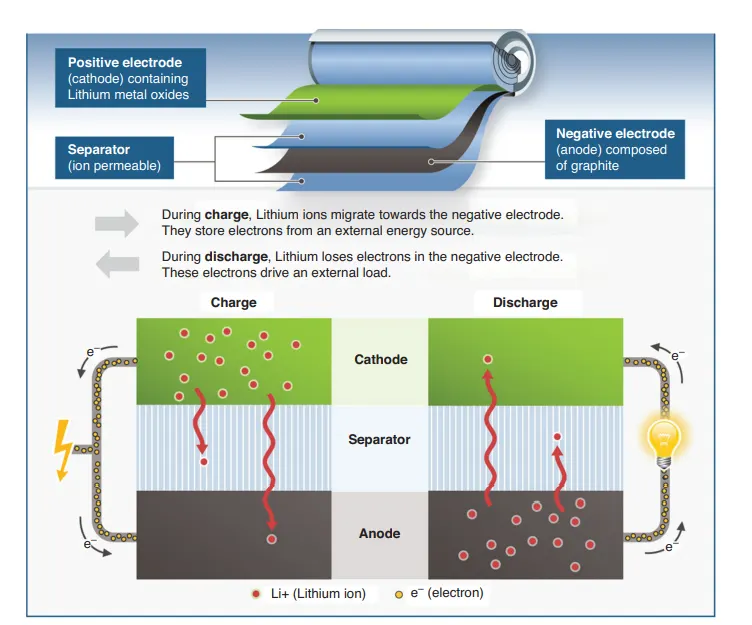
Lithium ion batteries are batteries that function based on the transfer of lithium ions between a cathode and an anode.
Lithium ion batteries work by using the transfer of lithium ions and electrons from the anode to the cathode. At the anode, neutral lithium is oxidized and converted to Li+.These Li+ions then migrate to the cathode, where they are incorporated into LiCoO2.This results in the reduction of Co(IV) to Co(III) when the electrons from the anode reaction are received at the cathode. Because lithium is involved in the reactions at both electrodes, the battery can be recharged by running the reactions in reverse.
WORKING OF LITHIUM ION BATTERY:
THE TYPES OF LITHIUM ION BATTERY ARE CLASSIFIED AS ,
The main Six types of Lithium Battery Technologies are,
1.NCA-Lithium Nickel Cobalt Aluminium
2.LCO-Lithium cobalt oxide
3.LMO-Lithium Manganese Oxide/Spinels
4.NMC-Lithium Nickel Manganese Cobalt
5.LFP-Lithium Iron Phosphate
6.LTO-Lithium Titanium Oxide
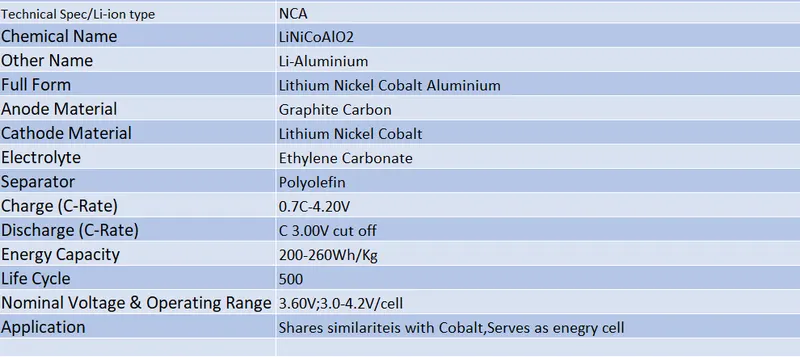
1.NCA-Lithium Nickel Cobalt Aluminium (Li(NixCoyAl1−x−y)O2)
- It shares similarities with NMC by offering high specific energy and specific power(the rate at which the battery can deliver energy), and a long life span.
- NCA is not as safe as the others listed above and as such, require special safety monitoring measures to be employed for use in EVs.They are also more costly to manufacture, limiting their viability for use in other applications.
ANODE REACTION:
`Li_xC_nrarrnC+xLi^++xe^-`
CATHODE REACTION:
`Li_1__xMO2^+xLi^++xe^-) rarrLiMO2`
OVERALL REACTION:
`Li_1__xMO2+Li_xC_nrarrLiMO2+nC`
2.LCO-Lithium cobalt oxide
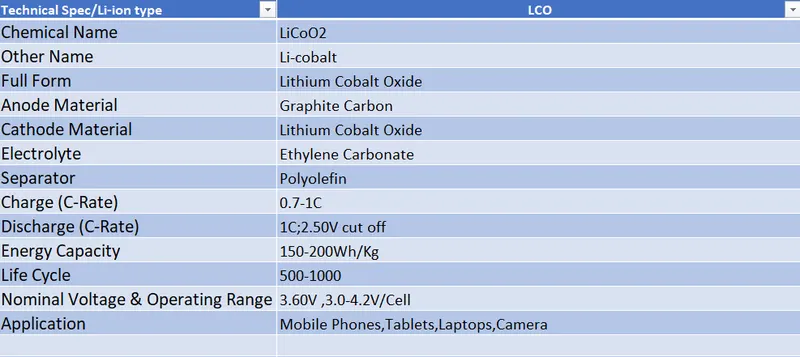
- The lithium cobalt oxide battery has been the battery of choice for most personal electronics (laptops, cameras, tablets, etc.) due to their high energy density, long life cycle and ease of manufacturing.
- Lithium cobalt batteries are very reactive and therefore suffer from poor thermal stability and must be monitored during operation to ensure safe use.
- The limited availability of cobalt also makes it more expensive and difficult to be a viable option for use in EVs.Nevertheless, this high energy dense battery powers the Tesla Roadster and Smart Fortwo electric drive (ED).
ANODE REACTION:
`LiC_6rarrxLi^++xe^-)+C_6`
CATODE REACTION :
`Li_(1-x)CoO_2+xLi^++xe^-)rarrLiCoO_2`
OVERALL REACTION:
`C_6+LiCoO_2harrLi_xC_6+Li_(1-x)CoO_2`
3.LMO-Lithium Manganese Oxide/Spinels
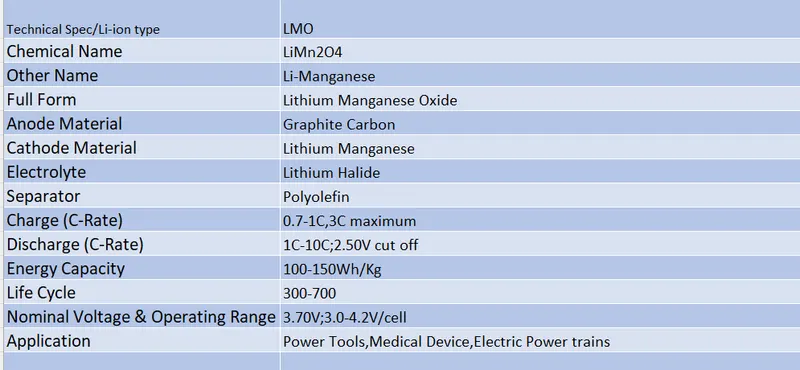
- The architecture forms a three-dimensional spinel structure that improves ion flow on the electrode, which results in lower internal resistance and improved current handling.
- Low internal cell resistance enables fast charging and high-current discharging. Li-manganese can be discharged at currents of 20–30 A with moderate heat buildup in an 18,650 package.
- Most Li-manganese batteries blend with lithium manganese cobalt oxide (NMC) to improve the specific energy and prolong the life span.
- The LMO-NMC has been used by multiple EV manufacturers in the past including Nissan Leaf, Chevy Volt and BMW i3.One of the main research efforts in the field of lithium-manganese oxide electrodes for Li-ion batteries involves developing composite electrodes using structurally integrated layered Li2MnO3 and spinel LiMn2O4,
- chemical formula of xLi2MnO3 (1−x)Li1+yMn2−yO4. The combination of both structures provides increased structural stability during electrochemical cycling while achieving higher capacity and rate-capability.
ANODE REACTION:
`xLi^+xe^-)+6CrarrLi_xC_6`
CATHODE REACTION:
`LiMnO_2rarrLi_1__xMn_2O_4+xLi^++xe^-`
OVERALL REACTION:
`LiMn_2O_4+6CrarrLiC_6+Mn_2O4`
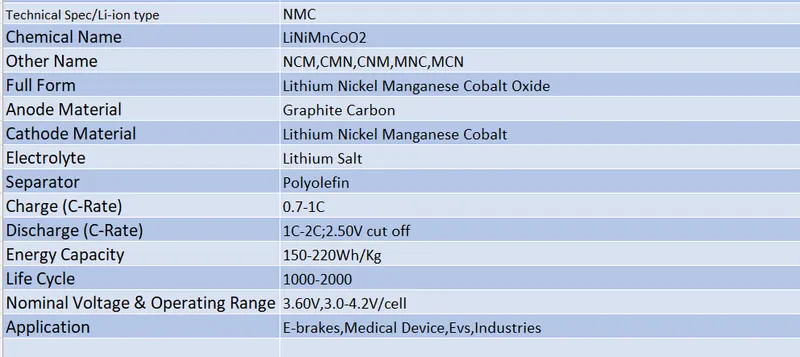
4.NMC-Lithium Nickel Manganese Cobalt
- Lithium Nickel Manganese Cobalt Oxide (NMC) electrodes can be designed for high specific energy or power with high density.
- The secret of NMC lies in combining nickel and manganese
- nickel is known for its high specific energy but poor stability; manganese has the benefit of forming a spinel structure to achieve low internal resistance but offers a low specific energy .
- The mix of the various metals (nickel and manganese) varies by manufacturer and is a very closely guarded formula.
- Researchers are using nickel-rich electrodes to increase energy density, while reduction in cobalt is also helpful since it lowers costs.
- Combining nickel and manganese enhances each other’s strengths, making NMC the most successful Li-ion system and suitable for EV powertrains.
- These batteries are currently in high demand given the high specific energy and excellent thermal characteristics. As mentioned above, NMC has been used by many EV manufacturers, including Nissan Leaf, Chevy Volt and BMW i3.
ANODE REACTION:
`xLi^++xe^-)+nCrarrLi_xC_n`
CATHODE REACTION:
`LiMO_2rarrLi_(1-x)MO_2+xLi^++xe^-`
OVERALL REACTION:
`Li_(1-x)MO_2+Li_xC_nrarrLiMO_2+nC`
5.LFP-Lithium Iron Phosphate
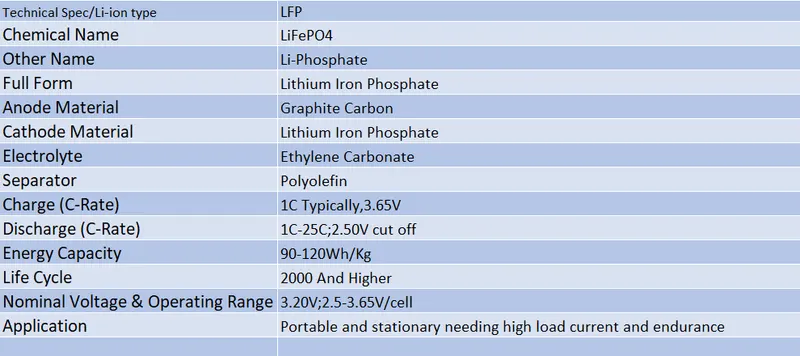
- LiFePO4 (LFP) offers good electrochemical performance with low resistance, besides high current rating and long cycle life.
- The phosphate helps to stabilize the electrode against overcharging and provides a higher tolerance to heat which limits the breakdown of the material.
- These batteries have a wide temperature range and can operate between +60 ◦C to −30 ◦C and are much less likely to suffer from a thermal runaway.
- LiFePO4 has a higher self-discharge than other Li-ion batteries, which can cause balancing issues with aging. This can be mitigated through the use of sophisticated control electronics, at increased battery pack cost. Further, moisture seems to significantly limit the lifetime of the battery.
ANODE REACTION:
`LiC_6rarrLi^++e^-)+C_6`
CATHODE REACTION:
`FePO_4+Li+e^_rarrLiFePO_4`
OVERALL REACTION:
`LiFePO_4+6CrarrLiC_6+FePO_4`
6.LTO-Lithium Titanium Oxide
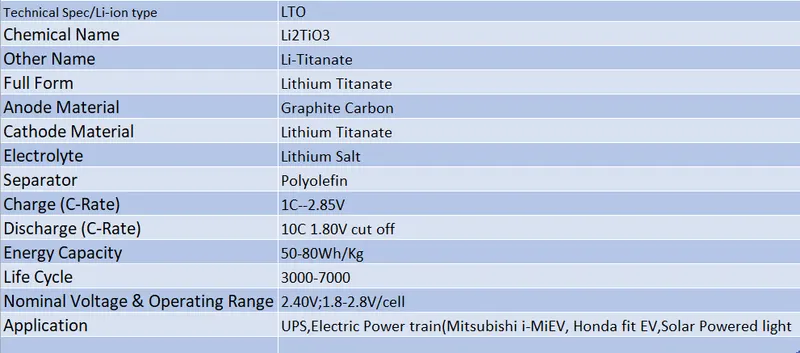
- Batteries with lithium titanate negative electrodes have been known since the 1980s.
- Li-titanate (LTO) replaces the graphite in the negative electrode of a typical Li-ion battery and the material forms into a spinel structure.
- The counter-electrode can be lithium manganese oxide or NMC. Spinel lithium titanate has been regarded as a highly useful electrode material because of the zero volume change during lithiation, leading to an extremely long operational lifetime for the electrode, coupled with the improved safety owing to an extremely flat discharge and charge plateau at about 1.55 V vs. Li/Li+.
- This material has low electronic conductivity and the Li+ diffusion coefficient of this material can result in poor performance at high power levels, though this can be improved through the reduction of the lithium ion transport path lengths through proper nanostructuring.
- the improvement of the electronic conductivity through doping, surface coating, and forming composites with better electronic conductors such as carbon materials.
- Titanate batteries are used in certain Japanese-only versions of Mitsubishi’s i-MiEV electric vehicle, and Honda uses them in its Fit EV.
- LTO are also used in the Tosa concept electric bus. Due to their high level of safety, lithium titanate batteries are used in mobilemedical devices.
ANODE REACTION:
`Ti_5O_12+4Li^++4e^-)rarrLi_4Ti_5O_12`
CATHODE REACTION:
`4LiMn_2O_4rarr4Mn_2O_4+4Li^++4e^-`
OVERALL REACTION:
`Li_4Ti_5O_1+4Mn_2O_4rarr4LiMn_2O_4+Ti_5O_12`
2.Comparing the differences between each type of Li+ion batteries based on their characteristics.
- There are no ideal contenders for the electric powertrain, and Li-ion remains a good choice.Figure Below graphically compares different types of Li-ion batteries used in EVs considering several characteristics, with the larger colored area being more desirable.
- The major factors considered are specific energy, specific power, safety, performance, life span, and cost.
- Specific energy demonstrates how much energy a battery can hold per unit weight, which reflects the driving range.
- Specific power is the ability to deliver high current on demand and demonstrates potential vehicle acceleration.
- Safety is naturally one of the most important aspects when choosing a battery for the EV—an incident could significantly affect public opinion.
- Performance reflects the condition of the battery when driving the EV in extreme temperature conditions.
- Life Span reflects cycle count and longevity.
- Cost naturally presents technology feasibility, with necessary ancillary systems for safety, battery management for state of charge status monitoring, climate control for longevity, and the 8–10-year warranty adding to this challenge.
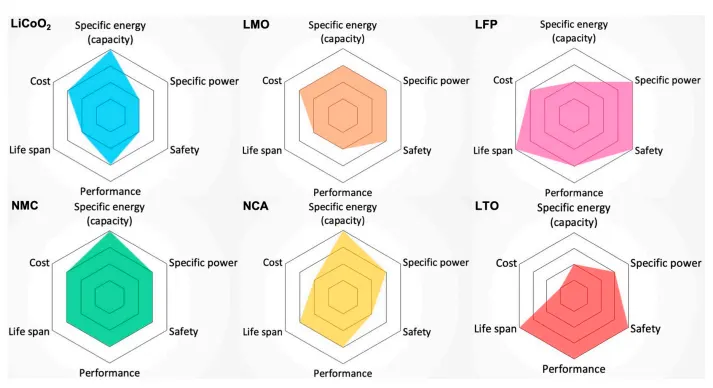
FIG: Comparisons of different types of Li-ion batteries used in EVs from the following perspectives: specific energy (capacity), specific power, safety, performance, life span, and cost (the outer hexagon is most desirable). Lithium Nickel Manganese Cobalt Oxide (NMC), Lithium Iron Phosphate (LiFePO4) and Lithium Manganese Oxide stand out as being superior among the Six Different Types of Battery.