Week 1 Understanding Different Battery Chemistry
NOTE:EV LIVE SESSION BATCH 16
Q1.Prepare a table which includes materials & chemical reactions occurring at the anode and cathode of LCO, LMO, NCA, NMC, LFP and LTO type of lithium ion cells.Give your detailed explanation on it
ANS:
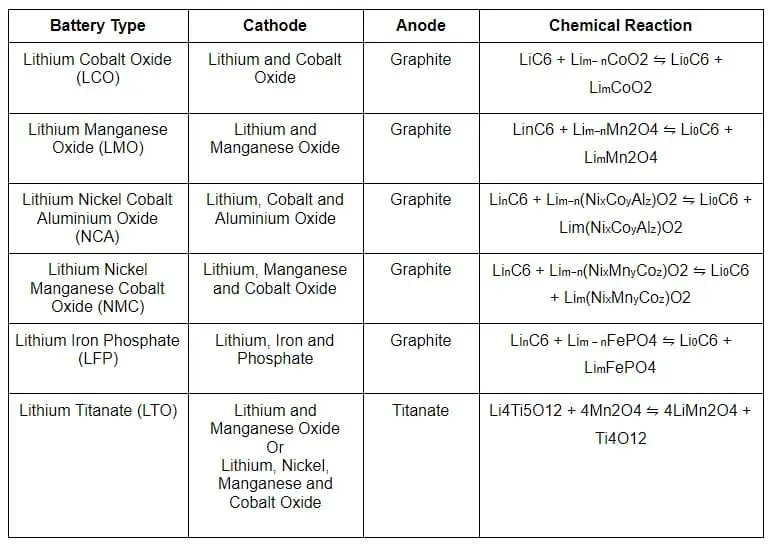
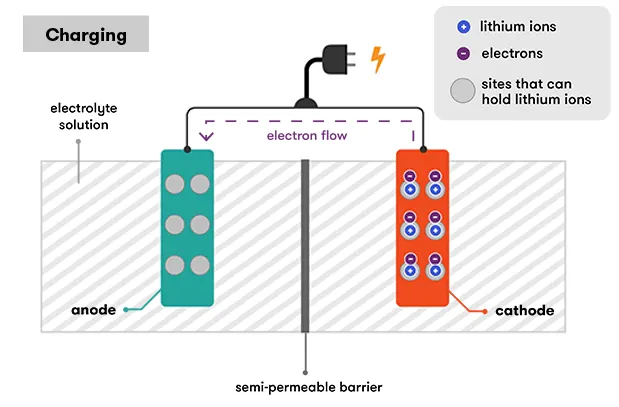
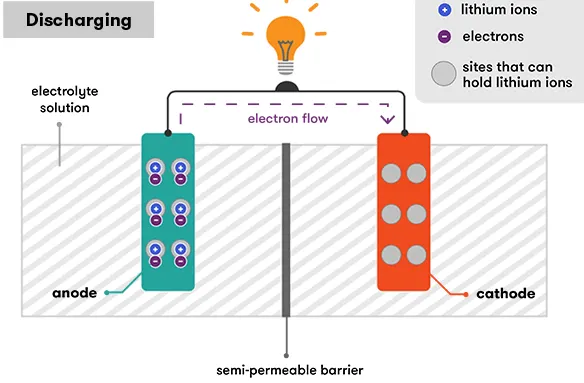
LITHIUM COBALT OXIDE (LiCoO2)
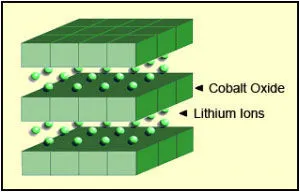
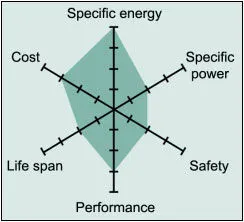
The most common lithium-ion cells have an anode of carbon (C) and a cathode of lithium cobalt oxide (LiCoO2). In fact, the lithium cobalt oxide battery was the first lithium-ion battery to be developed from the pioneering work of R Yazami and J Goodenough, and sold by Sony in 1991. The cobalt and oxygen bond together to form layers of octahedral cobalt oxide structures, separated by sheets of lithium. It’s important that this structure allows the cobalt ions to change their valence states between Co+3 and Co+4 (lose and gain a negatively-charged electron) when charging and discharging.
Of all the various lithium-ion batteries, these guys have the greatest energy density, which is why they’re currently the batteries found in our phones, digital cameras and laptops. Their drawback is their thermal instability. Their anodes can overheat and, at high temperatures, the cobalt oxide cathode can decompose, producing oxygen. If you combine oxygen and heat, you’ve got a pretty good chance of starting a fire and, as the chemicals sometimes used in the electrolyte solution, such as diethyl carbonate, are flammable, there can be some safety issues with this battery.
During discharge
At the anode, lithium is oxidised. Lithium ions are released from the carbon, along with electrons:
At the cathode, lithium-ions are absorbed by the lithium dioxide, and the electrode is reduced as it also receives the electrons from the circuit:
`Li_(1−x)CoO_2+xLi^++xe^−→LiCoO_2Li_(1−x)CoO_2+xLi^++xe^−→LiCoO_`
The overall reaction is:
LITHIUM IRON PHOSPHATE (LiFePO4)
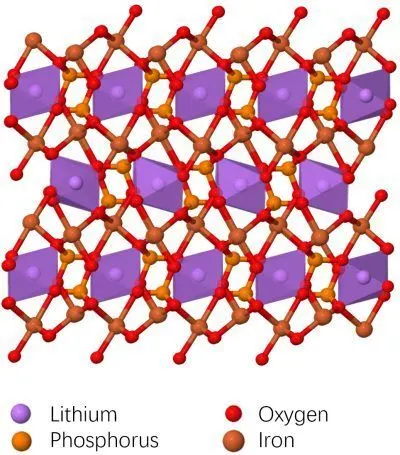
This cell has a high discharge rate and, because phosphate (PO4) can cope with high temperatures, the battery has good thermal stability, improving its safety. This makes it a good choice for things like electric vehicles and power tools, and for storing energy at power stations. It also has a long cycle life, meaning it can be discharged and charged many times. However, it has a lower energy density than a lithium cobalt oxide cell, and a higher self-discharge rate.
A lithium iron phosphate battery cell is similar to the lithium cobalt oxide cell. The anode is still graphite and the electrolyte is also much the same. The difference is that the lithium cobalt dioxide cathode has been replaced with the more stable lithium iron phosphate. In fact, no lithium or iron ions remain in the iron phosphate (FePO4) cathode of a fully charged cell. The lithium ions can intercalate into or out of the cathode material through well-defined tunnels in its structure without significantly altering the iron phosphate framework.
The cathode of this type of cell is made of negatively charged phosphate anions, bonded with positively charged iron cations in a structure that is capable of storing lithium ions within the iron phosphate molecules. The bonding arrangement in this structure means that the oxygen atoms are tightly bonded into the structure, which gives the cathode its chemical stability.
At the anode, lithium is oxidised. Lithium ions are released from the carbon, along with electrons:
During discharge
At the cathode, lithium ions are absorbed by the lithium dioxide, and the electrode is reduced as it also receives the electrons from the circuit:
The overall reaction is:
LITHIUM MANGANESE OXIDE (LiMn2O4)
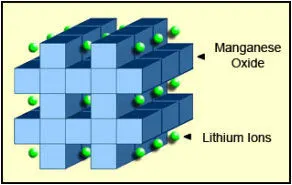
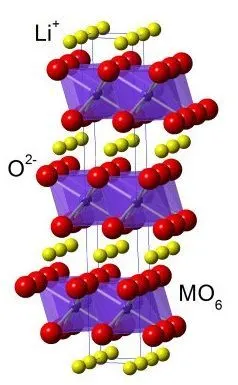
- This type of lithium battery uses a cathode made from lithium-manganese spinel (Li+Mn3+Mn4+O4). Spinel is a type of mineral with a distinctive AB2O4 structure.
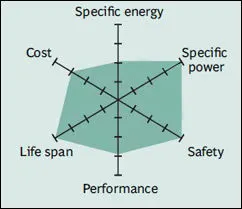
- The spinel structure has very good thermal stability, improving the battery’s safety. It also promotes ion flow within the electrolyte and lessens the internal resistance that contributes to the loss of a battery’s power over time.
- While this type of lithium battery offers high discharge and recharge rates (also due to the spinel structure of the cathode) it has a lower capacity and shorter lifetime.
LITHIUM NICKEL MANGANESE COBALT OXIDE (LiNiMnCoO2 or NMC)
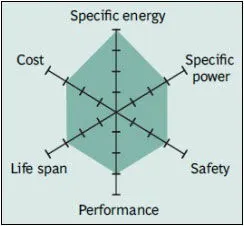
- Adding nickel and cobalt back into the mix changes things slightly again. Nickel provides a high specific energy and, when added to the stable structure of the manganese spinel, also results in a battery with the benefits of the manganese spinel structure (low internal resistance, high charging rate, good stability and safety).
- These batteries are generally made with a cathode with one-third nickel, one-third manganese and one-third cobalt, but the ratio can vary according to manufacturers’ secret formulas. These batteries are used in power tools, electric vehicles and medical devices.
- Lithium manganese batteries are often coupled with a lithium nickel manganese cobalt oxide battery, producing a combination that is used in many electric vehicles. High bursts of energy (for rapid acceleration) are provided by the lithium-manganese component, and a long driving range is provided by the lithium nickel manganese cobalt oxide component.
Lithium nickel cobalt aluminum oxide(LiNiCoAlO2 ) NCA
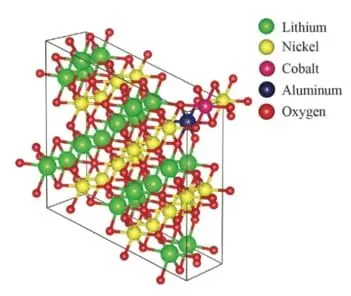
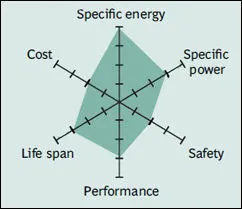
- NCA battery stands for Lithium nickel cobalt aluminum oxide based battery (LiNiCoAlO2). Also, NCA batteries are becoming more and more important in in-grid storage and electrical power terrain applications.
- NCA (Lithium nickel cobalt aluminum oxide) battery was invented in the year 1999. Its anode material is LiaC6, the cathode material is LibNi0.8Co0.15Al0.05O2 and the carrier is Li+. It is used in different applications like power grid applications, medical devices and Electric car. Most notably Tesla deploys NCA batteries in their electric vehicles system.
- NCA batteries can store the same amount of energy as NMC.NCA batteries are not widely common in the consumer industry, but are quite promising in the electric car industry.
Lithium titanate (LTO)
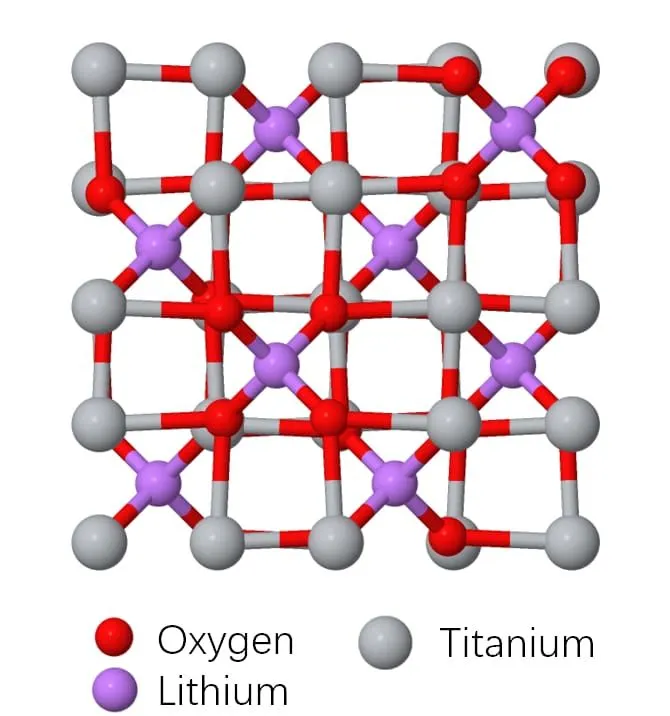
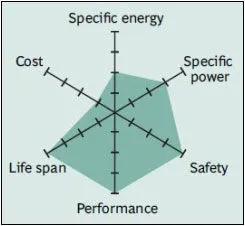
- Lithium titanate (LTO) based batteries rely on a promising new technology that employs nanostructured materials to improve the performance, quality, and lifetime of these batteries.
- The battery consists of the three main parts: an anode, a cathode, and electrolyte solution. However, the anode in these batteries is covered with nano-structured lithium-titanate instead of carbon (in the case of Li-ion batteries).
- This new technology increases the electrode’s active surface area and allows electrical charges to move more easily and quickly. The high currents can then provide fast charging and discharging rates, long cycle life, and the ability to withstand diverse environmental and temperature conditions.
- In essence, the LTO is a rechargeable battery based on the, or modified from, the Lithium-Ion (li-ion) battery technology. Li-titanate oxide (LTO) replaces the graphite in the anode of the typical Li-Ion battery and forms the materials into a spinel 3D crystal structure.
- Having a nominal a cell voltage of 2.40V, it releases a high current discharge current that is 10 times the capacity of the other types of lithium batteries. Instead of using carbon particles on its surface as other lithium batteries do, Lithium Titanate utilizes lithium-titanate nanocrystals
****************************************************************
Q2.Compare the differences between each type of Li+ion batteries based on their characteristics
ANS:
We can compare type of Li+ion batteries based on their characteristics in table below
| Battery Type | Nominal Voltage | Specific Energy | Charge Rate | Discharge Rate | Life Cycle | Thermal Runaway Temperature(°C) | Cost | Performance | Safety |
| LCO | 3.6V | 150-200 Wh/Kg | 0.7-1 C | 1C | 500-1000 | 150°C | Low | Medium | Less |
| LMO | 3.7V | 100-150 Wh/Kg |
Typical 0.7-1 C MAX 3C |
Typical 1C Max 10C | 300-700 | 250°C | Low | Low | Medium |
| NCA | 3.6V | 200-260 Wh/Kg | 0.7 C | 1 C | 500 | 150°C | Medium | Medium | Low |
| NMC | 3.6V | 150-220 Wh/Kg | 0.7-1 C | 1-2 C | 1000-2000 | 210°C | Low | Medium | Medium |
| LFP | 3.2V | 90-120 Wh/Kg | 1 C | 1C & On some cell 25C | 2000 | 270°C | Low | Medium | High |
| LTO | 2.4V | 50-80 Wh/Kg | Typical 1C Max 5C | Upto 10C | 3000-7000 | One of safest battery in Lion | High | High | High |
Conclusion:
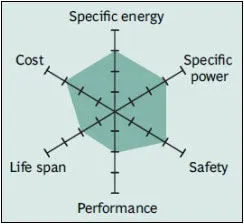
Lithium Cobalt Oxide has high specific energy as compared to the other batteries which make it the preferred choice for laptops and mobile phones. It also has a low cost and a moderate performance. However, it is highly unfavorable in all the other aspects when compared to the other lithium-ion batteries. It has low specific power, low safety, and a low lifespan.
Lithium Manganese Oxide has moderate specific power, moderate specific energy, and a moderate level of safety when compared to the other types of lithium-ion batteries. It has the added advantage of a low cost. The downsides are its low performance and low lifespan. It is usually used in medical devices and power tools.
Lithium Nickel Manganese Cobalt Oxide has two major advantages as compared to the other batteries. The first one is its high specific energy which makes it desirable in electric powertrains, electric vehicles, and electric bikes. The other is its low cost. It is moderate in terms of specific power, safety, lifespan, and performance when compared to the other lithium-ion batteries. It can be optimized to either have high specific power or high specific energy.