Week-6 Challenge: EV Drivetrain
NOTE: EV LIVE SESSION BATCH 16
Q1)Which types of power converter circuits are employed in electric and hybrid electric vehicle?
ANS:
There are 4 types of converter
1)DC to DC Converter: Which convert violtage leves of DC. It include buck converter,boost converter and buck-boost converter.also refer as chopper
2)DC to AC Converter: Which converts DC voltage into AC voltage.This converter also called as inverter.
3)AC to DC Converter: Which convert AC voltage to DC voltage. This is also called as Rectifire.
4)AC to AC Converter: Which converts AC voltage into another level of AC voltage.also called as regulator.
But in EV and HEV 1)DC to DC Converter 2)DC to AC Converter 3)AC to DC Converter are used.
--------------------------------------------------------------------------------
Q2)An Electric Vehicle's powertrain with 72V battery pack in shown in the diagram below. The duty ratio for acceleration operation is 'd1' and for the braking operation the duty ratio is 'd2'.
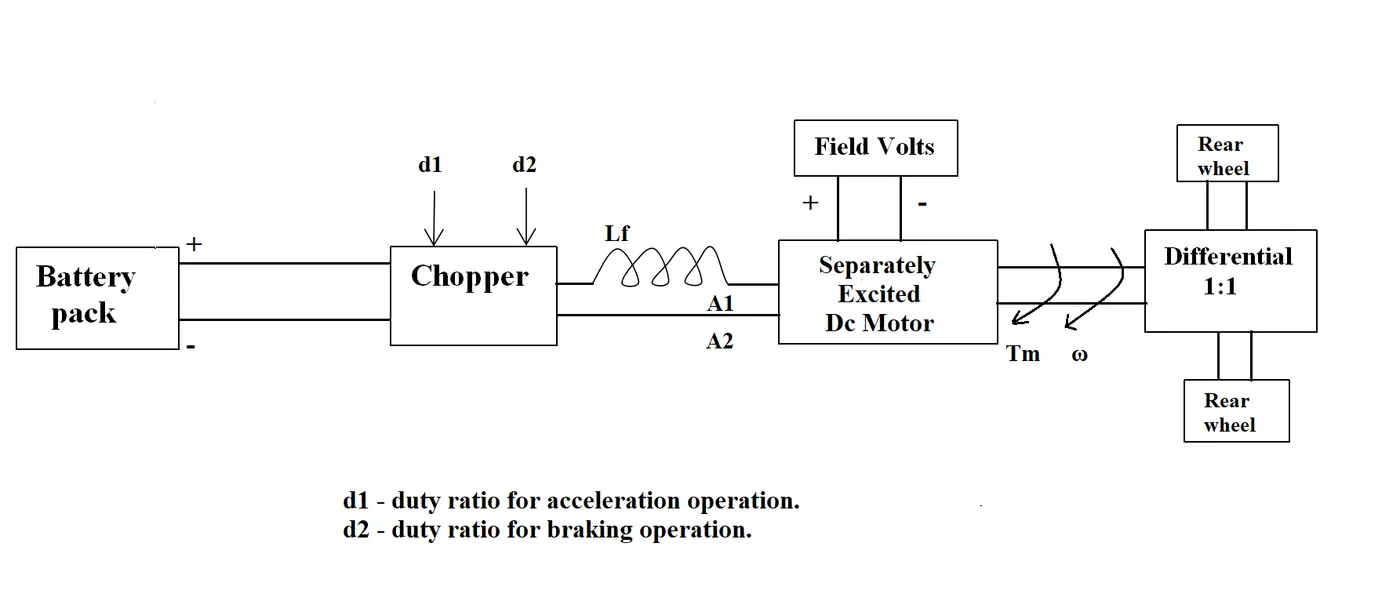
The other parameters of the electric vehicle is given below,
Motor and Controller Parameters:
Rated Armature voltage= 72 V
Rated armature current= 400 A
Ra= 0.5Ω, KΦ= 0.7 Volt second
Chopper Switching frequency= 400 Hz
The vehicle speed-torque characteristics are given by the below equation

What is EV steady state speed if duty cycle is 70%?
ANS:
the given data is;
Motor and Controller Parameters:
Rated Armature voltage= 72V
Rated armature current= 400 A
Ra= 0.5Ω, KΦ= 0.7 Volt second
Chopper Switching frequency= 400 Hz
duty cycle is 70%=0.7
speed torque characteristic given by eqn Tv=`24.7+(0.005)omega^2`
i/p vlg can be find out by;
i/p vtg=battery pack voltage*duty cycle
=72*0.7
i/p vtg=50.4 V
we know the angular speed eqn
`omega=(v/(kphi))-(Ra*T)/(kphi)^2`
`omega=50.4/0.7-0.5*((24.7+0.051*omega^2)/0.49)`
`omega=(22.93-0.000255*omega^2)/0.49`
`0.00255omega^2+0.49omega-22.93=0`
after solving above equn
at accleration mode d1=0.7
`omega=38.91 rps =38.91*60=2334.6 RPM`
7at braking mode d2=0.7
`omega=231.07 RPS=231.07*60=13864.2 RPM`
------------------------------------------------------------------------------------------------------------------------------------`
Q3. Develop a mathematical model of a DC Motor for the below equation using Simulink.
ω= V/Kϕ -Ra/Kϕ^2 .T
Ans:
Below model shows model of DC motor for given eqn ω= V/Kϕ -Ra/Kϕ^2 .T
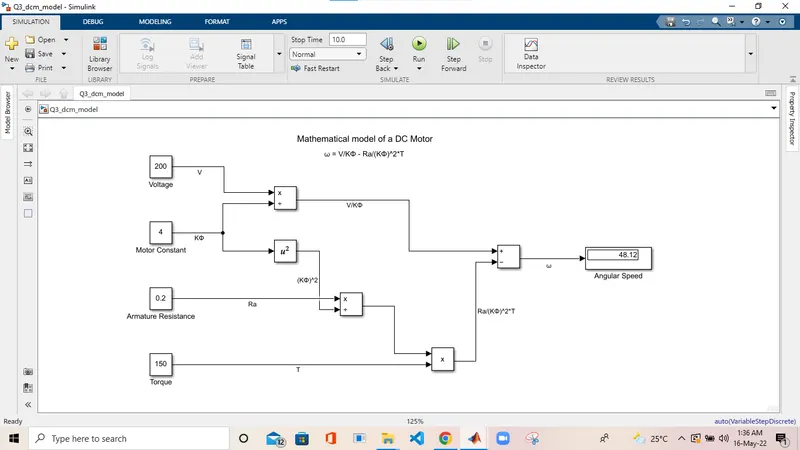
- In this model I used 4 constant block to give I/p of voltage motor constant armature resistance and torque
- As well as for product block for v/k`kphi` ; Ra/`kphi^2` and for multiply it with T
- Square block for `kphi^2`
- And add block for subtraction of this
- Display for to see output
- i change sign of above block asper requirement
- I give voltage as 200
Motor const as 4
Armiture resistance as 0.2
And torque as150 - After running model i get 48.12 as angular speed in display block
i attaching file for ref.
----------------------------------------------------------------------------------------------------
Q4) Refer to the blog on below topic:
Induction Versus DC brushless motors by Wally Rippel, Tesla
Explain in brief about author’s perspective.
ANS:
In this block author basically compare two motor technology of BLDC motor and Induction motor..at the starting he wa talking about old technology there were lead acid batteries, DC brush motors, and contactor controllers.and said that that technology Lead has been replaced by lithium and DC by either DC brushless or induction. Contactors, meanwhile, have given way to modulating inverters.And said that each will have its loyal proponents and religious detractors.
further he talking about BLDC and Induction motors comparitively.In BLDC motor permanant magnet is used in Rotor circuit.The inverter provides current control . Without it, brushless motors are useless motors. the stators for the 3-phase induction motor and the DC brushless motor are virtually identical. Both have three sets of “distributed windings” that are inserted within the stator core. The essential difference between the two machines is with the rotor. In induction motor, it has no magnets.stacked steel laminations with buried peripheral conductors that form a shorted structure.adding to this he explain the working of both motor in brief.
As permanant magnet used in BLDC its gives good control,good performance in torque;high peak efficiency.but due to no use of permanant magnet in Induction motor controlling become complex,it not meeting torque without inverter circuit and torque is less alsocompared to BLDC.
On other hand BLDC havelimitation due to use of permanant magnet as it is very expensive one;required motor controller;anable to adjust the magnetic field as like inductionm motor,the size also increase compare to Induction motor. but in Induction motor we can adjust the magnetic field,magnetic losses also less.
Both DC brushless and induction drives use motors having similar stators. Both drives use 3-phase modulating inverters. The only differences are the rotors and the inverter controls. And with digital controllers, the only control differences are with control code.One of the main differences is that much less rotor heat is generated with the DC brushless drive. Rotor cooling is easier and peak point efficiency is generally higher for this drive.
At the end authod unable to conclude which of both is better than other. and he noted that BLDC drives will likely dominate in the hybrid and coming plug-in hybrid markets, and that induction drives will likely dominance for the high-performance pure electrics