Week 1 Understanding Different Battery Chemistry
Challenge 1-
Li-ion batteries are the new technology developed in the battery industry. It has high voltage and Higher specific energy density amoung family of the battery. there are variety of lithium ion batteries are available at the present time. the variety of materials used as the cathode which determine the behaviour of the Battery.
Most of the Li-ion cells have different type of lithium substance at the cathode and graphite anode with current collector at both sides. an Seperator is used to isolate between anode and cathode material and It only allows ions to pass and it will not allow any electron to flow through them so that any electron must go through the external circuit in order to take part in chemical reaction and this results in battery current which we analysed at the external circuit.
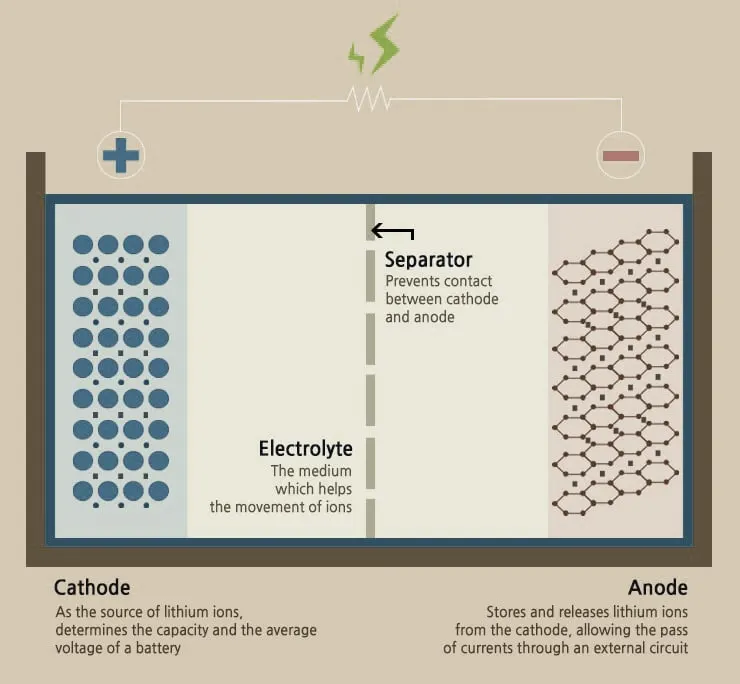
there is one medium presentin between cathod and anode which is called electrolyte. It is electrically nuetral and it helps ions to move from anode to cathode or vice-versa.
When cells discharge, the positive Li-ions are move from anode to cathode and after reaching cathode it will make a a substance of lithium with a electron(come from the external circuit) and when cell charge this Lithium substance bond will get intrupt and the LI-ion go from the positive electrode to negative electrode in order to charge the battery.
Here we gonna discuss the Discharging process of battery therefore we refer positive electrode as cathode and negative electrode as anode.
There are mainly six categories of Li-ion batteries available at the market that is,
Lithium Cobalt Oxide (LCO),
Lithium Manganese Oxide (LMO),
Lithium Nickel Manganese Cobalt Oxide (NMC),
Lithium Iron Phosphate (LFP),
Lithium Nickel Cobalt Aluminum Oxide (NCA),
and Lithium Titanate (LTO).
among this categories they exibit same behaviour, that is movement of lithium ion from anode to cathode and making of stable substance of lithium. for example in the LCO the anode will release the electron and the lithium ion and this Li-ion will move internally through the seperator and reach at cathode side to make a stable Li-substance.
Cathode reaction in the LCO,
CoO2 + Li(+) + e(-) `->` LiCoO2
anode,
LiC6 `->` 6C + Li(+) + e(-)
Now make a table in order to understand whats happening internally in the different type of Li-ion cells,
| Type | Cathode Reaction | Anode Reaction |
| LCO | CoO2 + Li(+) + e(-) `->` LiCoO2 | LiC6 `->` 6C + Li(+) + e(-) |
| LMO | Mn2O4 + Li(+) + e(-) `->` LiMn2O4 | LiC6 `->` 6C + Li(+) + e(-) |
| NMC | NiMnCoO2 + Li(+) + e(-) `->` LiNMnCoO2 | LiC6 `->` 6C + Li(+) + e(-) |
| NCA | NiCoAlO2 + Li(+) + e(-) `->` LiNiCoAlO2 | LiC6 `->` 6C + Li(+) + e(-) |
| LFP | FePO4 + Li(+) + e(-) `->` LiFePO4 | LiC6 `->` 6C + Li(+) + e(-) |
| LTO | - | Li7Ti5O12 `->` Li4Ti5O12 + 3Li(+) + 3e(-) |
As Li-ions(cations) are move from anode to cathode the It forms a stable substance which depends on the type of the Battery material and externally electrons flows from anode to cathode terminal which is the opposite direction of the conventional current.Depending on the material used at the cathode the Battery operationg voltages and other characteristics are determine.
Challenge 2-
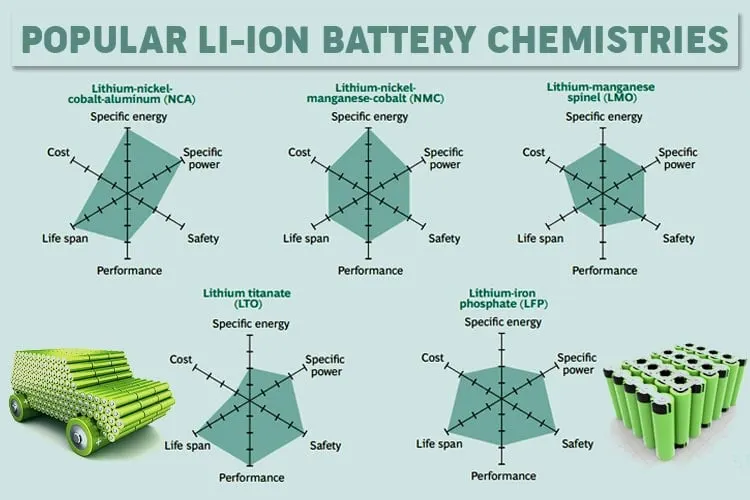
As we know the characteristics of Lithium ions batteries is mainly depends on the cathode material. The anode is usually made of Graphite and Hard carbon as It has low cost high stability and high specific caacity. the cathode materials determine the characteristics of the battery and hence have different type of battery confuguration.
Lithium Cobalt Oxide (LCO)
It has cobalt as main active material in the cathode and It has high energy density but LCO price increases as time because of excessivew use in the EV application. Cobalt is very volatile material and have lower therrmal stability. It is very sensible to its internal impedence and has current limiting factor due to its overheating.
It has several andvantages with high specific density and hence It widely used in the elctronic gadgets like laptop, mobile phones and have high demand in EV application.
Lithium Manganese Oxide (LMO)
Lithium Magnese Oxide batteries have low internal resistance and high temperature stability and it can handle upto 20-30 Amp of current as It have Low internal resistance. The main disadvantage of this battery is that, It has very low life cycle around 300-700.
It is mainly used where high current are required such as power tools.
Lithium Nickel Manganese Cobalt Oxide (NMC)
NMC has high specific energy density with quite good life cycle and It is Low cost among all other LI-ion batteries and have good charging and Discharging capacity with good thermal stability and lower internal resistance. all this properties makes this Battery to make perfect fit to Electrical vehicle applications.
Lithium Iron Phosphate (LFP)
Lithium iron phosphate batteries have longest life cycle in the category (5000-7000) with low cost that makes it the most affordable battery in the market and It has lower internal resistance hence higher thermal stability. Its main disadvbantage about this battery is, it has lower energy density with low discharge rate.
Due to its safety and affordable property this battery is widely used in E-motorcycle and E-rikshaw.
Lithium Nickel Cobalt Aluminum Oxide (NCA)
Lithium Nickel Cobalt Aluminium Oxide Batteries, popularly known as NCA batteries is quite new technology which have fast charging capacity with quite good lide cycle and It has higher cost due to the cobalt and nickel material used but It can provide higher Power with High specific density although it has safety concerns which will further increases cost of safety features.
Lithium Titanate (LTO)
Lithium Titanate anode is used to provide high charging and Discharging capability without compermising the thermal stability but It has low nominal voltage and energy density and high cost per kWh capacity.
LTO batteries are used in military applications and aerospace industries due to its high safety and high charging and discharging capacity.
There are following table for discribing the batteries we learn so far, rate in the 5 scale pointer
| LCO | LMO | NMC | LFP | NCA | LTO | |
| COST | 3 | 4 | 4 | 4 | 3 | 2 |
| SPECIFIC ENERGY | 5 | 4 | 5 | 3 | 5 | 3 |
| SPECIFIC POWER | 5 | 4 | 4 | 4 | 5 | 4 |
| SAFETY | 2 | 4 | 4 | 5 | 2 | 5 |
| PERFORMANCE | 4 | 3 | 4 | 4 | 4 | 5 |
| LIFECYCLE | 3 | 3 | 4 | 5 | 5 | 5 |