Week 1 Understanding Different Battery Chemistry
Understanding Different Battery Chemistry
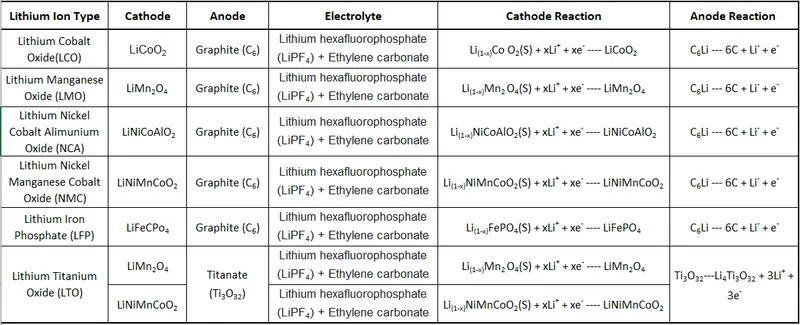
#1. Prepare a table which includes materials & chemical reactions occurring at the anode and cathode of LCO, LMO, NCA, NMC, LFP and LTO type of lithium ion cells.Give your detailed explanation on it.
Lithium Ion Cell
Lithium ion batteries are secondary type of batteries which can be designed for optimal capacity which can be recharged.
In lithium ion battery the anode and cathode is stored in lithium.
The lithium ion battery consist of:
- Anode
- Cathode
- Electrolyte
- Saperator
The Lithium Ion cells are of different type on the basics of their chemical composistion and they are:
1. Lithium Cobalt Oxide (LCO) - LiCoC2
Lithium cobalt oxide, sometimes called lithium cobaltate or lithium cobaltite, is a chemical compound with formula LiCoO. The cobalt atoms are formally in the +3 oxidation state, hence the IUPAC name lithium cobalt(III) oxide.
Lithium cobalt oxide is used in the positive electrodes of lithium-ion batteries.
These batteries are used in electronic devices like laptops, mobiles etc.
2. Lithium Manganese Oxide (LMO) - LiMn2O4
A lithium ion manganese oxide battery (LMO) is a lithium-ion cell that uses manganese dioxide, MnO2, as the cathode material. They function through the same intercalation/de-intercalation mechanism as other commercialized secondary battery technologies. Cathodes based on manganese-oxide components are earth-abundant, inexpensive, non-toxic, and provide better thermal stability.
3. Lithium Nickel Cobalt Alimunium Oxide (NCA) - LiNiCoAlO2
These batteries are mostly used in electric powertrains, grid storage and in automative industries. The NCA atteries provide a high specific energy, specific power and long lifespan.
4. Lithium Nickel Manganese Cobalt Oxide (NMC) - LiNiMnCoO2
Lithium nickel manganese cobalt oxides (abbreviated Li-NMC, LNMC, NMC or NCM) are mixed metal oxides of lithium, nickel, manganese and cobalt.
Structurally materials in this group are closely related to lithium cobalt(III) oxide (LiCoO2) and have a layered structure but possess an ideal charge distribution of Mn(IV), Co(III), and Ni(II) at the 1:1:1 stoichiometry. For more nickel-rich compositions, the nickel is in a more oxidized state for charge balance. NMCs are among the most important storage materials for lithium ions in lithium ion batteries. They are used on the positive side, which acts as the cathode during discharge. These batteries have a high specific energy and power.
This battery is commonly used in power tools and powertrain for vehicles.
5. Lithium Iron Phosphate (LFP) - LiFeCPo4
The lithium iron phosphate battery or LFP battery (lithium ferrophosphate) is a type of lithium-ion battery using lithium iron phosphate (LiFePO4) as the cathode material, and a graphitic carbon electrode with a metallic backing as the anode. The energy density of an LFP battery is low when compared to other types of litium ion batteries.
These batteries are used in motorcycle where the power is low and long lifecycle is required.
6. Lithium Titanium Oxide (LTO) - LiTiO2
The lithium-titanate or lithium-titanium-oxide (LTO) battery is a type of rechargeable battery which has the advantage of being faster to charge than other lithium-ion batteries, but the disadvantage of having a much lower energy density.
#2. Compare the differences between each type of Li+ion batteries based on their characteristics
As we discussed in the above question there are 6 type of Lithium ion batteries. These battery characteristic can be differentiated by the type of Cathode/Anode and by the characteristics of the batteries.
- Nominal Voltage
- Life Cycle/Span
- Specific Energy
- Specific Power
- Thermal Runaway
- Cost
LCO
| Voltages | 3.60V nominal; typical operating range 3.0–4.2V/cell |
| Specific energy (capacity) | 150–200Wh/kg. Specialty cells provide up to 240Wh/kg. |
| Charge (C-rate) | 0.7–1C, charges to 4.20V (most cells); 3h charge typical. Charge current above 1C shortens battery life. |
| Discharge (C-rate) | 1C; 2.50V cut off. Discharge current above 1C shortens battery life. |
| Cycle life | 500–1000, related to depth of discharge, load, temperature |
| Thermal runaway | 150°C (302°F). Full charge promotes thermal runaway |
| Applications | Mobile phones, tablets, laptops, cameras |
LMO
| Voltages | 3.70V (3.80V) nominal; typical operating range 3.0–4.2V/cell |
| Specific energy (capacity) | 100–150Wh/kg |
| Charge (C-rate) | 0.7–1C typical, 3C maximum, charges to 4.20V (most cells) |
| Discharge (C-rate) | 1C; 10C possible with some cells, 30C pulse (5s), 2.50V cut-off |
| Cycle life | 300–700 (related to depth of discharge, temperature) |
| Thermal runaway | 250°C (482°F) typical. High charge promotes thermal runaway |
| Applications | Power tools, medical devices, electric powertrains |
NMC
| Voltages | 3.60V, 3.70V nominal; typical operating range 3.0–4.2V/cell, or higher |
| Specific energy (capacity) | 150–220Wh/kg |
| Charge (C-rate) | 0.7–1C, charges to 4.20V, some go to 4.30V; 3h charge typical. Charge current above 1C shortens battery life. |
| Discharge (C-rate) | 1C; 2C possible on some cells; 2.50V cut-off |
| Cycle life | 1000–2000 (related to depth of discharge, temperature) |
| Thermal runaway | 210°C (410°F) typical. High charge promotes thermal runaway |
| Applications | E-bikes, medical devices, EVs, industrial |
LFP
| Voltages | 3.20, 3.30V nominal; typical operating range 2.5–3.65V/cell |
| Specific energy (capacity) | 90–120Wh/kg |
| Charge (C-rate) | 1C typical, charges to 3.65V; 3h charge time typical |
| Discharge (C-rate) | 1C, 25C on some cells; 40A pulse (2s); 2.50V cut-off (lower that 2V causes damage) |
| Cycle life | 2000 and higher (related to depth of discharge, temperature) |
| Thermal runaway | 270°C (518°F) Very safe battery even if fully charged |
| Applications | Portable and stationary needing high load currents and endurance |
NCA
| Voltages | 3.60V nominal; typical operating range 3.0–4.2V/cell |
| Specific energy (capacity) | 200-260Wh/kg; 300Wh/kg predictable |
| Charge (C-rate) | 0.7C, charges to 4.20V (most cells), 3h charge typical, fast charge possible with some cells |
| Discharge (C-rate) | 1C typical; 3.00V cut-off; high discharge rate shortens battery life |
| Cycle life | 500 (related to depth of discharge, temperature) |
| Thermal runaway | 150°C (302°F) typical, High charge promotes thermal runaway |
| Applications | Medical devices, industrial, electric powertrain (Tesla) |
LTO
| Voltages | 2.40V nominal; typical operating range 1.8–2.85V/cell |
| Specific energy (capacity) | 50–80Wh/kg |
| Charge (C-rate) | 1C typical; 5C maximum, charges to 2.85V |
| Discharge (C-rate) | 10C possible, 30C 5s pulse; 1.80V cut-off on LCO/LTO |
| Cycle life | 3,000–7,000 |
| Thermal runaway | One of safest Li-ion batteries |
| Applications | UPS, electric powertrain (Mitsubishi i-MiEV, Honda Fit EV), solar-powered street lighting |