Question 1:- Prepare a table which includes materials & chemical reactions occurring at the anode and cathode of LCO, LMO, NCA, NMC, LFP and LTO type of lithium ion cells.Give your detailed explanation on it.
Answer :-
| Battery Type |
Full Name |
Material At Anode |
Material at Cathode |
Electrolyte |
| LCO |
Lithium Cobalt Oxide (LiCoO2) |
Graphite Carbon |
Cobalt oxide |
Ethylene Carbonate |
| LMO |
Lithium Manganese Oxide (LiMn2O4) |
Graphite |
lithium manganese oxide |
Lithium Halide |
| NCA |
Lithium Nickel Cobalt Aluminum Oxide (LiNiCoAlO2) |
Graphite |
Lithium Nickel Cobalt Aluminum Oxide(-9% Co) |
Ethylene Carbonate |
| NMC |
Lithium Nickel Manganese Cobalt Oxide (LiNiMnCoO2) |
Graphite |
lithium nickel manganese cobalt oxide |
Lithium Salt |
| LFP |
Lithium Iron Phosphate(LiFePO4) |
Graphite |
Lithium Iron Phosphate(LiFePO4) |
Ethylene Carbonate |
| LTO |
Lithium Titanate (Li2TiO3) |
Li2TiO3 (titanate) anode |
lithium manganese oxide or NMC |
Lithium Salt |
The reactions mentioned are during the discharge state of the batteries.
| Battery Type |
Reaction At Anode |
Reaction at Cathode |
| LCO |
 |
 |
| LMO |
Li → Li++e- |
MnO2+Li++e- → MnOOLi |
| NCA |
 |
 |
| NMC |
 |
 |
| LFP |
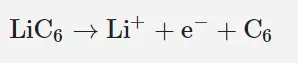 |
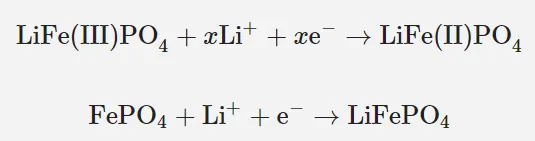 |
| LTO |
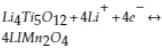 |
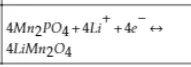 |
Question 2:- Compare the differences between each type of Li+ion batteries based on their characteristics.
Answer :-
Some of the battery terms used for Comparision of different batteries are
1. Voltage :- Battery voltage is the amount of electrical potential a battery holds, measured in volts.
2. C- rate :- The battery C Rating is the measurement of current in which a battery is charged and discharged at. The capacity of a battery is generally rated and labelled at the 1C Rate (1C current), this means a fully charged battery with a capacity of 10Ah should be able to provide 10 Amps for one hour.
3. Cycle life :- The cycle life of batteries is the number of charge and discharge cycles that a battery can complete before losing performance.
4. Specific Energy :- The gravimetric energy density or the specific energy of a battery is a measure of how much energy a battery contains in comparison to its weight, and is typically expressed in Watt-hours/kilogram (W-hr/kg).
5. Thermal runaway :- Thermal runaway is a chain reaction within a battery cell that can be very difficult to stop once it has started. It occurs when the temperature inside a battery reaches the point that causes a chemical reaction to occur inside the battery. This chemical reaction produces even more heat, which drives the temperature higher, causing further chemical reactions that create more heat.
|
Comparision of different battery Characterstics
|
Lithium Cobalt Oxide (LiCoO2) |
Lithium Manganese Oxide (LiMn2O4) |
Lithium Nickel Cobalt Aluminum Oxide (LiNiCoAlO2) |
Lithium Nickel Manganese Cobalt Oxide (LiNiMnCoO2) |
Lithium Iron Phosphate(LiFePO4) |
Lithium Titanate (Li2TiO3) |
| Voltages |
3.60V nominal; typical operating range 3.0–4.2V/cell |
3.70V (3.80V) nominal; typical operating range 3.0–4.2V/cell |
| 3.60V nominal; typical operating range 3.0–4.2V/cell |
|
| 3.60V, 3.70V nominal; typical operating range 3.0–4.2V/cell, or higher |
|
| 3.20, 3.30V nominal; typical operating range 2.5–3.65V/cell |
|
| 2.40V nominal; typical operating range 1.8–2.85V/cell |
|
| C-rate (Charge) |
0.7–1C, charges to 4.20V (most cells); 3h charge typical. Charge current above 1C shortens battery life. |
0.7–1C typical, 3C maximum, charges to 4.20V (most cells) |
| 0.7C, charges to 4.20V (most cells), 3h charge typical, fast charge possible with some cells |
|
| 0.7–1C, charges to 4.20V, some go to 4.30V; 3h charge typical. Charge current above 1C shortens battery life. |
|
| 1C typical, charges to 3.65V; 3h charge time typical |
|
| 1C typical; 5C maximum, charges to 2.85V |
|
| C- rate( Discharge) |
| 1C; 2.50V cut off. Discharge current above 1C shortens battery life. |
|
1C; 10C possible with some cells, 30C pulse (5s), 2.50V cut-off |
| 1C typical; 3.00V cut-off; high discharge rate shortens battery life |
|
| 1C; 2C possible on some cells; 2.50V cut-off |
|
| 1C, 25C on some cells; 40A pulse (2s); 2.50V cut-off (lower that 2V causes damage) |
|
| 10C possible, 30C 5s pulse; 1.80V cut-off on LCO/LTO |
|
| Cycle Life |
500-1000 |
300–700 |
500 |
1000–2000 |
| 2000 and higher (related to depth of discharge, temperature) |
|
|
| Thermal Runaway |
150°C |
250°C (482°F) typical. High charge promotes thermal runaway |
| 150°C (302°F) typical, High charge promotes thermal runaway |
|
| 210°C (410°F) typical. High charge promotes thermal runaway |
|
| 270°C (518°F) Very safe battery even if fully charged |
|
| One of safest Li-ion batteries |
|
| Specific Energy |
150–200Wh/kg. |
100–150Wh/kg |
| 200-260Wh/kg; 300Wh/kg predictable |
|
|
|
|
| Applications |
Mobile phones, tablets, laptops, cameras |
Power tools, medical devices, electric powertrains |
| Medical devices, industrial, electric powertrain (Tesla) |
|
| E-bikes, medical devices, EVs, industrial |
|
| Portable and stationary needing high load currents and endurance |
|
| UPS, electric powertrain (Mitsubishi i-MiEV, Honda Fit EV), solar-powered street lighting |
|
| Cost per unit specific energy |
~ $100 per kWh |
$114 per kWh- |
|
|
|
|