Week 1 Understanding Different Battery Chemistry
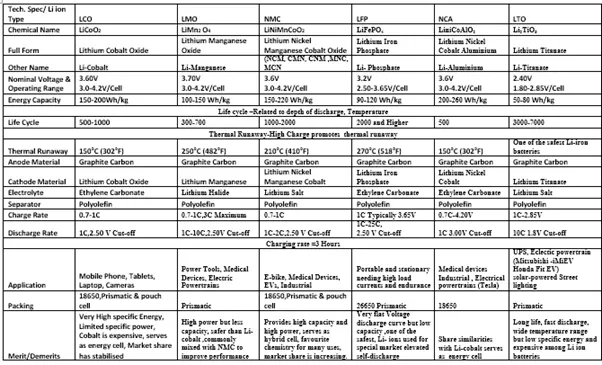
1.Prepare a table which includes materials & chemical reactions occurring at the anode and cathode of LCO, LMO, NCA, NMC, LFP and LTO type of lithium ion cells. Give your detailed explanation on it.
Answer:-
Battery is an electrochemical device to provide electrical power, which converts chemical energy in to electrical energy. Battery are mainly classified in to two types such as Primary cell and secondary cell. Primary cells are the non-rechargeable batteries and secondary cells are the rechargeable batteries.
Lithium ion battery: - Redox reactions that takes places on the electrode surfaces facing the electrolyte, the oxidation happens in the negative electrode (Anode)and reduction happens in the positive electrode (Cathode). The commonly used material are graphitised carbon in anodes and lithium cobalt oxide in cathode
LCO-Lithium Cobalt Oxide :- Lithium cobalt oxide, sometimes called lithium cobaltate or lithium cobaltite,[3] is a chemical compound with formula LiCoO2 . The cobalt atoms are formally in the +3 oxidation state, hence the IUPAC name lithium cobalt(III) oxide.Lithium cobalt oxide is a dark blue or bluish-gray crystalline solid,[4] and is commonly used in the positive electrodes of lithium-ion batteries.
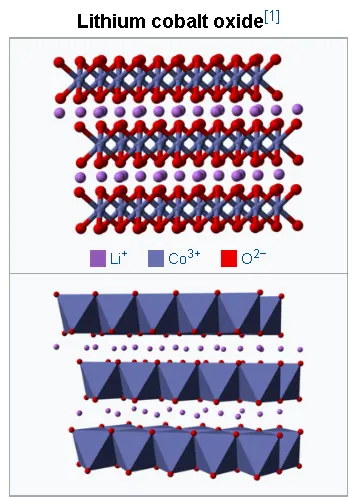
The structure of LiCoO2 has been studied with numerous techniques including x-ray diffraction, electron microscopy, neutron powder diffraction, and EXAFS. The solid consists of layers of monovalent lithium cations (Li+) that lie between extended anionic sheets of cobalt and oxygen atoms, arranged as edge-sharing octahedra, with two faces parallel to the sheet plane. The cobalt atoms are formally in the trivalent oxidation state (Co3+) and are sandwiched between two layers of oxygen atoms (O2−).
In each layer (cobalt, oxygen, or lithium), the atoms are arranged in a regular triangular lattice. The lattices are offset so that the lithium atoms are farthest from the cobalt atoms, and the structure repeats in the direction perpendicular to the planes every three cobalt (or lithium) layers. The threefold rotational axis (which is normal to the layers) is termed improper because the triangles of oxygen (being on opposite sides of each octahedron) are anti-aligned.
Preparation
Fully reduced lithium cobalt oxide can be prepared by heating a stoichiometric mixture of lithium carbonate Li 2CO3 and cobalt oxide Co3O4 or metallic cobalt at 600–800 °C, then annealing the product at 900 °C for many hours, all under an oxygen atmosphere. Nanometer-size particles more suitable for cathode use can also be obtained by calcination of hydrated cobalt oxalate β-CoC2 O4·2H2O, in the form of rod-like crystals about 8 μm long and 0.4 μm wide, with lithium hydroxide LiOH, up to 750–900 °C.Its high specific energy makes Li-cobalt the popular choice for mobile phones, laptops and digital carreras. The battery consists of a cobalt oxide cathode and a graphite carbon anode.The cathode has a layered structure and during discharge, lithium ions move from the anode to the cathode The flow reverses on charge. The drawback of Li-cobalt is a relatively short life span, low thermal stability and limited load capabilities (specific power).
Lithium manganese Oxide(LiMn2 04) - IMO
Li-ion with manganese spinel was first published in the materials Research Bulletin in 1983.Moli Energy commercialized a Li-ion cell with lithium manganese oxide as cathode material. The architecture forms a three-dimensional spinel structure that improves ion flow on the electrods , which results in lower internal resistance and improved current handling. A further advantage of spinel is high thermal stability and enhanced safety, but the cycle and calendar life are limited
Lithium Nickel Manganese Cobalt Oxide(LiNiMnco02) - NMC
One of the most successful Li-ion systems is a cathode combination of nickel-manganes-cobalt (NMC). Similar to Li-manganese, these systems can be tailored to serve as Energy cells. The secret of NMC lies in combining nickel and manganese. An analogy of this is table salt in which the main ingredients, sodium and chloride, are toxic on their own but mixing them serves as seasoning salt and food preserver. Nickel is known for its high specific energy but poor stability,manganese has the benefit of forming a spinel structure to achieve low internal resistance but offers a low specific energy-Combining the metals enhances each other strengths.
Lithium ion phosphate(LiFePO4) - LFP:-
In 1996, the University of Texas (and other contributors) discovered phosphate as cathode material for rechargeable lithium batteries. Li-phosphate offers good electrochemical performance with low resistance. This is made possible with nano-scale phosphate cathode material. The key benefits are high current rating and long cycle life, besides good thermal stability, enhanced safety and tolerance if abused. Li-phosphate is more tolerant to full charge conditions and is less stressed than other lithium-ion systems if kept at high voltage for a prolonged time. Li-phosphate is often used to replace the lead acid starter battery.
Lithium Nickel Cobalt Aluminium Oxide (LiNiCoAl02) - NCA
Lithium nickel cobalt Aluminium oxide battery or NCA, has been around since 1999 for special applications. It shares similarities with NMC by offering high specific energy, reasonably good specific power and a long life span. Less flattering are safety and cost. NCA is a further development of lithium nickel oxide. Adding aluminium gives the chemistry greater stability. High energy and power densities, as well as good life span, make NCAA candidate for EV powertrains.High cost and marginal safety are negatives.
Lithium Titanate(L2Ti03) - LTO
Batteries with lithium titanate anodes have been known since the 1980s.Li-titanate replaces the graphite in the anode of a typical lithium-ion battery and the material forms into a spinel structure.
The cathode can be lithium manganese oxide or NMC Li-titanate has a nominal cell voltage of 240V, can be fast charged and delivers a high discharge current of 10C, or 10 times the rated capacity. The cycle count is said to be higher than that of a regular Li-ion. Li-titanate is safe, has excellent low-temperature discharge characteristics and obtains a capacity of 80 percent at -30°C (-22°F).LTO (commonly Li4 Ti5 O12) has advantages over the conventional cobalt- blended Li-ion with graphite anode by attaining zero-strain property, no SEI film formation and no lithium plating when fast charging and charging at low temperature.
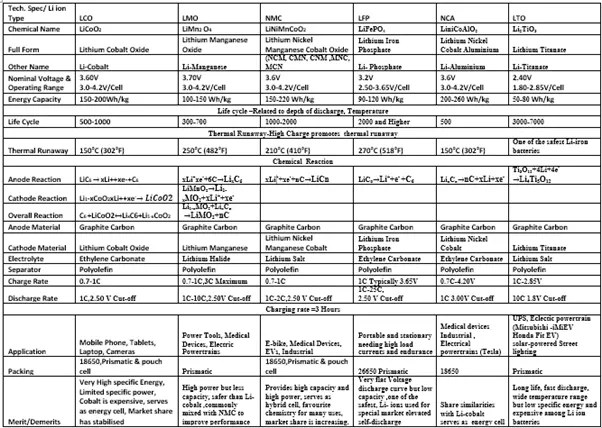
2.Compare the differences between each type of Li+ion batteries based on their characteristics