Week 1 Understanding Different Battery Chemistry
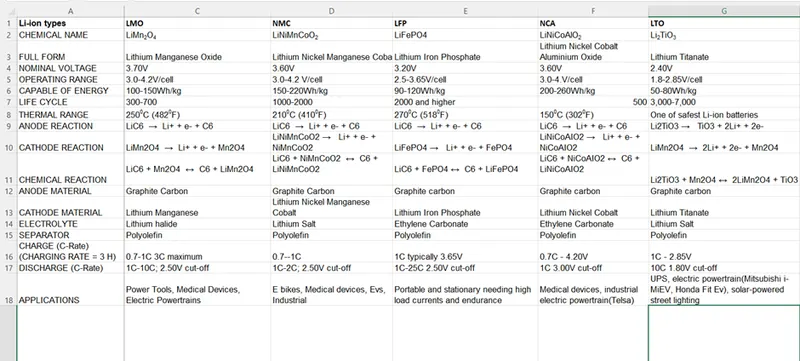
- Prepare a table which includes materials & chemical reactions occurring at the anode and cathode of LCO, LMO, NCA, NMC, LFP and LTO type of lithium-ion cells. Give your detailed explanation on it
AIM: To prepare a table which includes materials & chemical reactions occurring at the anode and cathode of LCO, LMO, NCA, NMC, LFP and LTO type of lithium-ion cells.
Introduction to batteries: -
- The battery is an energy storage device formed by one more electrochemical cells that can store and delivered electricity by an internal chemical process.
- When a battery is supplying power, its positive terminal is the cathode and its negative terminal is the anode. The negative terminal is the source of electrons that will flow through an external electric circuit to the positive terminal.
- The amount of energy stored and delivered by the cell is determined by the active material mass in the electrodes.
- When a battery is connected to an external electric load, a redoxreaction converts high-energy reactants to lower-energy products, and the free energy difference is delivered to the external circuit as electrical energy.
- Batteries can be divided into two major groups, primary and secondary.
- Primary Batteries are non-rechargeable systems, due to non-reversibility of the redox reaction.
- Secondary batteries differ from the primary by the ability to reverse the redox reaction and therefore be able to have several discharge /charge cycles. Rechargeable batteries are mostly produced in the discharged state thus an initial charge process is needed prior to use.
Lithium – Ion battery and its type with Electrochemistry
Lithium-ion battery: A lithium-ion battery or Li-ion battery is a rechargeable battery. It is commonly used for portable electronics, electric vehicles, hybrid electric vehicles and aerospace application.
Basically, in the batteries, li-ion transfer from the negative electrode (e-) though an electrolyte to the positive electrode (e+) during discharge, and back when charging. Lithium is the lightest of all metals, has the greatest electrochemical potential and provides the largest specific energy per weight. The metal-lithium battery (Li-ion) uses graphite as anode and active materials in the cathode.
The main parts of the lithium-ion batteries are
- Anode: it is the type of the electrode where oxidation is occurs and the electrons are lost. The mostly used material for this is the graphite
- Cathode: the cathode is the electrode where the reduction takes place and electrons are gained. The combination of both is called redox reaction. Active materials like metal oxides, spinel’s, olivine’s are used
- Electrolyte: an electrolyte is a substance that produces an electrically conducting solution when dissolved in a polar solvent, such as water.
- Separator: a separator is a permeable membrane which placed between anode and cathode in a battery.
The electrolyte carries positively charged lithium ions from the anode to the cathode and vice versa through the separator. The movement of the lithium ions creates free electrons in the anode which creates a charge at the positive current collector. The electrical current then flows from the current collector through a device being powered to the negative current collector. The separator blocks the flow of electrons inside the battery.
While the battery is discharging and providing an electric current, the anode releases lithium ions to the cathode, generating a flow of electrons from one side to the other. When plugging in the device, the opposite happens: Lithium ions are released by the cathode and received by the anode.
Types of Li-ion Cells: -
- Lithium cobalt oxide (LicoO2) – LCO
- Lithium manganese Oxide (LiMn204) - LMO
- Lithium Nickel manganese Cobalt Oxide (LiNiMnco02) – NMC
- Lithium phosphate (LiFepo4) – LFP
- Lithium Nickel cobalt Aluminium Oxide (LiNiCoAIO2) – NCA
- Lithium Titanate (Li2Tio3) - LTO
Lithium cobalt oxide (LicoO2) – LCO
Lithium cobalt oxide battery mainly relies on the intercalation and disintercalation of lithium ions between anode and cathode to realize the storage and release of energy.
While charging, at the external electric field, lithium elements in the LiCoO2 molecules of the anode material become lithium ion with positive charge, which moves from the anode to cathode. After chemical reaction with the carbon atoms of the cathode, LiC6 is formed, which is stably embedded into the layered graphite cathode.
When discharging, on the contrary, in the internal electric field turns, Li+ breaks away from the cathode, goes along the direction of the electric field, returns to the anode, and then becomes LiCoO2. This process called a "rocking chair battery". The more lithium ions involved in back-and-forth embedding and disembedding activities, the more energy the battery can store.
- High thermal and chemical stability
- Its high specific energy makes Li-cobalt the popular choice for mobile phones, laptops and digital cameras. The battery consists of a cobalt oxide cathode and a graphite carbon anode.
- The cathode has a layered structure and during discharge, lithium ions move from the anode to the cathode.
- The flow reverses on charge.
- The drawback of Li-cobalt is a relatively short life span, low thermal stability and limited load and capabilities (specific power)
- It is not friendly to the environment. Currently, cobalt belongs to heavy metal, which has a certain corrosive effect on soil
- The safety performance of lithium cobalt oxide is poor.
- The discharge rate of lithium cobalt oxide is high.
- Lithium cobalt oxide has high power.
Lithium manganese Oxide (LiMn204) - LMO
Li-ion with manganese spinel was first published in the Materials Research Bulletin in 1983.
LiMn2O4 gets its name from the use of a manganese matrix structure in the cathode. LiMn2O4 can handle relatively high power in very short bursts and offers high thermal stability. This makes it one of the safer Li-ion chemistries because higher temperatures are required to cause thermal runaway. LiMn2O4 cells can also be tweaked for either higher power or higher capacity at the expense of each other.
- LMO has no precious metal and its price is relatively low.
- Moli Energy commercialized a Li-ion cell with lithium manganese oxide as cathode material.
- LMO with spinel structure is relatively safe.
- The architecture forms a three-dimensional spinel structure that improves ion flow on the electrode, which results in lower internal resistance and improved current handling.
- A further advantage of spinel is high stability and enhanced safety, but the cycle and calendar life are limited.
- high-temperature performance is particularly poor
Lithium Nickel manganese Cobalt Oxide (LiNiMnco02) – NMC
Ternary lithium battery refers to lithium battery that uses ternary materials of lithium nickel cobalt manganese oxide (LiNiMnCoO2, NMC) or lithium nickel cobalt aluminate (NCA) as anode material. Ternary means different proportions for different adjustments of nickel salt, cobalt salt and manganese salt as three different components. Lots of batteries have many different proportions of ternary materials. Its nominal voltage can reach 3.6-3.8V. It has high energy density, high voltage platform, high tap density, long endurance range, large output power, excellent performance at low temperature, but poor stability at high temperature, and has high cost.
In nickel-manganese-cobalt ternary material, the incorporation of manganese element can enhance the stability of the material, so that the structure will not collapse due to lithium ion embedding. The addition of nickel can increase the capacity and become a new valence element. Then the ternary anode material system is represented by NMC.
- One of the most successful Li-ion systems is a cathode combination of nickel-manganese-cobalt (NMC).
- NCM is expensive affecting by cobalt enterprises (high nickel materials reduce BOM costs, but increases process costs).
- Similar to Li-manganese, these systems can be tailored to serve as Energy cells or power cells.
- The secret of NMC lies in combining nickel and manganese.
- NCM with layered structure is easy to mix lithium and nickel, and has poor safety (the higher Ni%, the worse it is).
- An analogy of this is table salt in which the main ingredients, sodium and chloride, are toxic on their own but mixing them serves as seasoning salt and food preserver.
- Nickel is known for its high specific energy but poor stability.
- Manganese has the benefit of forming a spinel structure to achieve low interna; resistance but offers a low specific energy.
- Combining the metals enhances each other strengths.
Lithium phosphate (LiFepo4) – LFP
Lithium-ion battery anode is lithium metal compounds, usually for lithium iron phosphate (LiFePO4 lithium iron phosphate, phosphoric acid lithium cobalt LiCoO2, etc.), the cathode is graphite or carbon (general use graphite), is to use organic solvent as the electrolyte between the cathode. On battery charging, the anode decomposition generated on lithium ion, lithium ion through the electrolyte into the battery cathode, anode carbon layer embedded micro hole.
In the process of battery (discharge) embedded in the lithium ions in the cathode microporous movement back to the anode. Back to the anode of lithium ion, the more the higher discharge capacity, we usually refer to battery capacity is the discharge capacity. In this way, the battery charge and discharge process, the lithium ions are constantly running back and forth between the cathode and so the lithium-ion battery is also called a rocking-chair batteries.
In 1996, the university of Texas (and other contributors) discovered phosphate as cathode material for rechargeable lithium batteries.
- Li-phosphate offers good electrochemical performance with low resistance.
- This is made possible with nano-scale phosphate cathode material.
- The key benefits are high current rating and long cycle life, besides good thermal stability, enhances safety and tolerance if abused.
- Li-phosphate is more tolerate to full charge conditions and is less stressed that other lithium-ion systems if kept at high voltage for a prolonged time.
- Li-phosphate is often used to replace the lead acid starter battery.
Coated carbon coating on the performance of lithium-ion batteries with the following promotion
1. Reduce the battery internal resistance, inhibition of charge and discharge cycle in the process of dynamic resistance increase.
2. Improve the consistency of the battery pack, decrease the cost of the battery pack.
3. Improve the active material and fluid collection of glue adhesion, reduce the pole piece manufacturing cost.
Lithium Nickel cobalt Aluminium Oxide (LiNiCoAIO2) – NCA
LiNiCoAlO2 is very similar to the NMC chemistry above, but with aluminium swapped for manganese in the cathode. The addition of aluminium helps NCA cells achieve the highest capacity of all Li-ion chemistries.
Like NMC, NCA is a very promising chemistry for the future development of Li-ion cells. It is best suited for high capacity, energy-dense purposes. This is why it was selected by Tesla for use in their electric cars. NCA excels in packing the most energy into the smallest space.
- Lithium nickel cobalt aluminium oxide battery, or NCA, has been around since 1999 for special applications.
- It shares similarities with NMC by offering high specific energy, reasonably good specific power and a long-life span.
- Less flattering are safety and cost.
- Summarizes the six key characteristics. NCA is a further development of lithium nickel oxide;
- Adding aluminium gives the chemistry greater stability.
- High energy and power densities, as well as good life span, make NCA a candidate for EV powertrains.
- High cost and marginal safety are negatives.
Lithium Titanate (Li2Tio3) – LTO
Lithium titanate (Li2TiO3) batteries, also known as Lithium titanate oxide (LTO) are rechargeable batteries designed following the nanotechnology battery technology. The lithium titanate chemistry underpins their operation.
The chemistry is the basic oxidation-reduction reaction that allows for electrons to transfer in the cells. In LTO batteries, the cathode is typically lithium iron phosphate (LFP), and the anode is lithium titanate (LTO).
Batteries with lithium titanate anodes have been known since the 1980s.
- Li-titanate replaces the graphite in the anode of a typical lithium – ion battery and the material forms into a spinel structure.
- The cathode can be lithium manganese oxide or NMC.
- Li-titanate has a nominal cell voltage of 2.40V, can be fast charged and delivers a high discharge current of 10C, or 10 times the rated capacity.
- The cycle count it is said to be higher than that of a regular Li-ion.
- Li-titanate is safe, has excellent low-temperature discharge characteristics and obtains a capacity of 80 percent at -3ooC (-22OF).
- LTO (commonly Li4Ti5O12) has advantage over the conventional cobalt-blended Li-ion with graphite anode by attaining zero-strain property, no SEI film formation and no lithium plating when fast charging and charging at low temperature.
- High current discharge- Around 10 times what other lithium batteries for off-grid systems produce.
- Exceptional charging/recharging capabilities- Due to the large surface area of lithium titanium batteries anode, there’s rapid electrons movement and consequently fast charging/ recharging capabilities.
- Excellent long lifespan of these batteries.
FUTURE OF BATTERIES: -
- Solid-state Li-ion: High specific energy but poor loading and safety.
- Lithium-sulphur: High specific energy but poor cycle life and poor loading.
- Lithium-air: High specific energy but poor loading, needs clean air to breath and has short life.
- Compares the specific energy of lead-, nickel- and lithium-based systems.
- While Li-aluminium (NCA) is the clear winner by storing more capacity than other systems, this only applies to specific energy.
- In terms of specific power and thermal stability, Li-manganese (LMO) and Li-phosphate (LFP) are superior.
- Li-titanate (LTO) may have low capacity but this chemistry outlives most other batteries in terms of life span and also has the best cold temperature performance.
- Moving towards the electric powertrain, safety and cycle will gain dominance over capacity. (LCO stands for Li-cobalt, the original Li-ion)
The diagram below compares the specific energies of lead, nickel and lithium systems. Although lithium aluminium (NCA) is the winner by storing more capacity than other systems, it is only suitable for power usage in certain scenarios. Lithium manganate (LMO) and lithium phosphate (LFP) are superior in specific power and thermal stability. Lithium Titanate (LTO) may have a lower capacity, but it has the longest life than other batteries and has the best low-temperature performance.
NCA has the highest specific energy; However, lithium manganate and lithium iron phosphate are superior in power and thermal stability. Lithium titanate has the best service life.
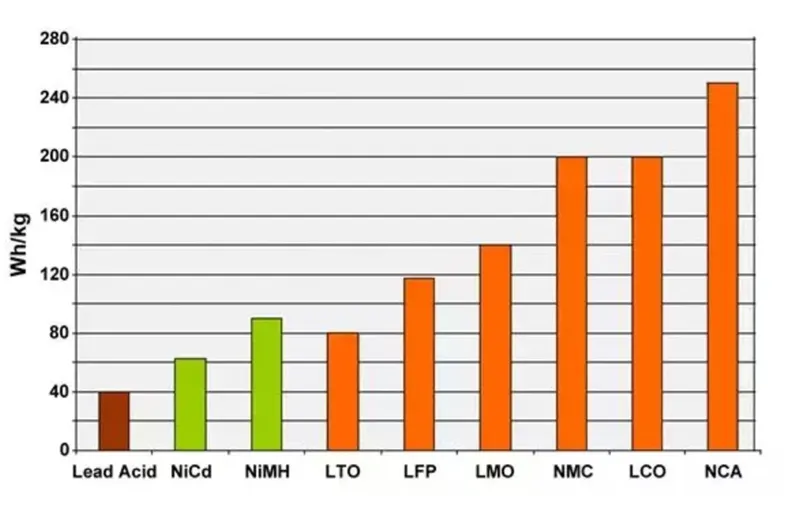 Diagram of lead, nickel and lithium - based batteries
The tabular form for materials & chemical reactions and other characteristics occurring at the anode and cathode of LCO, LMO, NCA, NMC, LFP and LTO type of lithium-ion cells. Are given in the excel as shown below.