Week 1 Understanding Different Battery Chemistry
- Prepare a table which includes materials & chemical reactions occurring at the anode and cathode of LCO, LMO, NCA, NMC, LFP and LTO type of lithium ion cells. Give your detailed explanation on it
Answer:
Battery:
A battery is a device that stores chemical energy and converts it to electrical energy.
It consists of one or more electrochemical cells with external connections for powering electrical devices such as flashlights, mobile phones and electric cars.
When a battery is supplying power, its positive terminal is the cathode and its negative terminal is the anode. The terminal marked negative is the source of electrons that will flow through an external electric circuit to the positive terminal. When a battery is connected to an external electric load, a redox reaction converts high-energy reactants to lower-energy products, and the free energy difference is delivered to the external circuit as electrical energy.
Lithium-ion batteries can be designed for optimal capacity with the drawback of limited loading, slow charging and sensitive to high temperature. An industrial battery may have a moderate ampere rating but the focus is on durability. Specific energy only provides part of battery performance.
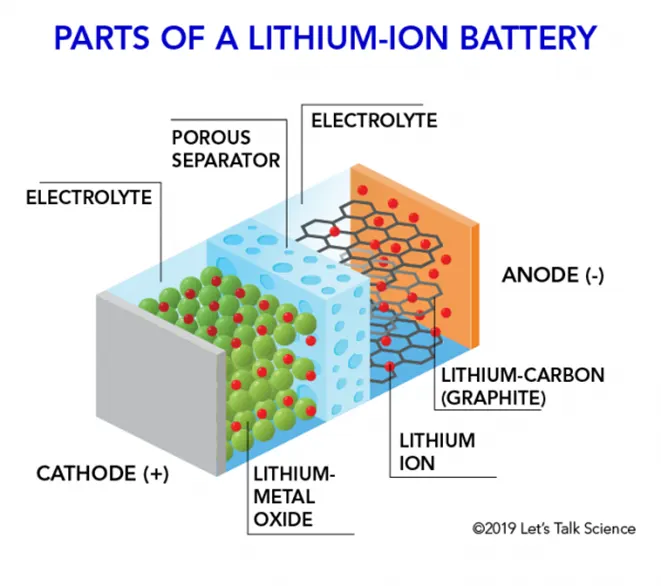
A battery is made up of anode, cathode, separator, electrolyte and two current collectors (positive and negative). The anode and cathode store the lithium.
The electrolyte carries positively charged lithium ions from the anode to the cathode and vice versa through the separator. The movement of lithium ions creates free electrons in the anode which creates the charge at the positive current collector. The electrical current then flows from the current collector through a device being powered to the negative current collector. The separator blocks the flow of electrons inside the battery.
The following figure shows the different parts of lithium-ion battery:
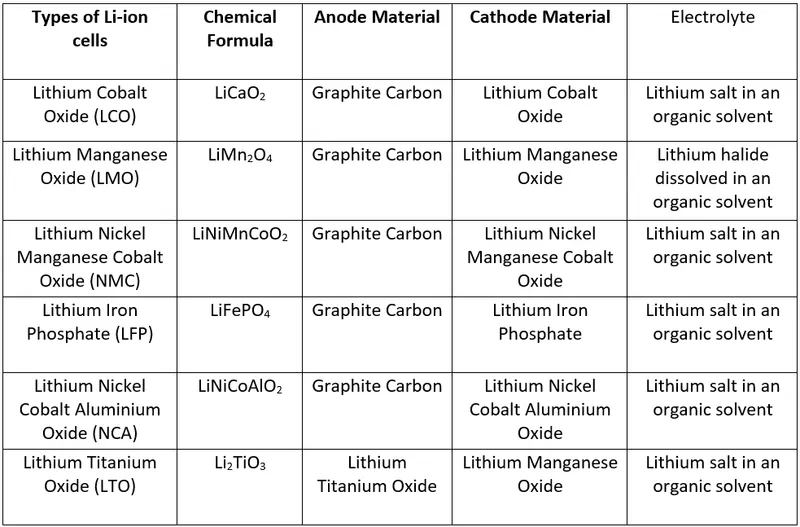
The table below shows the different Li-ion cells with their chemical formula, electrolyte, anode and cathode materials:
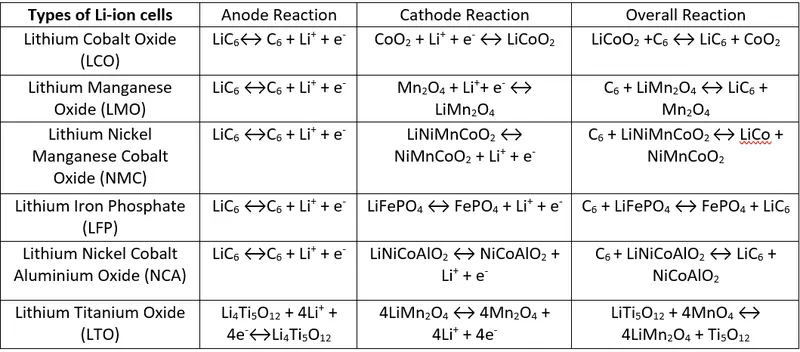
The table below shows the different Li-ion cells with their anode and cathode reactions.
- Compare the differences between each type of Li-ion batteries based on their characteristics
There are certain factors for which each Li-ion battery can be differentiated from one another and can be given as below.
Nominal Voltage: It is the system voltage at which the device is designed to operate. The rated voltage is usually higher than the nominal voltage to ensure the safe operation of the device.
Cycle: The charge and discharge when took place for a single time makes a cycle. The higher the cycles can take place, the higher is the lifespan.
The current rate: This is used to determine the fast charging capability and short circuit discharge capability of a battery.
Thermal runway: In simplest terms, thermal runway begins when the heat generated within a battery exceeds the amount of heat that is dissipated to its surroundings. If the cause of excessive heat creation is not remedied, the condition will worsen. Internal battery temperature will continue to rise, causing battery current rise, creating a domino effect. The rise in temperature In a single battery will begin to affect the other batteries nearby and the pattern will continue, thus the term runway.
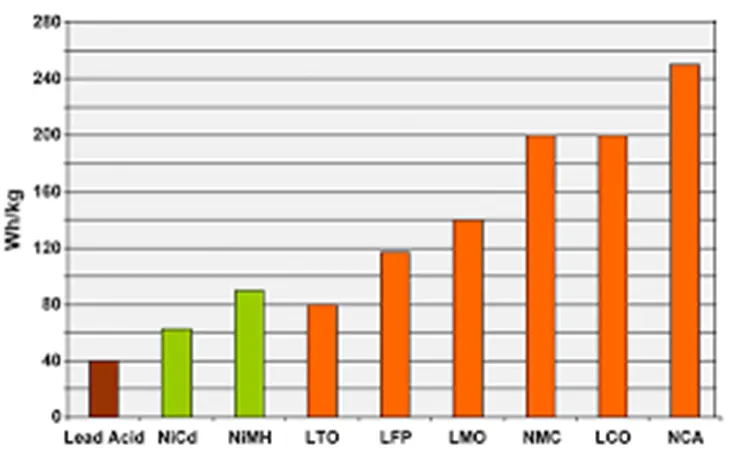
Specific energy: It is the amount of energy stored per unit mass (Wh/Kg). this is very important deciding factor that decides how much energy or power we are going to get from different batteries with the same amount of weight.
The figure below shows the specific energy of different types of lithium based batteries:
The differences between the different types of Li-ion cells based on their characteristics are shown below:
Characteristics of Lithium Cobalt Oxide (LCO):
|
Voltages |
3.60 V nominal; typical operating range 3.0 – 4.2 V/cell |
|
Specific Energy (Capacity) |
150 – 200 Wh/Kg, specifically cells provide up to 240 Wh/Kg |
|
Charge (C-rate) |
0.7 – 1 C, charges to 4.20 V (most cells); 3h charge typical. Charge current above 1C shortens battery life. |
|
Discharge (C-rate) |
1C; 2.50 V cut off. Discharge current above 1C shortens battery life |
|
Cycle life |
500 – 1000, related to the depth of discharge, load, temperature |
|
Thermal Runway |
150o C (302o F). Full charge promotes thermal runway |
|
Cost |
Relatively expensive |
|
Applications |
Mobile phones, tablets, laptops, cameras |
|
Comments |
Very high specific energy, limited specific power, cobalt is expensive, serves as a energy cell, market share has stabilized |
Characteristics of Lithium Manganese Oxide (LMO):
|
Voltages |
3.70 V (3.80 V) nominal, typical operating range 3.0 – 4.2 V/cell |
|
Specific Energy (Capacity) |
100 – 150 Wh/Kg |
|
Charge (C-rate) |
0.7 – 1 C typical, 3C maximum, charges to 4.20 V (most cells) |
|
Discharge (C-rate) |
1 C; 10 C possible with some cells, 30 C pulse (5s), 2.50 V cut off |
|
Cycle life |
300 – 700 (related to the depth of discharge, temperature) |
|
Thermal Runway |
250o C (482o F) typical, high charge promotes thermal runway |
|
Cost |
Relatively expensive |
|
Applications |
Power tools, medical devices, electric powertrain |
|
Comments |
High power but less capacity, safer than Li-cobalt, commonly mixed NMC to improve performance |
Characteristics of Lithium Nickel Cobalt Aluminium Oxide (NCA)
|
Voltages |
3.60 V nominal, typical operating range 3.0 – 4.2 V/cell |
|
Specific Energy (Capacity) |
200 – 260 Wh/Kg, 300 Wh/Kg predictable |
|
Charge (C-rate) |
0.7 C charges to 4.20 V (most cells), 3H charge typical, fast charge possible with some cells |
|
Discharge (C-rate) |
1C typical, 3.0 V cut off, high discharge rate shortens battery life |
|
Cycle life |
500 (related to the depth of discharge, temperature) |
|
Thermal Runway |
150o C (302o F) typical, high charge promotes thermal runway |
|
Cost |
$350 per KWh |
|
Applications |
Medical devices, industrial, electric powertrain |
|
Comments |
Shares similarities with Li-Cobalt, serves as energy cells, mainly used by Panasonic and Tesla, growth potential |
Characteristics of Lithium Nickel Manganese Cobalt Oxide (NMC):
|
Voltages |
3.60 V, 3.70 V nominal, typical operating range 3.0 – 4.2 V/cell or higher |
|
Specific Energy (Capacity) |
150 – 220 Wh/Kg |
|
Charge (C-rate) |
0.7 – 1 C, charges to 4.20 V, some go to 4.30 V, 3h charge typical, charge above 1C shorten the battery life |
|
Discharge (C-rate) |
1C; 2C possible on some cells, 2.50 V cut off |
|
Cycle life |
1000 – 2000 (related to the depth of discharge, temperature) |
|
Thermal Runway |
210o C (410o F) typical, high charge promotes thermal runaway |
|
Cost |
$420 per kWh |
|
Applications |
E-bikes, medical devices, EVs, industrial |
|
Comments |
Provides high capacity and high power, serves as hybrid cell, favourite chemistry for many uses, market share is increasing |
Characteristic of Lithium iron Phosphate (LFP):
|
Voltages |
3.20 V, 3.30 V nominal, typical operating range 2.5 – 3.65 V/cell |
|
Specific Energy (Capacity) |
90 – 120 Wh/Kg |
|
Charge (C-rate) |
1C typical, charges to 3.65 V, 3h charge time typical |
|
Discharge (C-rate) |
1C, 25C on some cells, 40A pulse (2s), 2.50 V cut off (lower than 2V causes damage) |
|
Cycle life |
2000 and higher (related to the depth of discharge, temperature) |
|
Thermal Runway |
270o C (518o F), very safe battery even if fully charged |
|
Cost |
$580 per kWh |
|
Applications |
Portable and stationary needing high load currents and endurance |
|
Comments |
Very flat voltage discharge curve but low capacity, one of the safest Li-ions, used for special markets, elevated self-discharge |
Characteristics of Lithium Titanium Oxide (LTO):
|
Voltages |
2.40 V nominal |
|
Specific Energy (Capacity) |
50 – 80 Wh/Kg |
|
Charge (C-rate) |
1 – 5 C |
|
Discharge (C-rate) |
10 – 30 C |
|
Cycle life |
3000 – 7000 |
|
Thermal Runway |
Very safe |
|
Cost |
$1005 per kWh |
|
Applications |
UPS, electric powertrain |
|
Comments |
Long working life, Fast charging, Low specific energy, Expensive |