A Compartive Study on Different Lithium Ion Battery Chemistry
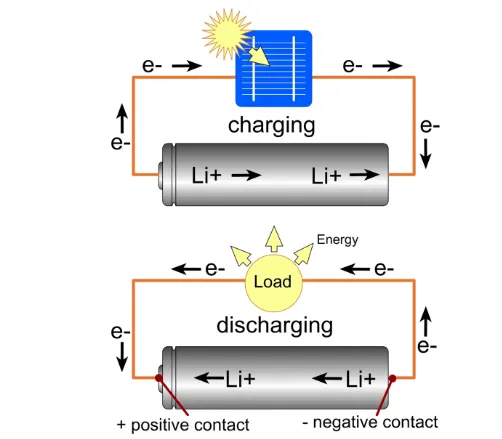
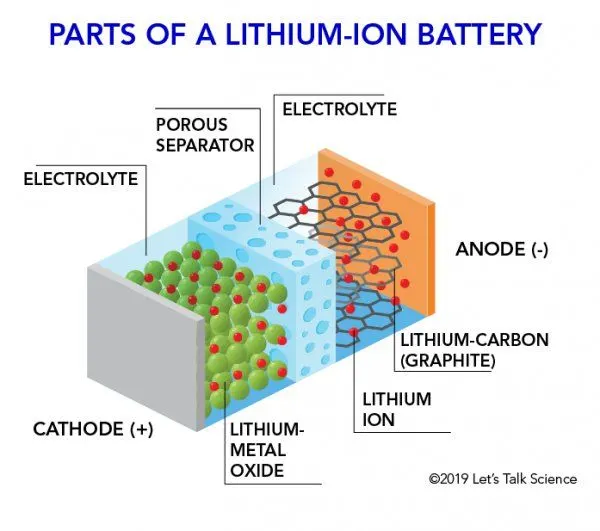
Lithium Ion Battery (LIB) is high energy density rechargeable battery where Li ion moves from positive electrode to negative electrode while charging and from negative to postive electrode during discharging and electrons moves through the outer circuit.The movement of electron and Li ion is same which can be illustrated from figure 1a. The typical LiB contains three main components i.e. Anode, Cathode and Seprator as illustrated in fugure 1b. At cathode,lintercalated lithium compound (lithium metal oxide)is used and at anode, mostly carbon based/Lithium Titanate electrode is used. The Seprator is polymeric membrane which is saturated with liquid electrolyte and only allows Li ion to pass through it.Ethylene carbonate, dimethyl carbonate, propylene carbonate which contains dissolved lithium salt are used as electrolyte for a li ion battery. The metal oxide and graphite are coated in a current collector plate. Mainly, Cathode material is coated to Aluminium plate and anode material is coated to copper plate.
Working:
During Charging, when a voltage is applied to the Li ion cell, Li ion and electron separate from the metal oxide. The electron moves towards the graphite anode via external circuilt while the Li ion moves through the seprator. Graphite anode acts as storage for the Li ion and electron due to structure. The battery is termed as fully charged when all the Li ion and electron moves towards the anode.
During Discharging, an external load is connected between the positive terminal and negative terminal of the Li ion cell. Now the Li ion and electron stored at the garphite side moves towards to cathode via seprator and external circuit resp to be in its stable state i.e. metal oxide. The movement of electron via external circuit generated electricity.
a b
Figure 1a:Movement of electron and Li ion during charging and discharging of Lithium Cells.1b Constructional feature of Li ion battery.
Table 1: Table Showing different anode and cathode materials
| Name | Anode Material | Cathode Material |
| Lithium Cobalt Oxide (LCO) | Graphite | Lithium Cobalt Oxide (LiCoO2) |
| Lithium Manganese Oxide(LMO) | Graphite | Lithium Manganese Oxide (LiMnO2) |
| Lithium Nickel Manganese Cobalt oxide(NMC) | Graphite | Lithium Nickel Manganese Cobalt Oxide(LiNiMnCoO2) |
| Lithium Nickel Cobalt Aluminium Oxide(NCA) | Graphite | Lithium Nickel Cobalt Aluminium Oxide(LiNiCoAlO2) |
| Lithium Iron Phosphate(LFP) | Graphite | Lithium Iron Phosphate(LiFePO4) |
| Lithium Titanate Oxide(LTO) | Lithium Titanate Oxide(Li4Ti5O12) | LMO or NMCC |
Chemical Reaction at Anode and Cathode for different chemistry
1)LCO:
a)During Charging
At Cathode:
`LiCoO_2->Li_(1-x)CoO_2+xLi^++xe^-`
At Anode:
`C_6+xLi^++xe^(-)->Li_xC_6`
b)During Discharging
At Anode:
`Li_xC_6->xLi^++xe^(-)+C_6`
At Cathode:
`Li_(1-x)CoO2+xLi^++xe^(-)->LiCoO_2`
During charging, Lithium atom present in Lithium Cobalt oxide is seprated to form Li ion and electron. Electron moves towards the anode via external circuit and Li ion moves towards the anode via seprator. During dischraging, Li ion which is at the anode wants to return in its more stable state i.e in form of Lithium Cobalt Oxide so it moves from seprator and electron moves through external circuit.
2) LMO
a)During Charging:
At Anode:
`C_6+xLi^++xe^(-)->Li_xC_6`
At Cathode:
`LiMnO_2->Li_(1-x)MnO_2+xLi^++xe^-`
b)During Discharging:
At Anode:
`Li_xC_6->xLi^++xe^(-)+C_6`
At Cathode:
`Li_(1-x)MnO_2+xLi^++xe^(-)->LiMnO_2`
During charging, LiMnO2 is reduced to give Li ion and electron which goes to the anode and during discharging the stored Li ion and electron from the anode side will come and oxides the material (Li(1-x)MnO2) in the cathode to form Lithium Manganese Oxide.
3)NMC
a)During Discharging
At Anode:
`Li_xC_6->xLi^++xe^(-)+C_6`
At Cathode:
`Li_(1-x)NiMnCoO_2+xLi^++xe^(-)->LiNiMnCoO_2`
b)During Charging
At Anode:
`C_6+xLi^++xe^(-)->Li_xC_6`
At Cathode:
`LiNiMnCoO_2->Li_(1-x)NiMnCoO_2+xLi^+xe^(-)`
During charging, LiNiMnCoO2 is reduced to give Li ion and electron which goes to the anode and during discharging the stored Li ion and electron from the anode side will come and oxides the material (Li(1-x)NiMnCoO2) in the cathode to form Lithium Nickel Manganese Cobalt Oxide.
4)NCA
During Charging:
At Cathode:
`LiNi_aCo_bAl_cO_2->Li_(1-x)Ni_aCo_bAl_cO_2+xLi^+xe^-`
At Anode:
`C_6+xLi^++xe^(-)->Li_xC_6`
During Discharging:
At Anode:
`Li_xC_6->xLi^++xe^(-)+C_6`
At Cathode:
`Li_(1-x)Ni_aCo_bAl_cO_2+xLi^++xe^(-)->LiNi_aCo_bAl_cO_2`
During charging, LiNiaCobAlcO2 is reduced to give Li ion and electron which goes to the anode and during discharging the stored Li ion and electron from the anode side will come and oxides the material (Li(1-x)NiaCobAlcO2) in the cathode to form Lithium Nickel Cobalt Aluminium Oxide.
5)LFP
During Charging:
At Anode:
`C_6+xLi^++xe^(-)->Li_xC_6`
At Cathode:
`LiFePO_4->Li_(1-x)FePO_4+xLi^++xe^(-)`
During Discharging:
At Anode:
`Li_xC_6->xLi^++xe^(-)+C_6`
At Cathode:
`Li_(1-x)FePO_4+xLi^++xe^(-)->LiFePO_4``
During charging, LiFePO4 is reduced to give Li ion and electron which goes to the anode and during discharging the stored Li ion and electron from the anode side will come and oxides the material (Li(1-x)FePO4) in the cathode to form Lithium Iron Phosphate.
6)LTO
Considering LMO is used as a Cathode material
During Charging:
At Anode:
`Li_4Ti_5O_12+xLi^++xe^(-)->Li_(4+x)Ti_5O_12`
At Cathode:
`LiMnO_2->Li_(1-x)MnO_2+xLi^++xe^-`
During Discharging:
At Anode:
`Li_(4+x)Ti_5O_12->Li_4Ti_5O_12+xLi^++xe^(-)`
At cathode:
`Li_(1-x)MnO_2+xLi^++xe^(-)->LiMnO_2`
During charging, LiMnO2 is reduced to give Li ion and electron which goes to the anode and during discharging the stored Li ion and electron from the anode side will come and oxides the material (Li(1-x)MnO2) in the cathode to form Lithium Manganese Oxide.
Comparision of Different Chemistry
As we can observe that, the only difference on different types of Lithium ion cell was the materials used for cathode and anode.The significance of different electrode materials is discussed below:
For Positive Electrode:
Lithium Cobalt Oxide:
- It has high energy density.
- It has lower cycle life as well as poorer safety.
- It is non suited for use in Off grid Products.
Lithium Manganese Oxide:
- It has good thermal stability and safety.
- It has lower cycle life.
Lithium Nickel Manganese Cobalt Oxide
- It has high energy density.
- It has good cycle life.
- It is safer and are targeted for off grid application.
Lithium Nickel Cobalt Aluminium Oxide:
- Lower thermal stability.
- Lower cycle life and higher cost.
Lithium Iron Phosphate:
- Lower energy density.
- compartively cheaper.
- Stable and have good cycle life.
For Anode Materials:
Carbon Based Anodes: Graphite.
Lithium Titanate:
- Lower energy density.
- Excellent thermal stabality
- High cycle life and safer.
- Expensive
Based on used materials as cathode and anode , the characteristics varies from one type of chemistry to other.
Table2: Comparision between all the chemistry Used as Li ion cells.
| LCO | LMO | NMC | NCA | LFP | LTO | |
|
Positive Electrode |
Lithium Cobalt Oxide | Lithium Manganese Oxide | Lithium Nickel Manganese Cobalt oxide | Lithium Nickel Cobalt Aluminium oxide | Lithium Iron Phosphate | Lithium Manganese Oxide |
|
Negative Electrode |
Graphite | Graphite | Graphite | Graphite | Graphite | Lithium titanate Oxide |
|
Operating Voltage Range |
2.5-4.2V | 2.5-4.2V | 2.5-4.2V | 2.5-4.2V | 2-3.65V | 1.5-2.8V |
|
Nominal Voltage |
3.6-3.7V | 3.7-3.8V | 3.6-3.7V | 3.6-3.7V | 3.2V | 2.3V |
|
Specific Energy(Wh/Kg) |
175-240 | 100-150 | 100-240 | 175-240 | 60-110 | 70 |
|
Energy density(Wh/L) |
400-640 | 250-350 | 250-640 | 400-640 | 125-250 | 120 |
|
Discharge rate |
2-3C | >30C | 2-3C | 2-3C | 10-125C | 10C |
|
Cycle life(100%DOD to 80% capacity) |
500+ | 500+ | 500+ | 500+ | 1000+ | 4000+ |
|
Ambient Temperature charging(Deg) |
0-45 | 0-45 | 0-45 | 0-45 | 0-45 | -20-45 |
|
Ambient Temperature Discharging(Deg) |
-20-60 | -30-60 | -20-60 | -20-60 | -30-60 | -30-60 |
|
Optimized For |
Energy | Power | Energy/Power | Energy | Power | Cycle life |
Reference:
- https://www.lightingglobal.org/wp-content/uploads/2019/06/Lithium-Ion_TechNote-2019_update.pdf
- https://en.wikipedia.org/wiki/Lithium-ion_battery#Electrolyte
- T. Manh et al, Comparative Study of Equivalent Circuit Models Performance in Four Common Lithium-Ion Batteries: LFP, NMC, LMO, NCA,Department of chemical engineering,University of waterloo.
- Z.Rebecca et al, Electrode optimization and behavior of LTO/LFP electrodes for applications in lithium ion batteries,Technische Universität München, Institute of Technical Electrochemistry.