Calculation of Automobile aerodynamic drag
.Objectives:
1: To know the variation of drag force with respect to velocity,
2: To know the impact of drag coefficient on drag force.
2.Introduction:
Automobile are the fine invention in context of mankind. Since the invention of internal combustion engine (ICE), transportation industry was boosted. Due to lower efficiency of ICE, different researcher and scientist had tried number of ways to tackle the huddle. In many research, automobile aerodynamic is one of the area.
A moving vehicle is subjected to mainly two forces, i.e. tractive force and resistive force. Tractive force is responsible for moving of vehicle while resistive force tries to resists the movement of vehicle. The amount of resistive force is directly proportional to the amount of fuel consumed by the vehicle. About 12-30% of fuel energy only used by vehicle to move forward while other are losses in engine, driveline and to overcome the resistive force. A moving vehicle is subjected to mainly three kinds of resistance force and they are:
- Rolling Resistance
- Aerodynamic Force
- Gradient Resistance
2.1 Rolling Resistance: Amount of rolling resistance depends on the type of surface the vehicle is moving. Rolling resistance is primarily caused by the hysteresis behaviour of tyre material. This behaviour of tyre causes uneven distribution of reaction force which ultimately generates the moment which causes the rolling of the tyre. Rolling resistance can be calculated from following formula:
`F_r=mgmucostheta`
Where; Fr is rolling resistance force, m is mass of vehicle g= 9.81ms-2 , θ is road inclination and µ is rolling resistance coefficient. Rolling resistance coefficient may vary for different tyres, road, thread geometry etc.
2.2Gradient Resistance: Grading resistance comes in effect when vehicle is moving up or down on a slope. Depending on movement of vehicle on slope, grading force helps in movement or tries to oppose the movement. When vehicle is moving up on slope gradient force tries to oppose the movement of vehicle while moving down on slope it tries to create motion. Gradient force is the vertical component of vehicle weight and can be expressed as follow:
`F_g=mgsintheta`
Where, θ is the inclination of road surface.
2.3Aerodynamic drag: Automobile moving at a certain speed experiences an opposing force called aerodynamic drag. When vehicle moves, it pushes the air at the front, which results in increase in frontal air pressure while at the rear end, low pressure zone is created. The pressure difference at the front and rear creates an opposing force which tries to resist the motion of vehicle. Aerodynamic drag in an automobile can be expressed by following relation:
`F_a=1/2C_dv^2rhoA`
Where, ρ is density of air, A is frontal area, v is velocity of vehicle, Cd is coefficient of drag
3. Problem Formation
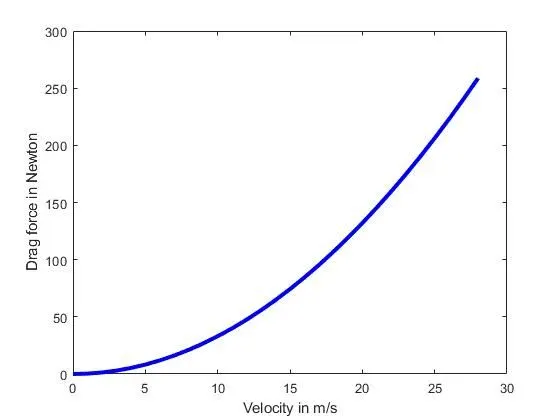
In order to study the impact of vehicle velocity on the drag force, frontal area and coefficient of drag of Mercedes Benz S class was considered which was found to be 2.5m2 and 0.22 respectively[1]. Initially an array of velocity was created by considering speed from 0 to 100 kmph. With respect to velocity, drag force is being calculated and plotted.
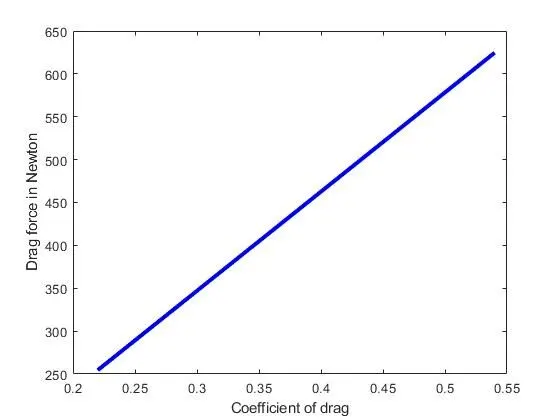
In order to study the impact of different drag coefficient, different Mercedes Benz car was considered assuming they have same frontal area and travelling at a speed of 100kmph.
Table 1:
Different Mercedes Benz car with their drag coefficient [2]:
|
S.N |
Name |
Coefficient of Drag |
|
1 |
G class |
0.54 |
|
2 |
SL |
0.34 |
|
3 |
CLA -250 |
0.30 |
|
4 |
C class sports coupe |
0.29 |
|
5 |
S class |
0.27 |
|
6 |
C class coupe |
0.26 |
|
7 |
C 220 Blue efficiency sedan |
0.24 |
|
8 |
CLA 180 blue efficiency |
0.22 |
Program/code:
%1.  To Study the effect of velocity on drag force
close all % To close all program
clear all   %To clear data
clc    % To clear screen

%Inputs

d=1.2;  % Densiity of air which is 1.2

cd=0.22; % Drag coefficient of mercedez benz S class

a= 2.5; % Frontal area of meredez benz s class


%studying parameters

v=0:28; % velocity input and 100kmph is equal to 27.77m/s as formula is interms of meter and rounding it to 28m/s


%Calculation of drag force

fd=0.5*d*cd*a*v.^2;  % Drag force calculation formula


%plotting

plot(v,fd,'color','b','linewidth',3)

xlabel('Velocity in m/s')
ylabel('Drag force in Newton')
Code for second objectives
%To study the variation of drag force with repect to drag coefficient
close all % To close all program
clear all   %To clear data
clc    % To clear screen

%Inputs

d=1.2;  % Densiity of air which is 1.2

v=27.77; % Assuming the vehicle is moving in a constant speed of 100kmph i.e 27.77m/s
a= 2.5; % Assuming all the considered model have same fronatal area


%studying parameters


cd=[0.54 0.34 0.30 0.29 0.27 0.26 0.24 0.22]; % Drag coefficient as mention in table 1


%Calculation of drag force

fd=0.5*d*cd.*a*v.^2;  % Drag force calculation formula


%plotting

plot(cd,fd,'color','b','linewidth',3)

xlabel('Coefficient of drag')
ylabel('Drag force in Newton')
Result and Discussion:
4.1 With respect to velocity
Figure 1 shows the variation of drag force with respect to different velocity. As shown in figure the value of drag force depends on the velocity of vehicle. When speed of vehicle was around 10m/s, the value of below 50N. When speed of the vehicle was increased beyond 10m/s than exponential increase in drag force was observed. When speed of vehicle increases more than 25m/s, than the value of drag force was more than 4 times as of the value of drag force at 10m/s. From the figure it was clear that, velocity has great impact on drag force. As in low velocity, the drag force is quite low while for higher velocity drag force is too high.
4.2 Variation with Coefficient of Drag
Figure 2 shows the variation of drag force with respect to different value of drag coefficient. From figure it was clear that drag force increases linearly with increase in coefficient of drag for same frontal area and velocity of vehicle. The drag force for Mercedes Benz CLA 180 blue efficiency was around 250N at a speed of 100kmph while for G class drag force was more than 600N while assuming same frontal area.
- Conclusion:
Velocity of vehicle has great impact on drag force, as velocity of vehicle increases, the amount of drag forces increases exponentially. While with increase in drag coefficient, drag force increases linearly.
Reference:
1.https://www.repairerdrivennews.com/2020/09/07/mercedes-2021-s-class-nvh-aerodynamic-efforts-could-impact-bodywork, last accessed: 12th August,2021
- https://en.wikipedia.org/wiki/Automobile_drag_coefficient, last accessed: 12th August, 2021