Week 1 Understanding Different Battery Chemistry
AIM: Understanding Different Battery Chemistry
OBJECTIVE:
1.Prepare a table which includes materials & chemical reactions occurring at the anode and cathode of LCO, LMO, NCA, NMC, LFP and LTO type of lithium ion cells.Give your detailed explanation on it
2.Compare the differences between each type of Li+ion batteries based on their characteristics
THEORY:
What is a battery?
A battery is a device that converts chemical energy contained within its active materials directly into electric energy by means of an electrochemical reduction (redox) reaction. This type of reaction involves the transfer of electrons from one material to another via an electric circuit.
While the term battery is often used the cell is the actual electrochemical unit used to generate or store electric energy.When a battery is supplying power, its positive terminal is the cathode and its negative terminal is the anode. The terminal marked negative is the source of electrons that will flow through an external electric circuit to the positive terminal. When a battery is connected to an external electric load, a redox reaction converts high-energy reactants to lower-energy products, and the free energy difference is delivered to the external circuit as electrical energy. Historically the term "battery" specifically referred to a device composed of multiple cells; however, the usage has evolved to include devices composed of a single cell.
What is a lithium ion battery?
A lithium-ion (Li-ion) battery is an advanced battery technology that uses lithium ions as a key component of its electrochemistry. During a discharge cycle, lithium atoms in the anode are ionized and separated from their electrons. The lithium ions move from the anode and pass through the electrolyte until they reach the cathode, where they recombine with their electrons and electrically neutralize. The lithium ions are small enough to be able to move through a micro-permeable separator between the anode and cathode. In part because of lithium’s small size (third only to hydrogen and helium), Li-ion batteries are capable of having a very high voltage and charge storage per unit mass and unit volume.
How does a Lithium ion battery work?
Li-ion batteries can use a number of different materials as electrodes. The most common combination is that of lithium cobalt oxide (cathode) and graphite (anode), which is most commonly found in portable electronic devices such as cellphones and laptops. Other cathode materials include lithium manganese oxide (used in hybrid electric and electric automobiles) and lithium iron phosphate. Li-ion batteries typically use ether (a class of organic compounds) as an electrolyte.
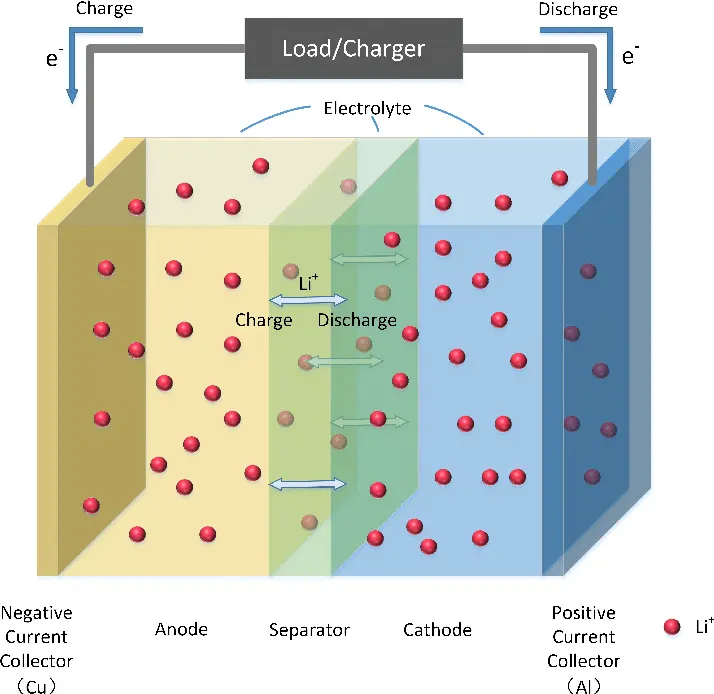
figure: the above image shoes us a schematic diagrsm of a litium ion battery.
OBJECTIVES:
1.Prepare a table which includes materials & chemical reactions occurring at the anode and cathode of LCO, LMO, NCA, NMC, LFP and LTO type of lithium ion cells.Give your detailed explanation on it
There are 6 most widely used litium ion batteries which are listed down below:
- Lithium Cobalt oxide(LiCoO2)-LCO
- Lithium Manganese Oxide(LiMn2O4)-LMO
- Lithium Nickel Manganese Cobalt Oxide(LiNiMnCoO2)-NMC
- Lithium Iron Phosphate(LiFePO4)-LFP
- Lithium Nickel Cobalt Aluminium Oxide(LiNiCoAlO2)-NCA
- Lithium Titanate(Li2TiO3)-LTO
Each lithium ion batteries are used in different uses
Here is a table which consists of the materials and the chemicals used in different type of Lithium ion battereis.
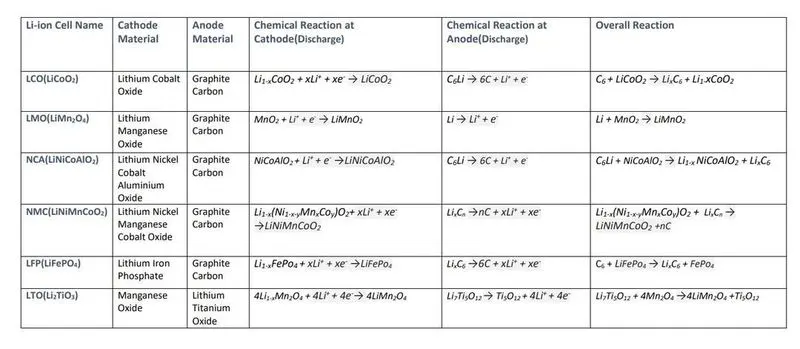
Describing the different type of batteries and their chemical reactions:
1. Lithium Cobalt oxide(LiCoO2)-LCO
it has high specific energy as compared to the other batteries which make it the preferred choice for laptops and mobile phones. It also has a low cost and a moderate performance. However, it is highly unfavorable in all the other aspects when compared to the other lithium-ion batteries. It has low specific power, low safety, and a low lifespan.
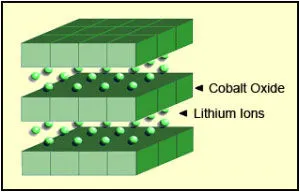
Inside a lithium ion battery oxidation-reduction or else knwn as redox reactio takes place. Reduction takes place at the cathode. There, cobalt oxide combines with lithium ions to form lithium-cobalt oxide (LiCoO2). The half-reaction is:
CoO2 + Li+ + e- → LiCoO2
Oxidation takes place at the anode. There, the graphite intercalation compound LiC6 forms graphite (C6) and lithium ions. The half-reaction is:
LiC6 → C6 + Li+ + e-
Here is the full reaction (left to right = discharging, right to left = charging):
LiC6 + CoO2 ⇄ C6 + LiCoO2
2.Lithium Manganese Oxide(LiMn2O4)-LMO
Lithium Manganese Oxide has moderate specific power, moderate specific energy, and a moderate level of safety when compared to the other types of lithium-ion batteries. It has the added advantage of a low cost. The downsides are its low performance and low lifespan. It is usually used in medical devices and power tools.
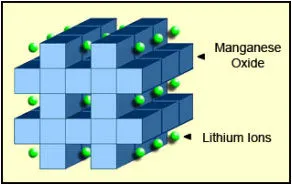
During charging process;
The reaction on the anode: LiMn2O4==Li1-xMn2O4+Xli++Xe(electron)
The reaction on the cathode: 6C+XLi+Xe==LixC6
During discharging process:
The reaction on the anode Li1-xMn2O4+xli++xe(electron)==LiMn2O4
The reaction on the cathode LixC6==6C+xLi+xe
3.Lithium Nickel Manganese Cobalt Oxide(LiNiMnCoO2)-NMC
Lithium Nickel Manganese Cobalt Oxide has two major advantages as compared to the other batteries. The first one is its high specific energy which makes it desirable in electric powertrains, electric vehicles, and electric bikes. The other is its low cost. It is moderate in terms of specific power, safety, lifespan, and performance when compared to the other lithium-ion batteries. It can be optimized to either have high specific power or high specific energy.
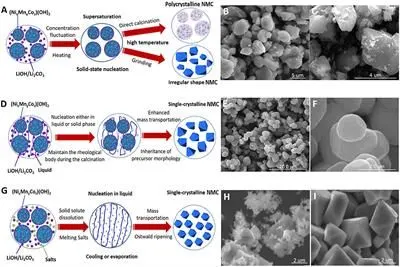
at cathode:
`LiMnO_2↔Li_(1−x)MO_2+xLi^++xe^−`
at anode
`LiMnO_2↔Li_(1−x)MO_2+xLi^++xe^−`
overall reaction:
`LiMnO_2↔Li_(1−x)MO_2+xLi^++xe^−`
4.Lithium Iron Phosphate(LiFePO4)-LFP
Lithium Iron Phosphate only has one major disadvantage when compared to other types of lithium-ion batteries and that is its low specific energy. Other than that, it has moderate to high ratings in all the other characteristics. It has high specific power, offers a high level of safety, has a high lifespan, and comes at a low cost. The performance of this battery is also moderate. It is often employed in electric motorcycles and other applications that require a long lifespan and a high level of safety.
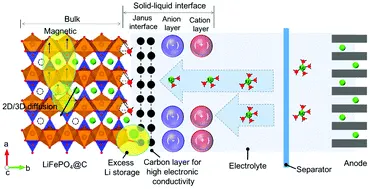
In charging process:
LiFePO4 - `xLi^+` -`xe^-`= xFePO4 + (1- x)LiFePO4
In discharging process:
FePO4 +`xe^-`+ `xLi^+` = xLiFePO4 + (1-x)FePO4
5.Lithium Nickel Cobalt Aluminium Oxide(LiNiCoAlO2)-NCA
Lithium Nickel Cobalt Aluminum Oxide offers one strong advantage as compared to the five other batteries and that is high specific energy. It is pretty moderate in the rest of the characteristics like performance, cost, specific power, and lifespan. The only downside to this battery type is its low level of safety. Its high specific energy and moderate lifespan make it a good candidate for electric powertrains.
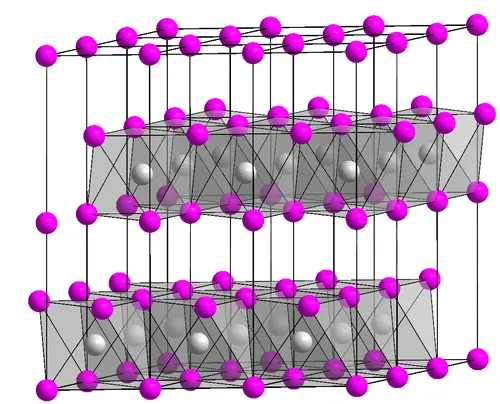
Cathode reaction:
`LiNiCoAlO_2↔Li_(1−x)NiCoAlO_2+xLi^++xe^−`
Anode reaction:
`xLi^++xe^−+6C↔Li_xC_6`
overall reaction:
`6C+LiNiCoAlO_2↔LiC_6+NiCoAlO_2`
6.Lithium Titanate(Li2TiO3)-LTO
Lithium Titanate offers high safety, high performance, and a high lifespan which are very important features every battery should have. Its specific energy is low compared to the five other lithium-ion batteries but it compensates for this with moderate specific power. The only major disadvantage of lithium titanate as compared to the other lithium-ion batteries is its extremely high cost. Another important feature of this battery worthy of mention is its remarkably fast recharge time. It can be used for storing solar energy and creating smart grids.
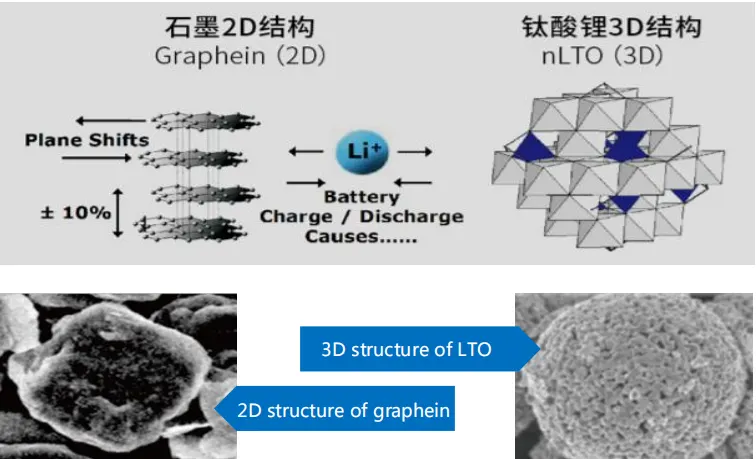
cathode reaction:
`4LiMn_2O_4↔4Mn_2O_4+4Li^++4e^−`
anode reaction:
`Ti_5O_12+4Li^++4e^−↔Li_4Ti_5O_12`
overall reaction:
`Li_4Ti_5O_12+4Mn_2O_4↔4LiMn_2O_4+Ti_5O_12`
2.Compare the differences between each type of Li+ion batteries based on their characteristics
All the 6 types oof batteries were discussed earlier and now the major difference in the charecteristics can be found out when choosing among these 6 batteries. These charecteristics are mentioned below:
- Nominal voltage: it is the system voltage at which the device is designed to operate.The rated voltage is higher than the nominal voltage to ensure the safe operation of the device.
- Cycle: The charge and the discharge wheen took place for a single time makes a cycle.Higher the cycles it take, higher is the life span of the cell.
- Current rate(C):the current rate is used to determine the fast charging capability and short-circuit discharge capability of a battery.
- Thermal Runaway: The thermal runaway begins when the heat generated within the battery exceeds the amount of heat that is dissipated to its surroundings. Internal battery temperature will continue to rise causing the battery current to rise creating a domimo effect. the rise in temperature will affect the nearby batteries and it will continue the process.
- Specific energy: It is the amount of energy stored in unit mass. THis is very important factor as it decides how much enregy or power we are going to get from different batteries with the same amount of weight.
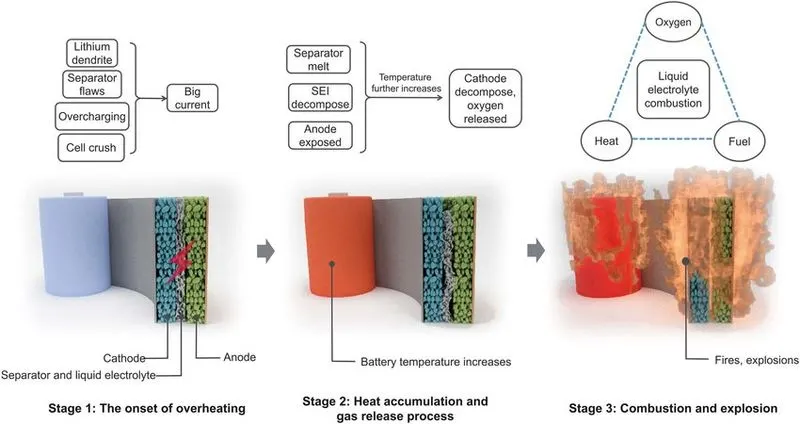
figure: three stages of thermal runaway
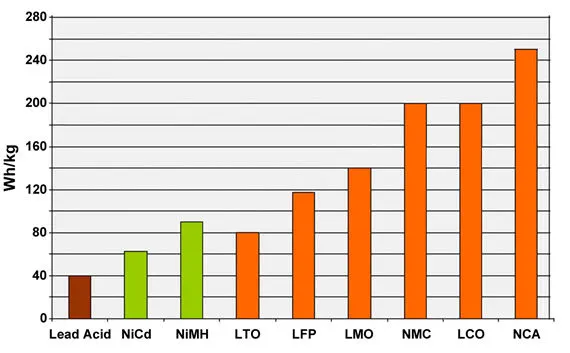
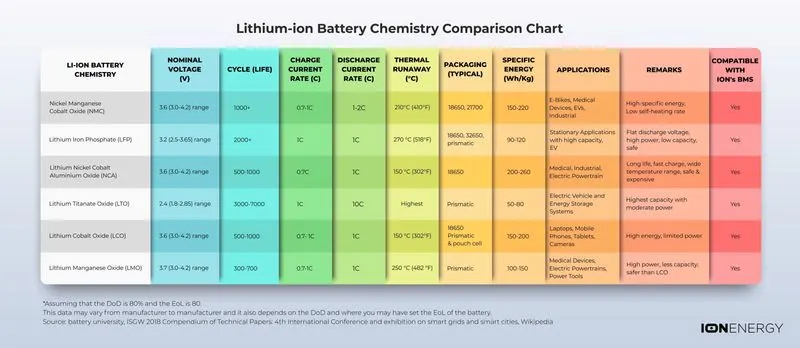
Specific energy: This defines the battery capacity in weight (Wh/kg). The capacity relates to the runtime. Products requiring long runtimes at moderate load are optimized for high specific energy.
Specific power: It's the ability to deliver a high current and indicates loading capability. Batteries for power tools are made for high specific power and come with a reduced specific energy.
Performance: This measures how well the battery works over a wide range of temperatures. Most batteries are sensitive to heat and cold and require climate control. Heat reduces life, and cold lowers performance temporarily.
Lifespan: This reflects cycle life and longevity and is related to factors such as temperature, depth of discharge, and load. Hot climates accelerate capacity loss. Cobalt blended lithium-ion batteries also usually have a graphite anode that limits the cycle life.
Safety: This relates to factors such as the thermal stability of the materials used in the batteries. The materials should have the ability to sustain high temperatures before becoming unstable. Instability can lead to thermal runaway in which flaming gases are vented. Fully charging the battery and keeping it beyond the designated age reduces safety.
Cost: Demand for electric vehicles has generally been lower than anticipated and this is mainly due to the cost of lithium-ion batteries. Hence cost is a huge factor when selecting the type of lithium-ion battery.
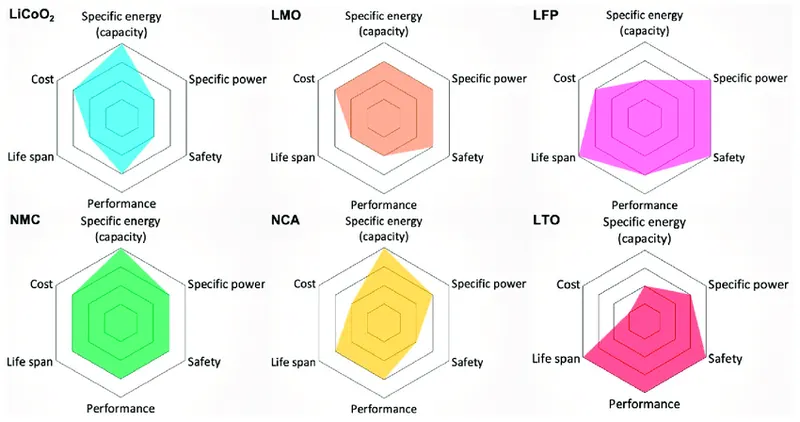
figure: comparision of all 6 lithium ion batteries using 6 key factors.
CONCLUSION:
ALL THE 6 TYPE OF LITHIUM ION BATTERIES ATRE HENCE STUDIED WITH ALL THE PARAMETERS, THEIR CHEMICAL REACTION AND THEIR PERFORMANCE.