Week 1 Understanding Different Battery Chemistry
Aim- Week 1 Understanding Different Battery Chemistry
Main Objective-
1.Prepare a table which includes materials & chemical reactions occurring at the anode and cathode of LCO, LMO, NCA, NMC, LFP and LTO type of lithium ion cells.Give your detailed explanation on it.
2.Compare the differences between each type of Li+ion batteries based on their characteristics.
1.Prepare a table which includes materials & chemical reactions occurring at the anode and cathode of LCO, LMO, NCA, NMC, LFP and LTO type of lithium ion cells.Give your detailed explanation on it.
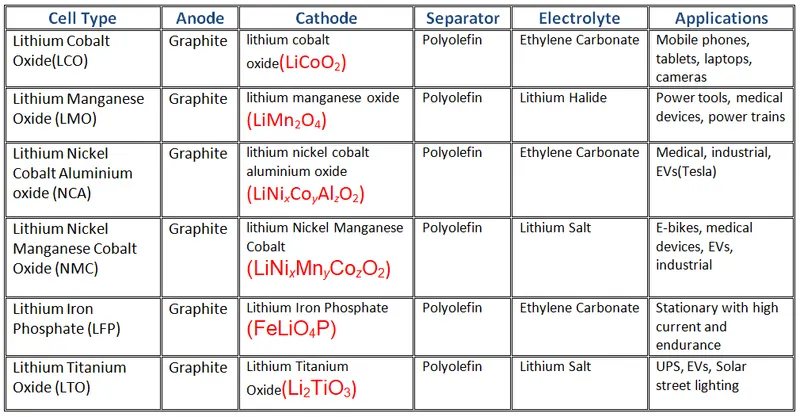
Here for the chemical formula for Cathod material for x+y+z=1 and the chemical reactions are given below after the explanation of each cell type.
2.Compare the differences between each type of Li+ion batteries based on their characteristics.
Lithium Ion batteries- A lithium-ion battery or Li-ion battery is a type of rechargeable battery in which lithium ions move from the negative electrode through an electrolyte to the positive electrode through Lithium salts as electrolyte during discharge, and back when charging. Li-ion batteries use an intercalated lithium compound as the material at the positive electrode and typically graphite at the negative electrode.
First Li- ion batteries was introduced by a Japenese chemist named Akira Yoshino in 1985. Commercially the Li-ion battery was developed by SONY and Asahi Kase team in 1991.
A lithium-ion (Li-ion) battery is an advanced battery technology that uses lithium ions as a key component of its electrochemistry. During a discharge cycle, lithium atoms in the anode are ionized and separated from their electrons. The lithium ions move from the anode and pass through the electrolyte until they reach the cathode, where they recombine with their electrons and electrically neutralize. The lithium ions are small enough to be able to move through a micro-permeable separator between the anode and cathode. In part because of lithium’s small size (third only to hydrogen and helium), Li-ion batteries are capable of having a very high voltage and charge storage per unit mass and unit volume.
Both electrodes in a lithium-ion cell are made of materials which can intercalate or ‘absorb’ lithium ions (a bit like the hydride ions in the NiMH batteries). Intercalation is when charged ions of an element can be ‘held’ inside the structure of a host material without significantly disturbing it. In the case of a lithium-ion battery, the lithium ions are ‘tied’ to an electron within the structure of the anode. When the battery discharges, the intercalated lithium ions are released from the anode, and then travel through the electrolyte solution to be absorbed (intercalated) in the cathode.
A lithium-ion battery starts its life in a state of full discharge: all its lithium ions are intercalated within the cathode and its chemistry does not yet have the ability to produce any electricity. Before you can use the battery, you need to charge it. As the battery is charged, an oxidation reaction occurs at the cathode, meaning that it loses some negatively charged electrons. To maintain the charge balance in the cathode, an equal number of some of the positively charged intercalated lithium ions are dissolved into the electrolyte solution. These travel over to the anode, where they are intercalated within the graphite. This intercalation reaction also deposits electrons into the graphite anode, to ‘tie’ up the lithium ion.
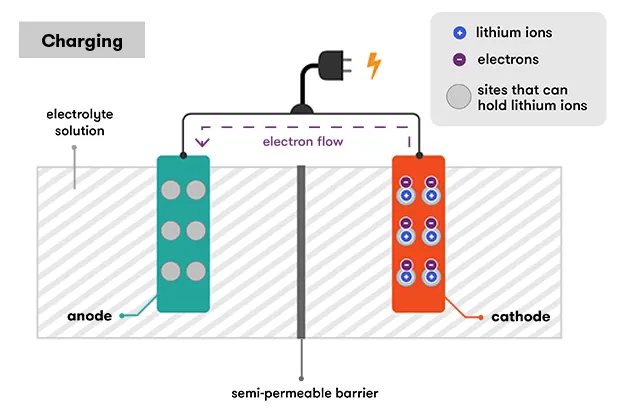
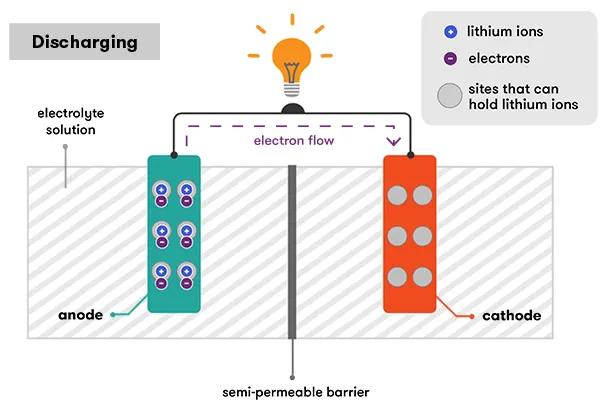
During discharge, the lithium ions are de-intercalated from the anode and travel back through the electrolyte to the cathode. This also releases the electrons that were tying them to the anode, and these flow through an external wire, providing the electric current that we used to do work. It’s the connection of the external wire that enables the reaction to proceed—when the electrons are free to travel, so are the positively charged lithium ions that will balance the movement of their negative charge.
When the cathode becomes full of lithium ions, the reaction stops and the battery is flat. Then we recharge our lithium-ion batteries again, and the external electric charge that we apply pushes the lithium ions back into the anode from the cathode.
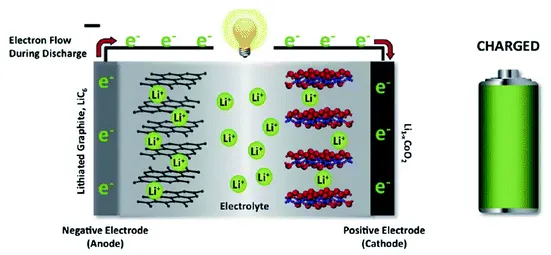
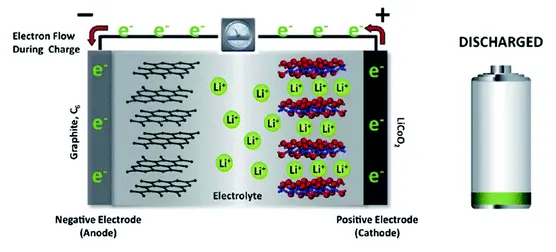
The electrolyte in a lithium-ion cell is usually a solution of lithium salts in a mixture of solvents (like dimethyl carbonate or diethyl carbonate) devised to improve battery performance. Having lithium salts dissolved in the electrolyte means the solution contains lithium ions. This means that individual lithium ions don’t have to make the complete journey from the anode to the cathode to complete the circuit. As ions are kicked out from the anode, others that are already hanging out in the electrolyte, near the electrode surface, can easily be absorbed (intercalated) into the cathode. The reverse happens during recharging.
Li-ion batteries can use a number of different materials as electrodes. The most common combination is that of lithium cobalt oxide (cathode) and graphite (anode), which is most commonly found in portable electronic devices such as cellphones and laptops. Other cathode materials include lithium manganese oxide (used in hybrid electric and electric automobiles) and lithium iron phosphate. Li-ion batteries typically use ether (a class of organic compounds) as an electrolyte.
In Lithium ion batteries or cell the lithium is the key composition but still other metals like cobalt, aluminium are being used for both positive and negative electrodes. Based on these compossition of materials used for the electrodes lithium ion batteries are divided into 6 different types
- Lithium Cobalt Oxide(LCO)
- Lithium Manganese Oxide (LMO)
- Lithium Nickel Cobalt Aluminium oxide (NCA)
- Lithium Nickel Manganese Cobalt Oxide (NMC)
- Lithium Iron Phosphate (LFP)
- Lithium Titanium Oxide (LTO)
1. Lithium Cobalt Oxide(LCO)
The most common lithium-ion cells have an anode of carbon (C) and a cathode of lithium cobalt oxide (LiCoO2). In fact, the lithium cobalt oxide battery was the first lithium-ion battery to be developed from the pioneering work of R Yazami and J Goodenough, and sold by Sony in 1991. The cobalt and oxygen bond together to form layers of octahedral cobalt oxide structures, separated by sheets of lithium. It’s important that this structure allows the cobalt ions to change their valence states between Co+3 and Co+4 (lose and gain a negatively-charged electron) when charging and discharging.
Of all the various lithium-ion batteries, these guys have the greatest energy density, which is why they’re currently the batteries found in our phones, digital cameras and laptops. Their drawback is their thermal instability. Their anodes can overheat and, at high temperatures, the cobalt oxide cathode can decompose, producing oxygen. If you combine oxygen and heat, you’ve got a pretty good chance of starting a fire and, as the chemicals sometimes used in the electrolyte solution, such as diethyl carbonate, are flammable, there can be some safety issues with this battery.
Lithium-ion batteries have in-built protections to prevent overheating, and to prevent the complete discharge of the battery which can also be damaging. Additionally, these protection circuits can sometimes be used to prevent over-charging of lithium-ion batteries, which can have serious consequences. Lithium-ion batteries come in a wide variety of shapes and sizes, and some contain in-built protection devices, such as venting caps, to improve safety.
Its high specific energy makes Li-cobalt the popular choice for mobile phones, laptops and digital cameras. The battery consists of a cobalt oxide cathode and a graphite carbon anode. The cathode has a layered structure and during discharge, lithium ions move from the anode to the cathode. The flow reverses on charge. The drawback of Li-cobalt is a relatively short life span, low thermal stability and limited load capabilities (specific power).
The following equations exemplify the chemistry.
The positive electrode (cathode) half-reaction in the lithium-doped cobalt oxide substrate is

The negative electrode (anode) half-reaction for the graphite is

The full reaction (left to right: discharging, right to left: charging) being

The overall reaction has its limits. Overdischarging supersaturates lithium cobalt oxide, leading to the production of lithium oxide, possibly by the following irreversible reaction:

Overcharging up to 5.2 volts leads to the synthesis of cobalt(IV) oxide, as evidenced by x-ray diffraction:

2. Lithium Manganese Oxide (LMO)
This type of lithium battery uses a cathode made from lithium-manganese spinel (Li+Mn3+Mn4+O4). Spinel is a type of mineral with a distinctive AB2O4 structure. The spinel structure has very good thermal stability, improving the battery’s safety. It also promotes ion flow within the electrolyte and lessens the internal resistance that contributes to the loss of a battery’s power over time. While this type of lithium battery offers high discharge and recharge rates (also due to the spinel structure of the cathode) it has a lower capacity and shorter lifetime.
Li-ion with manganese spinel was first published in the Materials Research Bulletin in 1983. In 1996, Moli Energy commercialized a Li-ion cell with lithium manganese oxide as cathode material. The architecture forms a three-dimensional spinel structure that improves ion flow on the electrode, which results in lower internal resistance and improved current handling. A further advantage of spinel is high thermal stability and enhanced safety, but the cycle and calendar life are limited.
At Anode
Li→Li++e−Li→Li++e-
At Cathode
Mn2O4+Li++e−→LiMn2O4Mn2O4+Li++e-→LiMn2O4
3. Lithium Nickel Cobalt Aluminium oxide (NCA)
The lithium nickel cobalt aluminium oxides (NCAs) are a group of mixed metal oxides. Some of them are important due to their application in lithium ion batteries. NCAs are used as active material on the positive pole (which is the cathode when the battery is discharged). NCAs are composed of the cations of the chemical elements lithium, nickel, cobalt and aluminium. The most important representatives as of this date[when?] have the general formula LiNixCoyAlzO2 with x + y + z = 1. In case of the NCA comprising batteries currently available on the market, which are also used in electric cars and electric appliances, x ≈ 0,8, and the voltage of those batteries is between 3.6 V and 4.0 V, at a nominal voltage of 3.6 V or 3.7 V. A version of the oxides currently in use in 2019 is LiNi0,84Co0,12Al0,04O2.
Lithium nickel cobalt aluminum oxide (LiNi0.8Co0.15Al0.05O2) is a cathode material that provides higher capacity than LiCoO2 when both are charged to 4.2 / 4.3V. NCA-based batteries are most suited for use in moderate rate applications that require high energy density.
Lithium nickel cobalt aluminum oxide battery, or NCA, has been around since 1999 for special applications. It shares similarities with NMC by offering high specific energy, reasonably good specific power and a long life span. Less flattering are safety and cost. NCA is a further development of lithium nickel oxide; adding aluminum gives the chemistry greater stability.

4. Lithium Nickel Manganese Cobalt Oxide (NMC)
Adding nickel and cobalt back into the mix changes things slightly again. Nickel provides a high specific energy and, when added to the stable structure of the manganese spinel, also results in a battery with the benefits of the manganese spinel structure (low internal resistance, high charging rate, good stability and safety).
These batteries are generally made with a cathode with one-third nickel, one-third manganese and one-third cobalt, but the ratio can vary according to manufacturers’ secret formulas. These batteries are used in power tools, electric vehicles and medical devices.
One of the most successful Li-ion systems is a cathode combination of nickel-manganese-cobalt (NMC). Similar to Li-manganese, these systems can be tailored to serve as Energy Cells or Power Cells. For example, NMC in an 18650 cell for moderate load condition has a capacity of about 2,800mAh and can deliver 4A to 5A; NMC in the same cell optimized for specific power has a capacity of only about 2,000mAh but delivers a continuous discharge current of 20A.
Lithium manganese batteries are often coupled with a lithium nickel manganese cobalt oxide battery, producing a combination that is used in many electric vehicles. High bursts of energy (for rapid acceleration) are provided by the lithium-manganese component, and a long driving range is provided by the lithium nickel manganese cobalt oxide component.
At Anode
LixCn→nC+xLi++xe−LixCn→nC+xLi++xe-
At Cathode
Li1−xMO2+xLi++xe−→LiMO2Li1-xMO2+xLi++xe-→LiMO2
Redox Reaction
Li1−xMO2+LixCn→LiMO2+nCLi1-xMO2+LixCn→LiMO2+nC
5. Lithium Iron Phosphate (LFP)
This cell has a high discharge rate and, because phosphate (PO4) can cope with high temperatures, the battery has good thermal stability, improving its safety. This makes it a good choice for things like electric vehicles and power tools, and for storing energy at power stations. It also has a long cycle life, meaning it can be discharged and charged many times. However, it has a lower energy density than a lithium cobalt oxide cell, and a higher self-discharge rate.
A lithium iron phosphate battery cell is similar to the lithium cobalt oxide cell. The anode is still graphite and the electrolyte is also much the same. The difference is that the lithium cobalt dioxide cathode has been replaced with the more stable lithium iron phosphate. In fact, no lithium or iron ions remain in the iron phosphate (FePO4) cathode of a fully charged cell. The lithium ions can intercalate into or out of the cathode material through well-defined tunnels in its structure without significantly altering the iron phosphate framework.
The cathode of this type of cell is made of negatively charged phosphate anions, bonded with positively charged iron cations in a structure that is capable of storing lithium ions within the iron phosphate molecules. The bonding arrangement in this structure means that the oxygen atoms are tightly bonded into the structure, which gives the cathode its chemical stability.
Li-phosphate offers good electrochemical performance with low resistance. This is made possible with nano-scale phosphate cathode material. The key benefits are high current rating and long cycle life, besides good thermal stability, enhanced safety and tolerance if abused.Li-phosphate is more tolerant to full charge conditions and is less stressed than other lithium-ion systems if kept at high voltage for a prolonged time. As a trade-off, its lower nominal voltage of 3.2V/cell reduces the specific energy below that of cobalt-blended lithium-ion.
At Anode
LiC6→Li++e−+C6LiC6→Li++e-+C6
At Cathode
LiFe(III)PO4+xLi++xe−→LiFe(II)PO4LiFe(III)PO4+xLi++xe-→LiFe(II)PO4
FePO4+Li++e−→LiFePO4FePO4+Li++e-→LiFePO4
Overall Reaction
LiFePO4+6C→LiC6+FePO4LiFePO4+6C→LiC6+FePO4
6. Lithium Titanium Oxide (LTO)
The lithium-titanium-oxide or lithium titanate(LTO) battery is a type of rechargeable battery which has the advantage of being faster to charge[2] than other lithium-ion batteries, but the disadvantage of having a much lower energy density.
Titanate batteries are used in certain Japanese-only versions of Mitsubishi's i-MiEV[3] electric vehicle, and Honda uses them in its EV-neo electric bike and Fit EV.[4][5] They are also used in the Tosa concept electric bus.[6] LTO batteries are also used in electric commuter ferries own by Danish public transport company, Arriva Denmark.[7][8] Kochi metro, an inland water transport in Kerala, India, is using LTO batteries to reduce carbon emission.[9] Due to their high level of safety and recharge capabilities, LTO batteries are used in car audio applications as well as mobile medical devices.
Batteries with lithium titanate anodes have been known since the 1980s. Li-titanate replaces the graphite in the anode of a typical lithium-ion battery and the material forms into a spinel structure. The cathode can be lithium manganese oxide or NMC. Li-titanate has a nominal cell voltage of 2.40V, can be fast charged and delivers a high discharge current of 10C, or 10 times the rated capacity. The cycle count is said to be higher than that of a regular Li-ion. Li-titanate is safe, has excellent low-temperature discharge characteristics and obtains a capacity of 80 percent at –30°C.
when charged/discharged in the potential range of 1.00–3.00 V
Li4Ti5O12+3Li++3e−↔Li7Ti5O12Li4Ti5O12+3Li++3e-↔Li7Ti5O12
Increased capacity of lithium–titanium oxide when cycled to 0.01 V is related to a full reduction of titanium ions from +4 to +3 oxidation state which involves additional two Li+ ions
Li7Ti5O12+2Li++2e−↔Li9Ti5O12Li7Ti5O12+2Li++2e-↔Li9Ti5O12
| TECHNOLOGY | PROS / CONS | APPLICATION FIELD |
|---|---|---|
Lithium Iron Phosphate (LFP-LiFePO4) |
|
|
Lithium-Cobalt-Oxide (LCO) |
|
|
Lithium Nickel Cobalt Aluminium (NCA) |
|
|
Lithium Nickel Manganese Cobalt (NMC) |
|
|
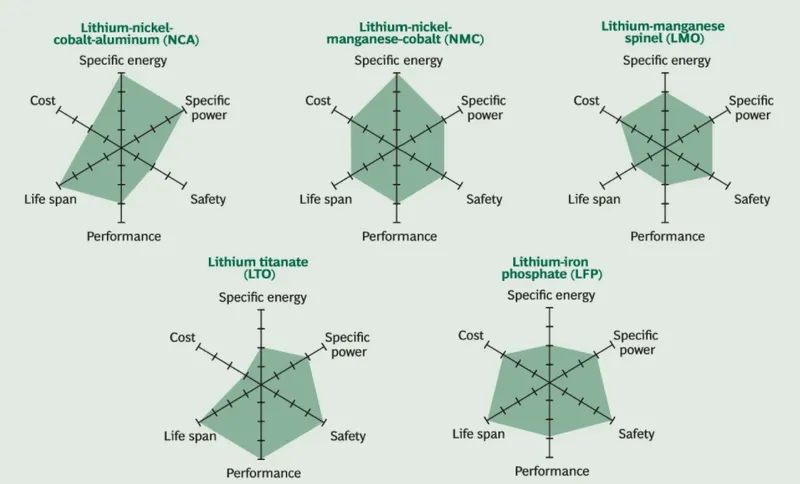
The below figure consists of trade off radar among 5 main lithium ion battery technologies which is givenm in 5 point scale