Week 1 Understanding Different Battery Chemistry
Aim:
To prepare a table to explain the material and chemical reaction of LCO, LMO, NCA, NMC, LFP and LTO type of lithium-ion cells and their characteristics.
Explanation:
A lithium-ion (Li-ion) battery is an advanced battery technology that uses lithium ions as a key component of its electrochemistry.
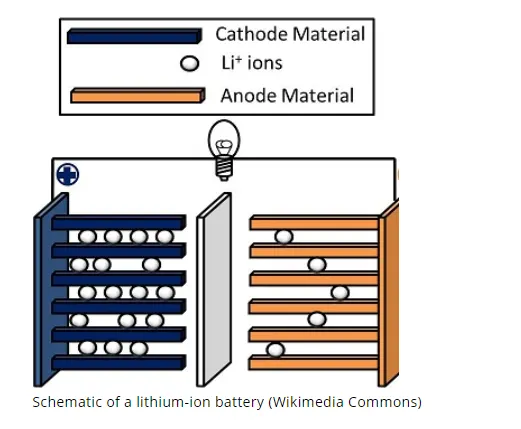
During a discharge cycle, lithium atoms in the anode are ionized and separated from their electrons. The lithium ions move from the anode and pass through the electrolyte until they reach the cathode, where they recombine with their electrons and electrically neutralize. The lithium ions are small enough to be able to move through a micro-permeable separator between the anode and cathode. In part because of lithium’s small size (third only to hydrogen and helium), Li-ion batteries are capable of having a very high voltage and charge storage per unit mass and unit volume.
Li-ion batteries can use a number of different materials as electrodes. The most common combination is that of lithium cobalt oxide (cathode) and graphite (anode), which is most commonly found in portable electronic devices such as cellphones and laptops. Other cathode materials include lithium manganese oxide (used in hybrid electric and electric automobiles) and lithium iron phosphate. Li-ion batteries typically use ether (a class of organic compounds) as an electrolyte.
Lithium Battery Technologies:
LCO: LMO:
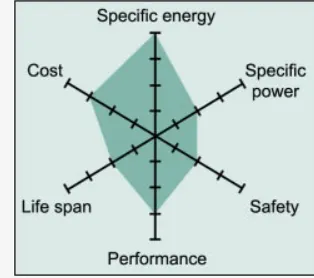
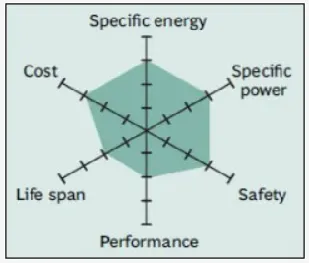
NCA: NMC:
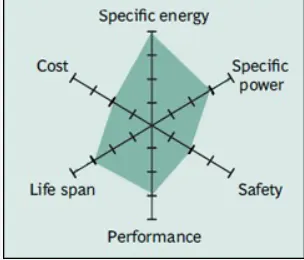
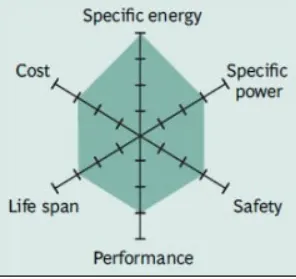
LFP: LTO:
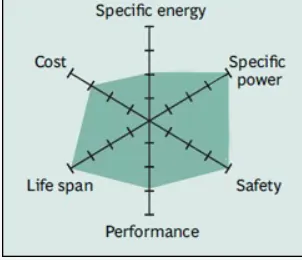
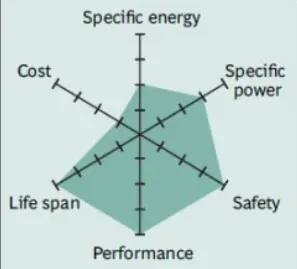
| LCO | LMO | NCA | NMC | LFP | LTO | |
| Full-Form: | Lithium Cobalt Oxide | Lithium Manganese Oxide | Lithium Nickel Cobalt Aluminum oxide | Lithium Nickel Manganese Cobalt oxide | Lithium Iron Phosphate | Lithium Titanate |
|
Cathode Material: |
lithiated metal oxide - `Li_2CoO_2` | Lithium Manganese oxide | `LiNiCoAlO_2` | LiNiMnCoO2 | `LiFePO_4` | Lithium Manganese oxide or NMC |
| Anode Material: | lithiated graphite | Graphite | Graphite | Graphite | Graphite | `Li_2TiO_3` |
| Electrolyte: | LiPF6 or similar lithium salt and Ethylene Carbonate as a solvent. | Lithium Halide | Lithium Salt | Ethylene carbonate | Ethylene Carbonate | Lithium Salt |
| Separator: | Polyolefin | Polyethylene | Ethylene Carbonate | Polyolefin | Polyolefin | Polyolefin |
| Anode Reaction: | `C_6Li rightarrow 6C +Li^+ +e^-` | `LiC_6 rightarrow C_6 + Li^+ + e^-` | C_6Li rightarrow xLi + xe^(-) + C_6` | C_6Li rightarrow xLi + xe^(-) + C_6` | C_6Li rightarrow xLi + xe^(-) + C_6` | `Li_2TiO_3 rightarrow TiO_3 + 2Li^+ + 2e^-` |
| Cathode Reaction: | `Li_(1-x)CoO_2(s) + xLi^+ +xe^(-) rightarrow LiCoO_2` | `Mn_2O_4 + Li^+ + e^(-) rightarrow LiMn_2O_4` | `NiCoAlO_2 + Li^+ + e^(- )rightarrow LiNiCoAlO_2` | `NiMnCoO_2 + Li^+ + e^(-) rightarrow LiNiMnCoO_2` |
`LiFe(III)PO_4 + xLi + xe^(-) rightarrow LiFe(II)PO_4` `FePO_4 + Li^+ + e^(-) rightarrow LiFePO_4` |
`Mn_2O_4 + Li^+ + e^(-) rightarrow LiMn_2O_4` |
| Cell Capacity(nominal, V): | 3.70 V | 3.80 V | 3.60 V | 3.60 V | 3.20 V | 2.40 V |
| Operating Range: | 3.0-4.2 V/cell | 3.0-4.2 V/cell | 3.0 - 4.2V/cell | 3.0 -4.2V/cell or higher | 2.5 - 3.65 V/cell | 1.8 - 2.85 V/cell |
| Application: |
|
|
Medical Devices, Industrial electric powertrain |
|
|
|
| Comments: |
|
|
|
|
|
|