Week 1 Understanding Different Battery Chemistry
AIM: To understand different batteries - chemistry
OBJECTIVE:
1.To prepare a table which includes materials & chemical reactions occurring at the anode and cathode of LCO, LMO, NCA, NMC, LFP and LTO type of lithium ion cells.
2.To compare the differences between each type of Li+ion batteries based on their characteristics.
INTRODUCTION:
Lithium-ion batteries are extremely popular and versatile. Found in cell phones, automobiles, power tools, and several other types of electronic devices, these rechargeable batteries are also making an impact powering material handling and airport ground support equipment. The technology behind lithium-ion batteries make them a great choice because of their distinct advantages and environmentally-friendly benefits.
A lithium-ion battery is made up of several parts. The cell, serving as the workhorse of the battery, is the most critical component of the battery.The cell is comprised of the following battery materials:
- Electrodes are the two battery ends. One is the anode and the other is the cathode.
- The anode stores the lithium and is typically made from carbon.
- The cathode also stores the lithium and is made from a chemical compound that is a metal oxide.
- The separator blocks the flow of negative and positive electrons inside the battery but allows for ions to pass through.
- The electrolyte liquid sits between the two electrodes. It carries the positively charged lithium ions from the anode to the cathode and vice versa depending on whether the battery is charging or discharging.
BATTERY PACK: The battery pack, which holds the lithium-ion cells, operates much like a computer. It contains the following:
- At least one temperature sensor to monitor the battery’s temperature.
- A voltage converter and regulator circuit that focuses on keeping the voltage and current at safe levels.
- A Euro connector, which allows power and information to move in and out of the battery pack.
- The cell tap, which oversees the cells voltages in the battery pack.
- A battery monitoring system, a small computer that oversees the whole battery and ensures safety to the user.
Working :
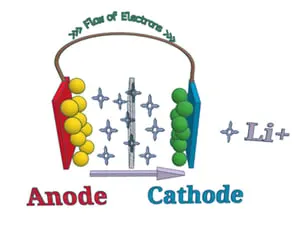
When you plug a lithium-ion battery into a device or piece of equipment, the positively-charged ions move from the anode to the cathode. As a result, the cathode becomes more positively charged than the anode. This, in turn, attracts negatively-charged electrons to the cathode.
A separator in the cell includes electrolytes that form a catalyst. This promotes ion movement between them. The movement of ions through the electrolyte solution is what causes the electrons to move through the device the battery is plugged into.
Lithium-ion batteries are rechargeable. When recharging, the lithium ions go through the same process, but in the opposite direction. This restores the battery for additional use.
The overall design of a lithium-ion battery provides many benefits for equipment users:
- Run times dramatically increase with their use compared to other battery types.
- Fast-charging capabilities provide less downtime for shift workers, and greater productivity.
- They feature flat discharge curves and provide higher constant power. This means no more annoying sluggishness in equipment as the battery charge level decreases.
SOLUTION:
1. To prepare a table which includes materials & chemical reactions occurring at the anode and cathode of LCO, LMO, NCA, NMC, LFP and LTO type of lithium ion cells.
Ans.
A Lithium-ion battery is the storehouse of energy. To harness the enormous amount of solar, wind, tidal energy – batteries are the only option available to us.
Advancement in battery tech has enabled the development of newer methods to store energy. The promise of clean and noiseless energy makes this field our first-step into the future.
Lithium is the lightest material known to us, with density (0.534 g/cm3), it is almost half as dense as water (1 g/cm3). It belongs to Group 1 (called Alkali) of the periodic table with one free electron in their outer shell which makes them highly reactive.
This metal is abundant in the Earth’s surface and can be mined and hence is cheap, making it an ideal choice for batteries.
1. Lithium Cobalt Oxide (LCO)
It has high specific energy but low specific power which means that charging and discharging with Current Rate (C) above rated values shorten the battery’s life. It has a cobalt Oxide Cathode and Graphite anode. The cathode is layered.
During discharge, the Li-ions move from anode to cathode. The flow reverses during charging. The graphite anode limits its cycle life hence it has a short life span. It has low thermal stability. Its main applications are mobile phones, laptops, cameras, etc.
The chemical reaction
2. Lithium Manganese Oxide (LMO)
The Manganese Oxide forms a 3D-spinel structure that improves the ion flow on the electrode. This results in lower internal resistance, which enables fast charging and high-current discharging. Adding to these, spinel structure also packs extra thermal stability. Making it safer compared to LCO. The LMO has a lower cycle life.
Most Li-manganese batteries blend with lithium nickel manganese cobalt oxide (NMC) to enhance the precise energy and prolong battery life. These three active metals, as well as silicon enhancement, can enhance specific energy (capacity), specific power (load capability) or longevity.
Li-manganese has high power and less capacity. It is used for power tools, medical devices as well as in electric vehicle powertrain.
3. Lithium Nickel Manganese Cobalt Oxide (NMC)
The cathodic combination of Nickel Manganese Cobalt is successful as it can be tailored to be either Energy cells or Power Cells. NMC has a good performance and excels in specific energy. This Lithium-ion battery can deliver a continuous discharge current.
The advantage of Nickel is its high specific energy but it has poor stability. Whereas Manganese achieves low internal resistance by forming a spinal structure. Unlike Nickel, Manganese offers low specific energy.
Their combination enhances each other’s performances. New electrolytes can boost capacity. It has the lowest self-heating rate and improved cycle life. This is a battery of choice for electric powertrains and industrial applications.
4. Lithium Iron Phosphate (LFP)
In this type, Li- Phosphate is used as the cathode since it has good electrochemical performance with low resistance. This is because of the nano-scale phosphate cathode material.
Various advantages of this Lithium-ion battery chemistry include – long lifecycle, good thermal stability, high current rating, enhanced safety, and tolerance in case of abuse.
Li-Phosphate is often used to replace lead-acid batteries as it has a moderate specific energy and has a very low tolerance for moisture, which reduces its cycle life drastically.
Other characteristics include a very flat voltage discharge curve but low capacity. LFP is one of the safest Li-ions in the market.
5. Lithium Nickel Cobalt Aluminium Oxide (NCA)
NCA batteries are gaining importance in electric powertrains and grid storage. They are not common in the consumer industry but are promising for the automotive Sector. Tesla, the US-based EV manufacturer researches this technology and uses this Lithium-ion battery chemistry.
NCA has the highest Specific Energy, good Specific Power, and a long life span. High cost and marginal safety are the negatives.
6. Lithium Titanate (LTO)
In this technology, Li-titanate replaces the graphite in the anode of a typical Lithium-ion battery and the material forms into a spinel structure.
The cathode can be lithium manganese oxide or NMC. Li-titanate can be fast-charged and delivers a high discharge current 10 times the rated capacity. The cycle count is higher than the regular Li-ion batteries.
Li-titanate excels in safety and has excellent low-temperature discharge characteristics and life span. The applications this lithium ion battery chemistry power include electric powertrains, UPS and solar-powered street lighting.
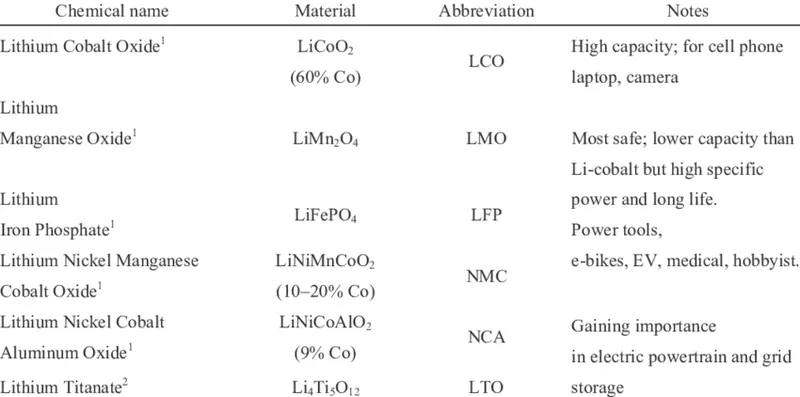
the following table shows the chemical reactions in different batteries
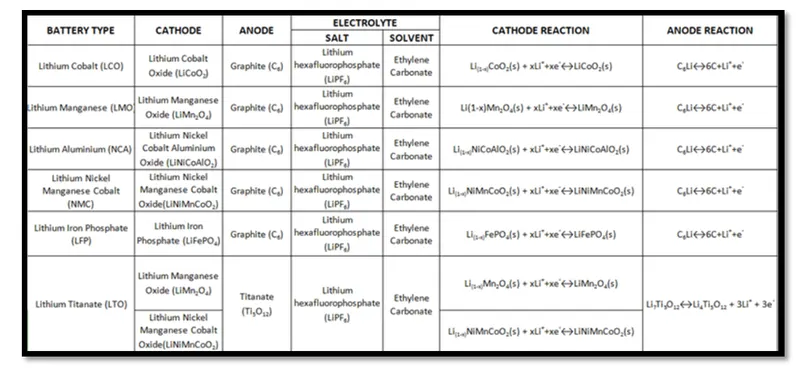
These are the REDOX reactions occur in Li-ion batteries.
2.To compare the differences between each type of Li+ion batteries based on their characteristics.
Ans.
Types of Lithium ion batteries:
There are different types of lithium-ion batteries and the main difference between them lies in their cathode materials. Different kinds of lithium-ion batteries offer different features, with trade-offs between specific power, specific energy, safety, lifespan, cost, and performance.
The six lithium-ion battery types that we will be comparing are Lithium Cobalt Oxide, Lithium Manganese Oxide, Lithium Nickel Manganese Cobalt Oxide, Lithium Iron Phosphate, Lithium Nickel Cobalt Aluminum Oxide, and Lithium Titanate.
Before choosing the type of battery there are some important points to be considered which affects the battery performance.
Specific energy: This defines the battery capacity in weight (Wh/kg). The capacity relates to the runtime. Products requiring long runtimes at moderate load are optimized for high specific energy.
Specific power: It's the ability to deliver high current and indicates loading capability. Batteries for power tools are made for high specific power and come with reduced specific energy.
Nominal Voltage: It is the system voltage at which the device is designed to operate. The rated voltage is usually higher than the nominal voltage to ensure the safe operation of the device.
Cycle: The charge and discharge make a Cycle
The current rate (C): This is used to determine the fast charging capability of a battery.
Thermal Runaway: It is a condition where an increase in temperature changes the conditions which increase the temperature further, often leading to disaster.
Performance: This measures how well the battery works over a wide range of temperature. Most batteries are sensitive to heat and cold and require climate control. Heat reduces the life, and cold lowers the performance temporarily.
Lifespan: This reflects cycle life and longevity and is related to factors such as temperature, depth of discharge and load. Hot climates accelerate capacity loss. Cobalt blended lithium ion also usually have a graphite anode that limits the cycle life.
Safety: This relates to factors such as the thermal stability of the materials used in the batteries. The materials should have the ability to sustain high temperatures before becoming unstable. Instability can lead to thermal runaway in which flaming gases are vented. Fully charging the battery and keeping it beyond the designated age reduces safety.
Cost: Demand for electric vehicles has generally been lower than anticipated and this is mainly due to the cost of lithium-ion batteries. Hence cost is a huge factor when selecting the type of lithium-ion battery.
The following is comparison info about different Lithium ion batteries:
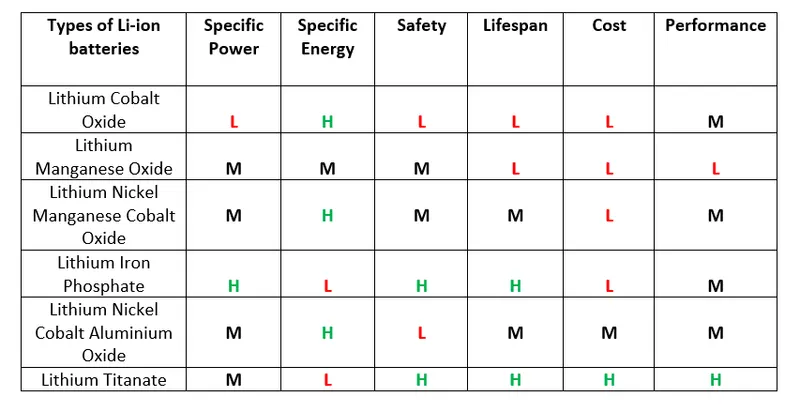
Here,
L indicates Low
M indicates Moderate
H indicates High
CONCLUSION:
Different Batteries chemistry is explained for Lithium Ion type.